No NBA roster ever feels complete. To plug one hole, you often open up another. Fit and on-court chemistry are fluid. Internal development, which all 30 teams talk themselves into at the outset of each new league year, looks different at the trade deadline than it does as free agency opens. The work always continues.
Having said that, some roster questions are easier to tackle than others. Marginal wins are not uniformly accessible, leaps across tiers get progressively more difficult to make.
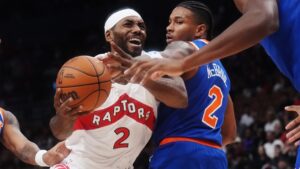
Like it was in 2018, that is the thinking of the Toronto Raptors again here as they get set to acquire Kawhi Leonard in a trade. For whatever risk the age, injury history, and outbound pick equity introduce, Leonard is a ceiling-raiser like few others. Yes, still.
After a jump back to the playoffs and genuine April relevance in 2025-26, the Raptors were faced with a question we always knew they’d eventually have to ask: The path to good was clear (and appreciated!), but what’s the path back to being great? Leonard, they hope, is the answer once again.
And while having an answer to that question opens up other questions, those new questions are easier to attack. You trade ceiling questions for floor questions whenever you can, near-term questions with the clock ticking for long-term questions that you have years to figure out. That’s not to say any “win-now” move is inherently justifiable, but you’d much rather be spending July 2 figuring out who is worth a mid-level exception, a two-way deal, or a Summer League invitation than trying to figure out where 30 per cent of your offensive possessions and the identity of your defence are going to go.
But those questions do exist, so let’s take a look at where everything stands for the Raptors if the reported Leonard acquisition goes through as expected.
The trade mechanics, and Leonard’s trade bonus
The Raptors are bringing back Leonard for Brandon Ingram, Gradey Dick, unprotected first-round picks in 2031 and 2033, second-round picks in 2030 and 2033, and a 2027 first-round pick swap.
From a cap perspective, this is mostly straightforward: Ingram and Dick were set to make a combined $47.1 million, Leonard was set to make $50.3 million, and picks don’t carry a cap hit. We’ve done it! Fast forward to July 6, when moves become official, and fire it through.
There is, however, a potential hurdle. Leonard is due a 15 per cent “trade kicker,” a bonus he’d negotiated in the event he were to be traded. That would be worth $7.44 million, and while the Clippers are the ones on the hook for it, it would apply to Leonard’s cap number. This is VERY important because, as we’ll see, the Raptors are extremely limited in what they can do from here already.
Leonard can choose to amend or waive his trade bonus entirely, in order to help the Raptors continue to construct the roster around him. Ingram waived his trade kicker when acquired, for example. If Leonard’s full-max extension is coming, maybe it’s something he’s amenable to. The sides do not have to figure this part out until the trade becomes official.
What is a hard cap, and why does it matter
Because the Raptors are taking back more salary than they’re sending out, the deal, as reported, will trigger a hard cap at the first apron amount ($209 million).
This gets clunky to explain, but the short version is that the NBA has four different salary thresholds, and building your roster gets more restricted at each subsequent level. For Toronto, this means that at no point can they exceed $209 million in salary. It isn’t like the luxury tax, where you can exceed it and then trade a player at the deadline to get out of it. You can’t go over it at all.
This gets complicated when filling out the roster, and would also be a small hindrance around the trade deadline.
I thought the deal may expand to include Trayce Jackson-Davis and Jamison Battle, so that the Raptors could send out more money than they took on. That would avoid the hard cap (for now), but only on the condition that Leonard waives a good chunk of his trade bonus, and it would leave the Raptors even thinner.
It is always possible that the trade expands between now and July 6, looping in other moves to make the cap machinations run a little smoother. With the information we have right now, the Raptors are hard-capped from here.
Other moves that have taken place
The Raptors picked up their team options on Jackson-Davis and Jamal Shead, allowed Jamison Battle’s contract to become fully guaranteed for the year, and declined their team option on Jonathan Mogbo (who is signing a two-way deal with the Kings). Chucky Hepburn has re-signed on a two-way contract.
Alijah Martin is also set to sign a two-year minimum deal with a partial guarantee in the second year, with a really good chance to compete for rotation minutes through Summer League and training camp.
Sandro Mamukelashvili, meanwhile, is off to the Lakers on a reported four-year, $52-million deal. As we’ll illustrate, the Raptors had no chance of getting anywhere close to that number. Awesome for Mamu, though.
A thought on the price
This isn’t really the analysis part of the process. We did a two-hour emergency episode of The Raptors Show for that, and Michael Grange has been all over it. However, there is an element I wanted to highlight because it’s related to roster management in general.
The Raptors preferred to give up picks over current players. They were also fine with riskier long-term pick obligations instead of more projectable near-term picks. It makes the framework riskier, but it also accomplishes two important things as a trade-off: it maintains a deeper current roster around Leonard and Scottie Barnes, and it gives the team more assets in the short-term to either draft or continue trading.
There’s not much point in going all-in for Leonard if the locker room looks like that episode of Fresh Prince around him. Accepting back-end risk for greater near-term ability to contend makes sense.
Where the roster sits right now
Including moves that have been reported but are not yet official, the Raptors have 12 players under contract for $197.4 million (plus whatever Leonard’s trade kicker comes in at), one two-way, and one unsigned second-round pick.
PG: Immanuel Quickley, Jamal Shead, Chucky Hepburn (two-way), Jaden Bradley (second-round; unsigned)
SG: RJ Barrett, Ja’Kobe Walter, Alijah Martin (reported)
SF: Kawhi Leonard, Jamsion Battle
PF: Scottie Barnes, Collin Murray-Boyles, Allen Graves
C: Jakob Poeltl, Trayce Jackson-Davis
The Raptors have three open roster spots, plus two two-way spots. Bradley will almost surely take one of those.
Two-way spots don’t count toward the cap, and they don’t need to be figured out immediately; the Raptors can use Summer League and training camp as a competition if they want. (You can have up to 21 players on the roster in the summer and training camp, so you don’t really need to lock these in until late October.)
So, a cap figure of $197.4 million with three roster spots to fill doesn’t sound too bad, right? The apron is $209 million, leaving the Raptors about $11.6 million. But this is the NBA, so it’s more complicated than that.
Explaining “unlikely incentives” and two different cap numbers for Toronto
Three Raptors have contracts that include unlikely incentives. These are bonuses that the players didn’t achieve the year prior, so the cap classifies them as unlikely, and they don’t count toward the salary cap. They only count against the luxury tax if they’re achieved. However, they count toward the apron no matter what.
Between Barrett ($3.6M), Quickley ($2.5M), and Poeltl ($500K), the Raptors have $6.6 million in salary that might not be paid but does count against the apron.
This is why getting hard-capped at the first apron is particularly restricting for the Raptors, because their “hard cap” salary is artificially high. (There have been very few unlikely incentives handed out in the last year or so in the NBA, as teams no longer seem willing to navigate this hurdle.)
In reality, the Raptors have just over $5 million beneath the hard cap to fill out their roster. And that could be lower if Leonard gets his full trade kicker.
Finding ways to fill out the roster (or not)
There are a few paths to the Raptors creating more breathing room here. Leonard could waive his trade kicker. They could trade a player for someone cheaper (although it’s worth noting that Barrett is an excellent fit with what they’re building, and a Poeltl deal would probably require sending more picks out). They could expand the Leonard trade to include another team, thereby sending out more salary and avoiding the hard cap altogether.
There are three smaller ways to tip-toe here, too. First, they could sign Bradley to an NBA deal instead of a two-way deal, as your own second-round pick has a slightly lower cap hit than a minimum-salary free agent. Second, they could leave the 15th roster spot open into the season, sacrificing some depth (and limiting how much their two-ways can play) to save on a salary.
I should reiterate here that this isn’t the same thing as finding ways to duck the luxury tax, like we’ve discussed in these pieces in the past. I don’t think you go out and get Leonard and then pinch pennies. Instead, these are roster-building restrictions enforced by the CBA.
Anyway, this all paints the picture that any additions from here will be close to or at the league minimum.
What about things like the mid-level exception?
Good question, good looking. Technically, the Raptors should have access to the taxpayer mid-level exception (which starts at $6.1 million) or the bi-annual exception ($5.5 million). They also have a $6.4-million trade exception from the Ochai Agbaji trade.
None of those allows you to exceed a hard cap. So those only become relevant if the Raptors find a way to make the trade without the hard-cap component.
Trade possibilities, and what picks can still be moved
As mentioned, subsequent trades could free up some breathing room. The Raptors have three second-rounders they can still trade away, and technically two more first-round picks (2027 and 2029), though the 2027 pick comes with a swap option on it. Those could be useful, but the bulk of Toronto’s attractive draft assets have been used now.
And again, that Agbaji trade exception doesn’t let you exceed the hard cap. It could be useful if a framework expands, though it can’t be combined with any player salaries to make cap math work; it can only be used to take a $6.4-million player (or cheaper) back.
Godspeed in the trade machine.
It won’t be this bleak forever (yeah, right)
Were the band Spanish Love Songs singing about the salary cap in that song? I have to assume so.
There’s good news and bad news as far as the long-term outlook here. Most notably, the hard cap only applies to this season. The Raptors don’t have to worry about it beyond that, which means that supplementing this group next summer would be a bit easier than this summer.
On the other hand, the cap sheet isn’t getting any leaner from here. Leonard is eligible for a two-year extension ($60.4M and $63.4M), Poeltl’s sizable extension kicks in next year, and Barrett and Shead are both extension-eligible as well.
Even before Barrett and Shead extensions, a Leonard extension pushes the 2027-28 salary figure to $184.7 million. That’s already just $27 million below the projected tax line; sign just one of those guys, add a first-round pick, use a mini mid-level, and you’re a deep-tax team quickly. Again, the franchise should be more willing to pay the luxury tax now, but each subsequent tax and apron level comes with more roster-building restrictions, so they’ll have to be careful.
So, boring couple of days then…
This is the NBA. Something wild could render this article obsolete by the time it publishes.
Barring a change to the framework that’s been reported, or another fairly major trade, the Raptors off-season from here will be about trying to find the next Mamukelashvili on a minimum deal and stocking a Summer League team for July 9-19 that might reveal the next Battle or Fred VanVleet among the undrafted free agents.
 1:09
1:09