TORONTO — "This summer we're in talent acquisition (mode). We still need more, better players," said Toronto Raptors executive vice president Bobby Webster at the team's season-end media availability in May.
Well, they can check that box off. When Toronto finalized the Kawhi Leonard trade on Monday, they officially reacquired the most talented player to wear a Raptors jersey.
Now the question is: how will their new and improved group mesh on the court?
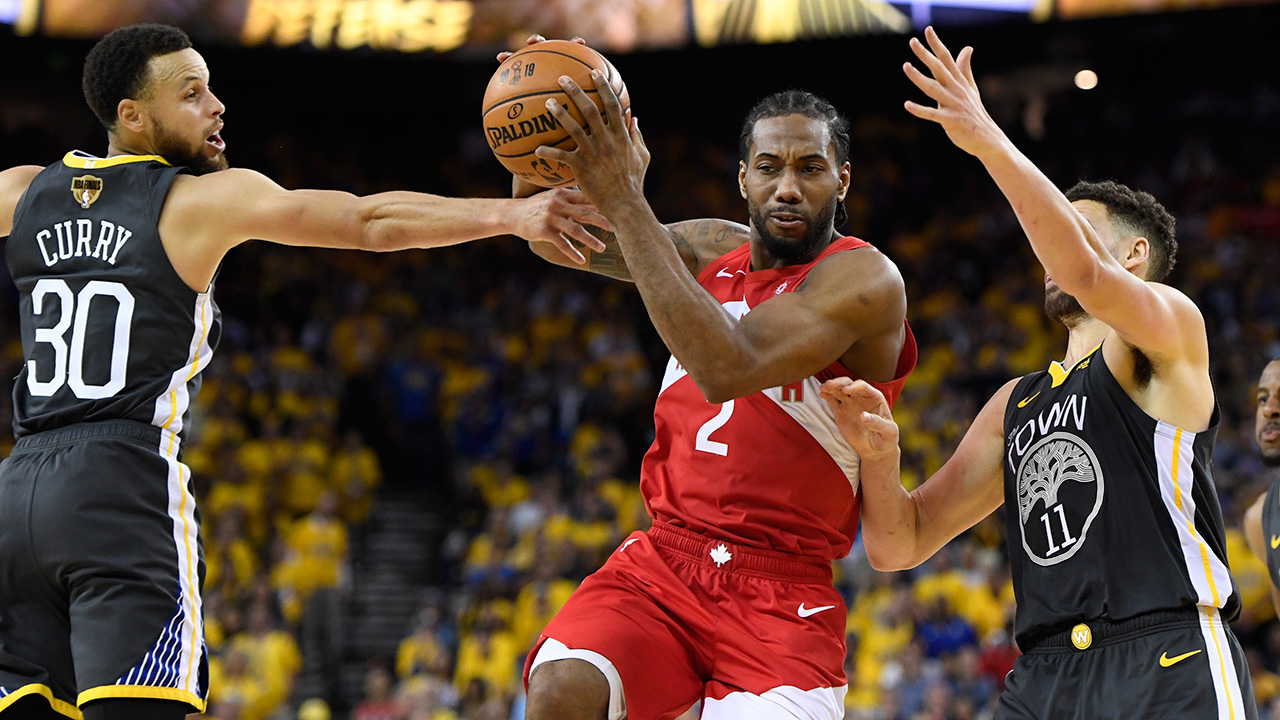
To start, Leonard's resume is self-explanatory: Seven all-star selections, seven All-NBA teams, two Defensive Player of the Year honours, and, of course, two Finals MVPs, the second coming with the Raptors in 2019. It's been a while since Leonard's seen that kind of glory, but his best playing days aren't far behind him.
Last season, Leonard had career highs in both points per game (27.9) and true shooting percentage (62.9). He finished seventh in MVP voting. The 35-year-old is still solidly among the NBA's elite and could take an upstart competitor like the Raptors to contender status.
But it's also far from a guarantee. After departing Toronto for his hometown Los Angeles Clippers in 2019, they didn't reach nearly the same heights. The furthest the Clippers made it was a conference finals berth in 2021, and they failed to make it past the first round for the next five seasons while Leonard struggled to stay healthy.
When Leonard first joined the Raptors, it was a match made in heaven (on the court). Toronto had the perfect mix of veteran talent and burgeoning youth to complement the star wing. Then, with the Clippers, the team looked dynamite on paper, but never quite came together.
Let's look at a few key areas that will define Leonard's fit on the current iteration of the Raptors and consider how he could raise the team's ceiling.
Similarities and differences
Comparisons between Leonard and Brandon Ingram will be natural after the trade, with Leonard ostensibly replacing Ingram in the Raptors' starting five.
There are similarities between Ingram's role in the Raptors' offence last season and Leonard's in 2018-19. Both were elite, high-frequency isolation scorers. Both were top five in mid-range attempts per game (5.4 and 5.5 attempts, respectively).
Another distinguishing feature of the pair's offence was how it existed in isolation from the rest of the Raptors' offence. There was a distinct difference between a "Kawhi Leonard possession" or "Brandon Ingram possession" and a regular "Toronto Raptors possession." Toronto's current scheme is based on motion and quick ball movement, but both players would often commandeer the ball. This isn't necessarily a bad thing. It's important to have players who can make difficult shots, taking that burden off their teammates.
But last season, the Raptors frequently used a variety of off-ball screens to free up Ingram and get him to preferred areas of the floor. He finished third in the NBA in possessions using off-ball screens. It didn't take too long for teams to figure this out. Eventually, Ingram often got top-locked — a defender denied him from using the screen. When opposing defences also took away the backcut, Ingram often lacked the physicality to fight through the aggressive coverage, which would usually kill large chunks of the shot clock before he managed to get free, or result in the Raptors just playing four-on-four.
Leonard's efficiency and forcefulness will be a significant upgrade here. His true shooting percentage was 5.6 percentage points higher than Ingram's (57.3 per cent), a massive gulf given the pair's volume. Leonard is also stronger, making him better equipped to wrestle with defenders and get use out of screens, should the Raptors continue to use him similarly.
Leonard has also progressed toward a more modern shot diet than Ingram over the years, taking fewer long mid-range attempts and more from three-point range, including one key shot type that could revolutionize the Raptors' offence.
Leonard can modernize Raptors' offence with his pull-up three-point shooting
The Raptors have been the worst pull-up three-point shooting team in the NBA over the last three seasons. Meanwhile, Leonard has leapt into the upper tier of pull-up threats.
Toronto not only made the fewest pull-up triples over that span cumulatively, but it also finished last in each individual season. The Raptors most recently averaged 1.5 per game on five attempts. They took over 100 fewer pull-up threes than the 29th-place team, and 11 players made more per game than the Raptors did as a team last season(!). Then, in the playoffs, that dipped further to 1.1 makes on 3.7 attempts when their only true pull-up shooter at the time, Immanuel Quickley, was out injured. Toronto didn't make a pull-up three in the playoffs until RJ Barrett drained a couple near the end of Game 3.
Leonard made 1.4 pull-up threes on 3.6 attempts last season, nearly matching the Raptors' output by himself. That's good for 36.9 per cent, sixth among the league's highest-volume shooters (minimum 200 attempts). He also shot 37.7 per cent on 2.1 attempts per game over the previous three seasons. His maintained efficiency on increased volume last season is another positive sign.
Making threes off the dribble is important for many reasons. One, the ball going in the basket is how points are scored. But it also gives a team another way to beat a defence and changes how opposing teams react. Leonard's ability to punish sagging defensive coverages or pull defenders further up the floor will inject much-needed dynamism into the Raptors' offence.
The value of pull-up shooting also increases in the playoffs. Teams took more pull-up threes per game in the post-season last year, and effective field goal percentage on pull-up attempts correlated with winning at a 10 per cent higher rate than in the regular season for a second straight year. Less efficient shots are available, making the tough ones matter more. The Raptors will still be far from the splash-brother Warriors, or the Timberwolves' new two-headed flamethrower of Anthony Edwards and LaMelo Ball, but Leonard should help pull them out of the pull-up three-point shooting basement and usher in a new, modern age.
How his play-type tendencies fit within Rajakovic's system
Looking at the breakdown of Leonard's play type data, he's a more efficient scorer than Ingram in all of them. Let's examine possessions per game, the frequency of total plays, points per possession, and percentile rankings for a couple of key play types last season, in comparison to both the player he's replacing and Darko Rajaković's system as a whole, starting with pick-and-roll ball-handling.
(This comes with the caveat that all of these numbers rely on the context surrounding them, which is changing this season.)
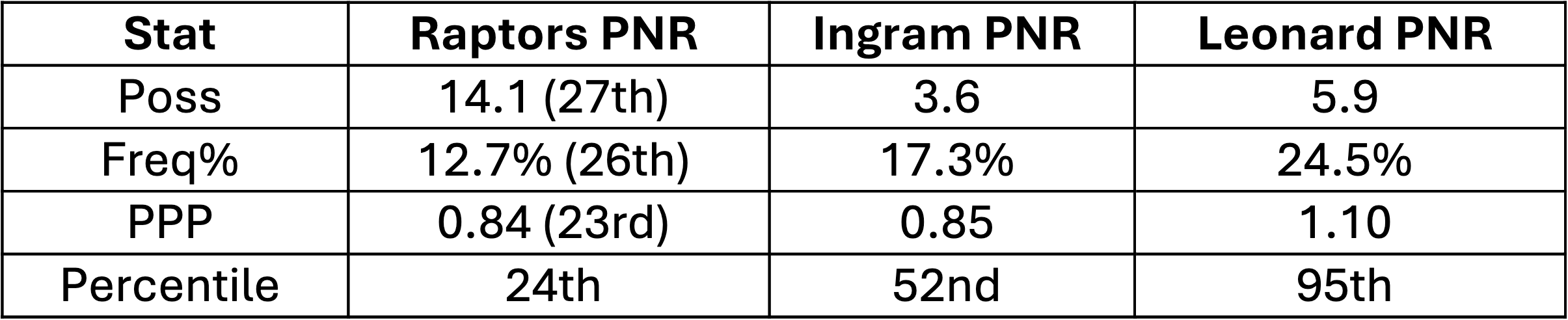
Ingram's 3.6 pick-and-roll ball-handler possessions led the Raptors last season, and Leonard nearly had him doubled. But Toronto didn't run much pick-and-roll overall. The question: Is this a philosophical decision by Rajaković, or was he simply working with the personnel he had? Considering his past affinity for the play type (Rajaković co-authored an academic paper on the pick-and-roll) and Leonard's prowess, it stands to reason the Raptors could run more of it.
Leonard's tight handle here also makes a big difference, resulting in a three per cent lower turnover frequency when using ball screens.
They're less-used play types, but Leonard also far outpaces Ingram as a scorer in isolation and post-ups. They isolated about the same amount last season, but Leonard was far more efficient. And when he gets a mismatch, his strength allows him to bully them closer to the basket, rather than fading from farther out over the top like Ingram often did.
Another area where Leonard will provide significant punch and serve as an upgrade over Ingram is in transition. The Raptors were third in the NBA last season in transition frequency. But they struggled to fully capitalize on those opportunities, finishing with middle-of-the-pack efficiency. Adding another forward who's proficient at vacuuming up rebounds (board man gets paid), can push in transition after doing so, and is also a hyper-efficient finisher in those situations should juice the Raptors' relentless running.

Leonard also had a 93rd-percentile steal rate according to Cleaning the Glass (it's never dipped below the 91st percentile in his career), and the Clippers ran out in transition 2.3 per cent more often with him on the floor. Safe to say The Klaw will fit into the Raptors' run-by-any-means-necessary ethos.
How does Leonard fit alongside Toronto's current core on both sides of the ball?
Adding a more talented player generally has a multiplicative effect on a team, but it's still worth examining the more granular ways Leonard could impact the Raptors' ecosystem.
We haven't touched on defence yet, so let's use Leonard's steal rate as a jumping-off point. I'd be remiss not to mention the stat that Joe Wolfond first pointed out: Leonard is one of two players in NBA history with more career steals than turnovers. The other is Ben Wallace.
His athleticism has declined, but he still has those terrifying hands. Toronto's high-pressure scheme featured uniquely aggressive help principles. Leonard will find impact as an off-ball defender blowing up plays in the gaps, especially since he'll take on a tertiary role behind Scottie Barnes and Collin Murray-Boyles.
Jokes were flying right away on social media about the daunting prospect of facing Barnes, Leonard and Murray-Boyles on a succession of switches. But adding a two-time Defensive Player of the Year to one of the league's best young duos, and a defence that ranked fifth in the NBA, is serious stuff. Moreover, they all have the versatility to guard across multiple positions, which is particularly valuable in the playoffs, when creating mismatches through switches is crucial.
Offensively, the Raptors already reaped the benefits of a proficient self-creator in Ingram taking more difficult shots last season. Barnes' efficiency leapt as his shot diet better fit his abilities. Leonard should move the needle further.
RJ Barrett's effective cutting and passable spot-up shooting fit in a similar bucket, and his ability to shift between a secondary creator and a capable pick-and-roll ball-handler on nights when Leonard may need rest will also be vital for the Raptors' offence.
Meanwhile, Leonard taking on more pick-and-roll possessions and on-ball reps overall could free up Immanuel Quickley to roam off-ball more often, where he's been deadly as a catch-and-shoot option and took strides last season forming up around drives.
Toronto's track record of keeping stars healthy bodes well for Leonard
All this is only possible if Leonard stays healthy. Just as it was the first time when Raptors vice president of player health and performance Alex McKechnie invented load management. OK, maybe the great Gregg Popovich should get credit for inventing it, but McKechnie undoubtedly popularized the term.
Leonard played just nine games in his final season with the Spurs due to right quadriceps tendinopathy. Then, in 2018-19 with the Raptors, he rested for 20 games, avoided playing any back-to-backs, but suited up 60 times and went on to win the championship. Bearing in mind Leonard's health issues in recent seasons with the Clippers, McKechnie's success working with Leonard and the pair's familiarity with one another, a reunion makes sense.
McKechnie just had similar success with another oft-injured star, as Ingram started a career-high 77 games, after appearing in only 18 the season before and averaging 49.5 throughout his career.
The fit between Leonard and McKechnie might be the most important of all. The hyper-efficiency, pull-up threes, play-type improvement and turnover differential. None of it happens without Leonard on the floor.