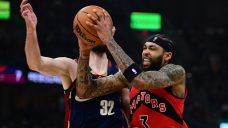
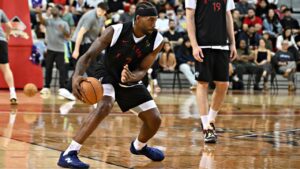
CLEVELAND — There was no staff dinner. No get-together for the Toronto Raptors coaching staff to hash out what went right or what went wrong (a longer conversation) after their Game 1 loss to the Cleveland Cavaliers on Saturday.
A full night and a full day with no travel to work around is an eternity in the NBA when it comes to game prep. Of course, the Raptors had five full days to come up with a game plan that might slow down the heavily favoured Cavaliers in a first-round series between a fourth and fifth seed in the Eastern Conference that suddenly is giving more 1-vs.-8 vibes.
The Raptors coaching staff left Rocket Arena for their hotel a few blocks over Saturday evening and got to work. They got an edit for the game film that captured what they wanted to emphasize at practice on Sunday and had some long conversations about how they wanted to present it.
They slept on it, met as a coaching staff at 8 a.m. on Sunday, made any last-minute tweaks they hope will help them narrow the gap after a 126-113 loss that never felt as even that close, and then laid it out for the players at a team meeting before taking it to the floor for a light walkthrough Sunday afternoon.
They had a lot of material to work from.
“So, we did not have any transition (offence),” said Raptors head coach Darko Rajakovic. “Our transition was bad. During the whole game, we allowed 126 points. Our defence was not good. We allowed them 13 second-chance points. That was not good. We were minus-seven in the possession battle. You know? It was not one thing … ”
Put another way: the Raptors shot an uncharacteristic 13-of-27 from three — including eight-of-11 from Scottie Barnes and Jamal Shead, two players the Cavaliers were daring to shoot — and 52 per cent overall while shooting 35 free throws (to 28 by Cleveland), and were still trounced.
The Raptors might be in deeper than they care to admit against a 52-win Cavaliers team that is fully whole for almost the first time after a season upended by trades and injury. The Cavaliers won 64 games last season and added James Harden this year, so there's that.
Still, the Raptors have to start somewhere, and it might not be their offence.
The Raptors' offensive rating was a perfectly respectable 115.3 points per 100 possessions against the Cavs in Game 1, just a fraction over their regular-season average, which was 15th overall. It was even better than the 115.3 rating suggests because the Raptors had only three points on the fast break, compared to their league-leading season average of 18.6 fast-break points.
But their defence was a non-factor. The 127.3 points per 100 possessions the Raptors allowed was the most of any of the eight teams that opened the playoffs on Saturday and was six points worse per 100 possessions than the lowly Washington Wizards allowed during the regular season. It was also about 15 points worse than the Raptors allowed as the fifth-rated defence during the regular season.
Much of that was obscured after Game 1 because a major talking point was how little Brandon Ingram was involved in the offence after halftime — he scored just four of his 17 points after the break and had just one of his nine field-goal attempts — and how that contributed to the Cavs starting the third quarter on a game-defining 21-6 run.
But upon examination, was the Raptors' offensive process all that bad? Or the major problem?
After all, two of the Raptors' five third-quarter turnovers came from trying to force the ball to Ingram, who was being aggressively denied by Cavs forward Dean Wade — one of the NBA’s better unsung defenders.
Also, some of the Raptors' best offensive possessions in that troubled third quarter came when Ingram was a decoy in the weak-side corner, which generated a lay-up for RJ Barrett coming out of a timeout in one instance or after another timeout when Ingram set a screen for Barnes, who turned the corner and found a wide-open Barrett for a corner three that missed.
Did the Raptors execute as well as they could have? Is it desirable to have your leading scorer minding his time in the weak-side corner as a routine? Not at all, but offence was not the Raptors' undoing.
Instead, Cleveland scored 36 points in the period, effectively putting the game on ice.
The Raptors could go a long way toward pumping up their offence by ramping up their defence.
“Defense usually leads to a lot of our offence. I think we let a couple of guys shoot that are labelled shooters that we shouldn’t have let shoot, or we let a couple of matchups go that we know we could have easily stopped,” said Raptors point guard Jamal Shead, who started in place of the injured Immanuel Quickley. “So I think that (a key is) making them score off of their second and third action instead of their first action, getting comfortable and coming off shooting shots they want to shoot.”
Easier said than done, maybe.
Cavaliers guard Donovan Mitchell scored 11 of his game-high 32 points in the third and scrambled the Raptors defence even when he didn’t score, such as when he drove against an unsettled Raptors defence in transition, drawing multiple defenders, allowing Wade a clear path to dunk home his miss.
Mitchell’s buckets came in a variety pack: turning Shead inside out when the Raptors guard pressured him up the floor and then blowing by Barnes for a lay-up; or using a screen set for him just over half-court to get up to full speed on a drive, like a running back galloping into the secondary after bursting through a big hole at the line of scrimmage; or hitting a three over Ingram in isolation to close the quarter.
In between, Max Strus — rounding into form after missing 67 games this season with a broken foot — scored a playoff career-high 24 points in part by punishing Toronto when it was too focused on Mitchell or James Harden, the Cavaliers' other superstar guard. Two of Strus’ third-quarter threes came when Barnes — who was covering him — had his attention elsewhere, and he scored on a cutting lay-up when the Raptors lost him as a trailer in transition.
The reality is defending the Cavaliers — or at least the version that was on the floor in Game 1 — can leave even a good defensive team looking like a kitten trying to swat away a light beam: you never quite seem to catch up to it.
As an example, the Raptors thrive off live-ball turnovers — pressuring ball-handlers and jumping passing lanes to jostle the ball free and start transition offence the other way. But Cleveland can stretch a defence to the limit, given you have to account for a pair of seven-foot rim threats in Jarrett Allen and Evan Mobley, two elite ball-handlers in Mitchell and Harden who are scoring threats from just over half court, and a seeming squadron of quality shooters that hang out on the weak side of any action, ready to punish defenders to edge too close to the ball.
The most telling stat of all from Game 1 might be that the Raptors had just seven deflections and three steals, compared with the 20.4 deflections and 8.8 steals they averaged during the regular season, which ranked fourth and 11th, respectively.
Is it reasonable for the Raptors to simply steal the ball more? Deflect more passes?
“I think we didn't play to our standard defensively,” said Shead. “We're a top-five defence in this league, and I think we have to do a better job of imposing our will on the other team."
Uh, how?
“It just takes a little bit more effort. We have that effort to give,” he said. “I think a lot of us, it was just our first playoff game, and then we kind of got lost in it, but I think we’ll be ready to go.”
They will need to be. There aren’t any adjustments the Raptors can make offensively if they’re going to give up 126 points and allow Cleveland to completely take away Toronto's transition game.
No amount of film study will solve that riddle.
Three-point Grange
Wishing on a point guard
There is some hope that the Raptors will have Quickley in the lineup Monday.
He went through practice Sunday but will undoubtedly be a game-time decision, given that between the plantar fasciitis that cost him nine games toward the end of the regular season and the hamstring strain he suffered in the final game of the regular season that kept him out of Game 1, the Raptors point guard has appeared in just three games since March 23.
In other words, it would nice if Quickley could to play, but expecting him to be at anything approaching peak shape after nearly a month missed with soft tissue injuries in his right leg is wishful thinking.
No grab, no go
Uh, about Barnes having just one rebound. It seems almost impossible, given he averaged 7.5 rebounds in the regular season and set a career high with 25 in a game against the Golden State Warriors.
But it happened. It hurt the Raptors offence because Barnes grabbing a defensive rebound and either starting the break himself or kicking ahead to teammates has been a big part of the Raptors' success this season.
“Our transition offence is really good when he rebounds the ball, when he's pushing the ball,” said Rajakovic. “So we’ve got to just make sure that he gets himself involved in rebounding together with his teammates. As I said, we did not do a good job of rebounding the ball and running. So we’ve got to get better in that aspect, for sure.”
Playoff time machine
Even after falling behind 0-1 in his first playoff series as an NBA head coach, Rajakovic was convinced that the experience will be a positive over time.
“I was so excited for them and for us. You know, right now, I have goose bumps, to have such a young team to have Ja’Kobe (Walter) — he started shaving just two weeks ago — in the playoffs. CMB (Collin Murray-Boyles) is a rookie, 20 years old, playing in the playoffs now, playing against really good veteran team. This is amazing for us, that there is so much to learn.
"I told guys, like, this one game that we played in the playoffs is the equivalent of 15 or 20 games in the regular season, how much you can learn, you know? So this is really, really beneficial for us, and this is gonna make us so much better.”
Hopefully by Monday night.