RJ Barrett was the last player in the Toronto Raptors' locker room.
There was a shower. Treatment. Hydration. No rush.
The seventh-year forward was in recovery mode, and for good reason.
Play 39 minutes against the Detroit Pistons and you’re going to feel it.
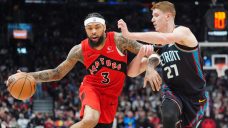
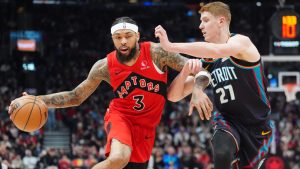
“It’s tiring bro, it’s tiring,” he told me after putting up 27 points and grabbing six rebounds against the East’s best team, all while more than holding his own on the defensive end. “But you got to (do) what it takes to win and get your rest on the days off and body back right, your mind back right, and go back and do it again.”
After plenty of doubts and many questions, the Raptors had just wrapped up their most encouraging weekend of the season, with wins over the Pistons and Phoenix Suns, both at home. The victories came on the heels of one of their most confounding stretches, one that raised plenty of questions about the team’s ability and commitment to play the kind of basketball that earning a place in the NBA playoffs typically requires.
The win Friday over the short-handed Suns was a welcome reprieve and a crucial response to one of the most dispiriting losses of the season just two nights before in New Orleans, where the Raptors' collective shrug to the image of Pelicans guard Dejounte Murray straddling Raptors guard Jamal Shead, fists clenched and glowering, threatened to become the overriding tableau of the Raptors season if things didn’t get turned around.
That victory, from down 11 in the fourth quarter, was so welcomed that Raptors head coach Darko Rajakovic’s first response afterwards was to — literally — praise God.
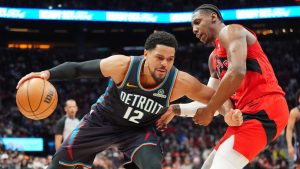
Two days later, the Raptors played as if touched by a higher power with a thorough win over the Pistons, the No. 1 team in the Eastern Conference and the same squad that had physically overwhelmed the Raptors in a blowout just before the all-star break.
In the middle of it all was Barrett — just not entirely in the way we have come to expect.
Certainly, Barrett continued his brilliant contributions offensively. Over the two wins, he averaged 24.5 points, six rebounds and 3.5 assists while connecting on 60.1 per cent of his field-goal attempts.
It was the continuation of — arguably — the best stretch of basketball Barrett has played as a Raptor. Over the past 10 games, Barrett has averaged 22 points and 6.1 rebounds on 55.8 per cent shooting, including 38 per cent from three.
The Canadian has had highly productive stretches offensively regularly over his career. He leads his draft class in total points, has averaged 20 points per game for a season three times and sits at 19 points per game now.
But Barrett standing out for his defensive contributions is a new dimension.
It’s been a point of personal emphasis, but also the product of a long ramp-up to get to peak fitness after missing 23 of 30 games from late-November to late-January due to a knee injury and then an ankle sprain.
“My body's starting to feel better,” the Canadian national-team star said. “I mean, it’s been a process, man, for the past couple months, trying to get back right, get comfortable enough to be able to one, play the minutes, then get used to playing the minutes, and now really being able to be effective on both sides of the ball every night.”
Against the Suns, Barrett took several turns against leading scorer and five-time all-star Devin Booker and more than held his own, most notably late in the fourth quarter of what was a four-point game.
Barrett slid hard to his left, corralling the Suns guard on his way down the lane and finishing the play with a steal and a stare at the Raptors bench. Earlier that quarter, he had recovered back to the rim as a help defender and got another steal that led to a triple by Ja’Kobe Walter (with a screen assist by Barrett) that helped spur the Raptors' comeback.
Against the Pistons, Barrett complemented his offence by helping set the tone defensively as well. He stepped up and drew a charge on Pistons star Cade Cunningham, the third time Barrett has done that this season (Jamal Shead leads the Raptors with five) just before halftime. In the second half, it was Barrett hounding Cunningham into another empty possession in front the Raptors bench, flexing as his teammates jumped up in recognition.

The Raptors Show
Sportsnet's Blake Murphy and two-time NBA champion Matt Bonner cover all things Raptors and the NBA. Airing every weekday live on Sportsnet 590 The FAN from 11 a.m.-noon ET.
Latest episode
"There is absolutely nothing that’s preventing him from being (an) elite two-way player,” Rajakovic said on Sunday. “And that’s from Day 1 that he came over here. We're preaching that to him there is no physical attribute that he does not have, that he's capable of guarding one-through-four of anybody in the league. It’s just having that grit and mindset of doing it over and over and over again. And he showed us in moments that he is capable of doing it, but lately he's doing it in much longer periods of time, and that's really helping the team to win.”
Which is where Barrett’s heart lies. He self-identifies as a winning player and he’s had enough experience doing it at different levels — youth basketball, college, internationally for Canada and even starting on two playoff teams for the then-rebuilding New York Knicks — that he can do it credibly.
But at this stage of his career, Barrett’s contributions will need to look a little different, at least on this Raptors team. Offensively, it’s more of a complementary role, finding gaps to contribute around Scottie Barnes, Brandon Ingram and even Immanuel Quickley. Defensively, the Raptors would benefit significantly if Barrett — a big, strong wing capable of switching on to multiple positions — can lift his game on that end, too.
That goes for now, as the Raptors try to hang on the sixth and final playoff spot in the East, and in the future, as Barrett heads into the last year of contract with the Raptors having the option to extend it this summer.
Barrett understands the mission.
“I’ve been focusing on it,” he said. “My teammates are always talking to me. Coach is always talking to me. For us to win, everybody has to buy in on that end. And I think I'm just trying to lead by example. You know, show like this is just the way that we got to do it.”
 1:05
1:05