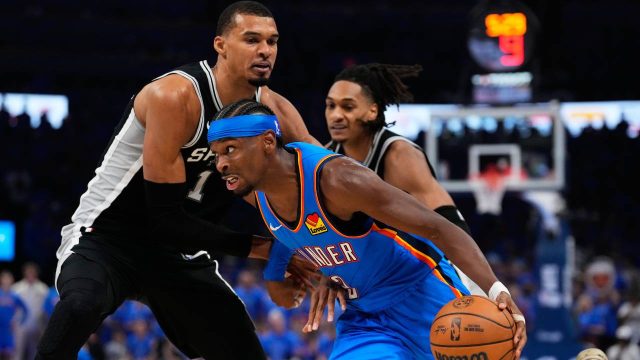
So far, the Oklahoma City Thunder and San Antonio Spurs' Western Conference Finals series has lived up to its lofty billing.
Game 1's double-overtime shocker was an instant classic as Victor Wembanyama and the upstart Spurs reached new heights, but as the games have progressed, the reigning champion Thunder have tightened their grip on the series.
They're now threatening to take a commanding 3-1 lead back home to Oklahoma City with a Game 4 win, while San Antonio aims to even the score and avoid facing three straight elimination games against the buzzsaw that is the Thunder. (Tip off at 8 p.m. ET / 5 p.m. PT on Sportsnet ONE and Sportsnet+).
Sunday night's pivotal contest is sure to be another heavyweight bout as the NBA's two best teams clash again in a game that could swing the series.
Let's look at a few key trends that could define which team wins Chapter 1 of this budding rivalry and comes out of the West.
Spurs playing too wild out west
Outside of Wembanyama's inside dominance in Game 1, the West finals have been played relatively even across most statistical categories. There's been minimal separation between their efficiency, three-point volume, and made free throws while even the rebounding has been equal over the last two games.
Turnovers are the exception, where the Thunder have a decided advantage, forcing the Spurs to commit 57 while giving up only 33 of their own.
The possession battle is paramount in the playoffs. Teams won 59 per cent of the time during the regular season when winning the turnover battle, and that has jumped to 66 per cent in these playoffs. That same number increased from 59 per cent to 74 per cent in the 2024-25 post-season, the largest leap of any stat category. The correlation between forcing more turnovers and winning grows stronger in the playoffs.
Much of this burden falls on the back of the Spurs' lead guard, Stephon Castle. He committed 20 turnovers over the first two games of the series, the first instance of such sloppiness in NBA playoff history.
The sophomore has proved adept at navigating the middle of the floor and making reads from there, but the Thunder's assaultive, swarming defence is a different beast. The return of an additional ball handler in De'Aaron Fox seemed to lessen the load on Castle in Game 3 — he made only one turnover. But Fox had four and San Antonio had 15 as a whole to Oklahoma City's 10. The Spurs must find a way to traverse the Thunder's incessant pressure to create advantages without giving the ball away — a tough needle to thread.
Solving the Wemby effect
Wembanyama's presence alone has become known to deter players from even attempting shots at the rim within his vicinity. Or, what's otherwise come to be known as "the Wemby effect."
This makes the seven-foot-four superstar's outsized block numbers all the more impressive. Yet, he had only two in Game 3 and Oklahoma City's paint scoring has incrementally climbed.
The remedy appears to be Shai Gilgeous-Alexander adjusting how he attacks the Spurs defence. He's shooting nearly six per cent worse on drives, down to 53.3 per cent from 59.2 during the regular season. But, he's now been passing out of drives 48 per cent of the time over the last two games, up from 38 per cent in the regular season and 42 per cent previously in the playoffs.
Gilgeous-Alexander shifted his approach with aplomb, building on the improved playmaking he enacted throughout the regular season by consistently making the right pass. It also helps that Oklahoma City has surrounded him with a bevy of proficient three-point shooters, helping lead to a 38.7 per cent conversion rate, second-best in the playoffs. That's climbed to 40.5 per cent over the last two games, albeit a tiny sample.
Meanwhile, matching Isaiah Hartenstein's minutes with Wembanyama's and having the burly seven-footer judo-throw the Alien around the paint has helped deter his dominance on the glass.
However, Wembanyama's otherworldly defensive playmaking can still be game-breaking. The Spurs could be an adjustment of their own away from stymying the Thunder and flipping the series on its head once more.
Which historic performer can ascend even further?
In Game 1, Wembanyama became the second player in league history to record over 40 points, 20 rebounds and three blocks in a playoff game — the only other being Hakeem Olajuwon, who did it twice in 1987 and '88.
The recently crowned Defensive Player of the Year was also on track to become the first-ever player to average greater than 22 points, 11 rebounds and four blocks in a playoff run before putting up a dud — relative to his ludicrous standards — in Game 3 (blocks were not tracked during Wilt Chamberlain and Elgin Baylor's era).
Alternatively, Gilgeous-Alexander has made his own history.
It started last season with a combination of two-point shooting efficiency never before seen by a guard in NBA history — not even Michael Jordan — as the now two-time MVP shot better than 57 per cent on over 15 two-point shots per game. Then, he miraculously levelled up again this season, shooting an eye-popping 60 per cent on twos, breaking Wilt Chamberlain's 63-year-old record for consecutive games with 20 or more points in the process.
They're surrounded by two of the best young cores in the league, but it all gravitates around Wemby and SGA. In an era defined by parity (different champions for seven straight seasons) and closing skill gaps, this duo are among the few who can truly claim the ability to swing a game with an outlier performance. A home run from either in Game 4 could alter the trajectory of these playoffs.