BY THE HORNS

T he Toronto Raptors joined the NBA in 1995, as an expansion franchise bearing a name inspired by the recently released Steven Spielberg-directed blockbuster Jurassic Park and a roster comprised of rookie point guard Damon Stoudamire and a bunch of castoffs and aging vets. The Raptors were not expected to win many games in the first year, and they didn’t, finishing with only 21 victories.
But today, when fans look back on the team’s inaugural season, one late-March game comes to mind right away. Michael Jordan and the Chicago Bulls had a 60-7 record and arrived in Toronto just nine wins away from tying the all-time regular-season wins record held by the 1971-72 Los Angeles Lakers. Meanwhile, the Raptors were 17-49, and already looking ahead to the off-season.
It seemed like a foregone conclusion the Bulls would pick up a win over the expansion franchise on their way to a historic season. Instead, this Sunday afternoon matchup would become what is still one of the most memorable in Raptors franchise history.
O n March 24, 1996, a record-setting crowd of 36,131, the largest ever for a basketball game in Canada, packed the SkyDome on a Sunday afternoon to watch the Toronto Raptors take on Michael Jordan and the Chicago Bulls.
With Raptors power forward Sharone Wright on the injured list with back spasms, the spot start went to Carlos Rogers, who opened the scoring with a thunderous one-handed dunk. Jordan drew “Oohs” and “Ahhs” from the home crowd a minute later as he responded with an up-and-under layup at the basket to get the visitors on the board. The Raptors pushed the pace and opened up an early seven-point lead. Just as it looked like they would run away with the first quarter, Michael Jordan hit a patented fadeaway jumper to stop the run.
On the next trip up the floor, he drove to the basket and missed a layup. A familiar face was in the paint to grab the offensive rebound and clean up the possession with a put-back. It was John Salley, who’d signed with Chicago in early March after the Raptors waived him. With Dennis Rodman serving a six-game suspension after head-butting referee Ted Bernhardt, and Luc Longley sitting out with knee tendinitis, the Bulls had patched together a frontline of Salley, Dickey Simpkins, and Bill Wennington, a Montreal native who had been taken 16th overall by the Dallas Mavericks in 1985. After hitting another midrange jumper, Jordan was already at nine points. He smiled at Raptors shooting guard Alvin Robertson. The two were Team USA teammates at the 1984 Summer Olympics in Los Angeles, where they won a gold medal together. The two had become friends but remained rivals on the court.
The Raptors had gone toe-to-toe with the Bulls in their previous three matchups. Chicago had barely escaped with a 92–89 win in a January visit to the SkyDome, exhaling at the buzzer when Oliver Miller’s game-tying three-point attempt went wide. The Raptors had a seven-point lead at halftime, but Jordan scored 38 points, including 15 in the fourth quarter, to narrowly avoid an upset. In this fourth and final meeting, Toronto was once again pushing the best team in the league. After the end of a back-and-forth first quarter, the Raptors held a 28–23 lead. Back-to-back threes from Steve Kerr tied the game a few minutes into the second quarter. Another fadeaway jumper from Jordan over Robertson gave Chicago the lead. On the next possession, Jordan drove toward the basket and drew contact with Robertson, who picked up his third personal foul. As Jordan hit both free throws to put the Bulls ahead by four, Robertson headed to the bench. Midway through the second quarter, it was Doug Christie’s turn to be Jordan’s primary defender.

G rowing up in Seattle, Wash., Christie learned the game of basketball in the streets, spending many afternoons and late evenings on the playground, even when there was a downpour outside. He was raised by his mother, Norma, a single mom who worked as a grocery clerk at the neighbourhood store and supported him in chasing his hoop dreams. But the inner-city neighborhood drew Doug toward the wrong crowd. In middle school, Norma sent her son to Longview, Wash., to spend time with his dad, John. It was the first time the two met. Doug and John played softball, went on fishing and hunting trips, and talked about growing up and learning to be an adult. It was the perfect time for Doug to have his father enter his life. He decided to become more than just a streetballer. Basketball would be Doug’s ticket to do something meaningful with his life. He met Mark Morris High School head coach Dave Denny, who molded Doug into a player with the athleticism and fundamentals to be one of the best players in the state.
After nearly two years with his father, Christie moved back home to live with his mom in Seattle. In his senior season at Rainier Beach High School, he led the school to its first-ever state championship and accepted an offer to play at Pepperdine University. After averaging 19.5 points, 5.9 rebounds, and 4.8 assists in his junior year at Pepperdine, Christie entered the 1992 NBA draft and was selected 17th overall. It was a dream come true. He was a member of the Seattle SuperSonics. It was his hometown team, and Christie still had memories of being a nine-year-old watching the Sonics, led by Dennis Johnson and Gus Williams, win the 1979 NBA championship.
But the dream scenario turned into a nightmare. Before his rookie season, Christie became mired in a public contract dispute with the team. The Sonics offered him a $500,000 annual salary, but Christie wanted $1.5 million, the same amount given to Victor Alexander, the previous year’s 17th pick. The two sides started going back and forth in the local newspapers, and the verbal jabs became personal. “There were things that were said about my mom that just weren’t right,” Christie says. “They came at it wrong.” After missing training camp and the first half of the season, Christie was traded to the Los Angeles Lakers in February 1993. At his introductory press conference, reporters compared him to Magic Johnson. In his two seasons in Los Angeles, Christie’s play did not exactly evoke memories of the “Showtime” Lakers. He was traded to New York before the start of the 1994–95 season.
Christie walked into Knicks head coach Pat Riley’s office for a preseason meeting and sat down for a conversation that would change the trajectory of his NBA career. “He pulled no punches,” Christie recalls. “He said, ‘Look, you’re not going to play. I got my guys, and that’s who we’re going with. What I suggest to you is that you find something that you can do that’ll keep you in this league for a long time.’” The Knicks had taken the baton from the “Bad Boy” Pistons and become the most physical team in the NBA. Heading into his third year in the league and already joining his third team, Christie needed to be honest with himself. If he wanted to stick around and have a long career, Christie would have to heed Riley’s advice and earn his minutes by being a defensive stopper.
Even though he only appeared in 12 games during his first season in New York, Christie spent every off-day working to become a better all-around pro. “I would get to the gym at eight in the morning. I’d lift, run a couple of miles, go shoot, practice, cool down, then stay in the gym until eight at night,” Christie says. “Guys like Derek Harper, Charles Oakley, Anthony Mason, and Patrick Ewing taught me so much about toughness, competitiveness, and this other side of the floor that I usually ignored. Defensive skills became something I wanted to possess. Not everybody wanted to play defence, but also not everybody could do it. I would watch tapes of players and try to figure out how I could take things away from them. I would figure out what they liked to do, what they didn’t like, and how many dribbles they took to score. I was trying to figure out how to take things away from them when we played.” While he studied every player around the league, Christie waited for his opportunity. After the 1994–95 season, the Knicks parted ways with Riley. His replacement would be Don Nelson, a more offensive-minded coach. Christie was pinned to the bench during the opening months of the 1995–96 season, unable to crack Nelson’s rotation. He was moved to Toronto at the trade deadline.
In his first practice with the Raptors, Christie showed up at Glendon College and found Isiah Thomas on the court. The general manager had ditched his usual suit-and-tie look and was in sweats, getting shots up with the rest of the team. He challenged Christie to a game of one-on-one. “I knocked him down,” Christie recalls. “We kept playing and had a great conversation after. My wife was there watching. When we got to our car, she said, ‘Ain’t that your boss? You knocked him down. Are you crazy?’ I said, ‘That’s what he wanted to see. He wanted to see who I was and what I was willing to do.’”
When the two finished scrimmaging, the general manager sat with Christie to chat about his long-term role with the team. “He said, ‘Look. I watched you in college. I watched you in the NBA. I know you can play,’” Christie recalls. “He told me, ‘You’re gonna play, so don’t worry about messing up. Basketball is about mistakes. Just try not to make the same mistake twice. Don’t look over at the bench when you make a mistake. Just go play. So be in shape because you’re going to play a lot.’ I said, ‘I won’t let you down, bro. Let’s go.’”
It was the first of many sit-downs between the two. When Christie found out he was living in the same Queens Quay condo as Thomas, he started visiting his general manager weekly and continuing his journey of becoming a better defender. “He opened my eyes to mastering the game of basketball. They were incredible conversations. I took so many gems from them,” Christie says. “He had me keep a journal. There were these workbooks, so whenever we played a player, there was a page where you would put the player’s name, their averages, and what you would hold that player to that night. There was this next column where you would write down what actually happened, and at the bottom, you could put in your notes. Some nights I was guarding six guys, sticking everyone from point guards to small forwards. Suddenly, I was like, ‘Okay, he likes to go left. This guy likes to go right. Are they strong? Are they weak? Are they in shape?’ There was so much information.”


Teammates started to see Christie’s newfound approach to defence in practice. “He was a tough motherf—er,” says Vincenzo Esposito. “He would guard every position. I loved practicing against him even though it was so hard. He was probably the best defender I’ve ever played against.”
Christie was also the perfect backcourt mate for Damon Stoudamire, who was initially upset at seeing Willie Anderson, part of the package sent to New York for Christie, get traded. “Then Isiah said we were getting Doug, and I said, ‘Shit. Okay.’ That made it easier,” Stoudamire says. “He could play point and allow me to play off the ball. He guarded the best perimeter player. He took so much pressure off me.”
Christie remembers Stoudamire being his biggest supporter. “I would be in someone’s jersey, and we would go to the huddle, and Damon would be like, ‘Hold up. Wait, wait. Is nobody going to say it? D was in his shit,’” Christie recalls. “Damon was a scorer. I always told him, ‘Do your thing. I’m here. I will guard your guy some nights because their point guard might be their best player. I’m not tripping. I got you.’ He respected that. We had a great vibe.”
As Robertson walked to the bench in the middle of the second quarter, Raptors head coach Brendan Malone signaled for Christie to switch defensive assignments and become Jordan’s primary defender. “I was hitting him, holding him, pushing him,” Christie says. “It was like streetball at the highest level.”
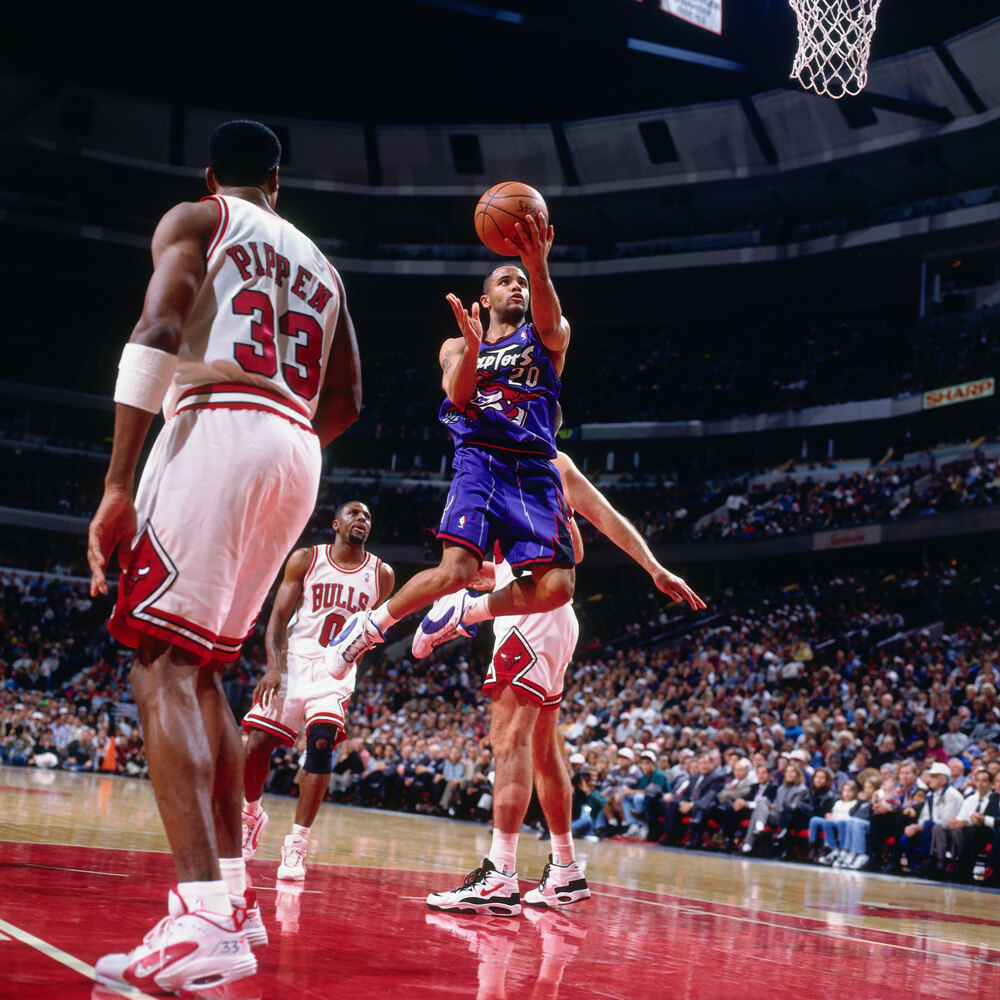
The home crowd was getting an up-close look at the Raptors’ backcourt of the future. Stoudamire had averaged 22.7 points and 11.7 assists in his first three games against the Bulls. After their first game, Jordan told reporters he needed head coach Phil Jackson to switch up the defensive assignments in the second half so he didn’t have to spend all game chasing the rookie around. Chicago was the best defensive team in the league but had no answers for stopping the rookie guard all season.
“Damon could score on the Monstars,” Raptors forward Tracy Murray says. “He was a natural-born scorer. He could shoot it. He could create his own space to get his shot off. He was fast enough to get by you. He could score at all three levels. That was a nightmare matchup for anyone.”
Stoudamire’s team-high 14 points in the first half gave Toronto a two-point lead over the Bulls at halftime. The rookie was once again leading the way on the court. In his first season, Stoudamire had established himself as the leader of the team.
A classic was unfolding at the SkyDome between an expansion franchise and a team chasing history, and Eddie Williams was in the stadium to witness it in person. The evening before, he hosted a party and invited players from both teams to attend. Williams moved to Toronto from London, England, when he was 11. He grew up in the Little Italy neighbourhood of the city and paid six dollars to watch an NBA exhibition game at Maple Leaf Gardens. Williams traveled to Niagara Falls to watch NCAA hoops and even once pooled together enough gas money with friends to drive to Syracuse to watch Leo Rautins. After studying recreation and leisure services at Humber College and working for an event-planning services company, he organized an event on his own for the first time at 18. Inside a Portuguese banquet hall, Williams served Jamaican beef patties and Sarasoda, a go-to drink in the 1980s advertised as a non-alcoholic beverage but widely known to contain 0.9-per cent alcohol, which was perfect for the young adults in attendance who wanted to feel a slight buzz. He started to promote and organize parties across the city and soon made enough money to pay his bills. Williams created a company called Party People Productions. The small production crew of seven people started to work in the local nightclub scene and were now planning parties on a much bigger scale.
Williams had met Thomas at an event before the start of the season. “He told me the players were going to be looking to do endorsements and appearances,” he recalls. Williams connected several players with the Don Valley Lexus-Toyota car dealership and helped them secure Four Runner trucks when they arrived in Toronto for training camp. He started hanging out with the players, introducing them to the club scene. One evening, Williams threw out the idea of throwing a weekend party towards the end of the season. Robertson liked the idea, and the two started looking at a date that made sense. They landed on a Saturday in late March. The Bulls would be in town on an off-day. Robertson convinced Jordan to endorse the party officially and agree to put his name on the flyer. It became the biggest party of Williams’ career. “I remember having meeting after meeting about it,” he says. “I had never planned an event with more than 200 people. The closest thing was probably a wedding reception. So this was a big deal.”
Williams had worked with the event staff at the Holiday Inn on King St. W. in downtown Toronto, and decided to host the party there. Three banquet halls inside the venue were transformed into a proper-looking dance floor with custom lights and wall decorations. A local DJ was hired. The live entertainment included a comedy set. The in-house catering would provide Caribbean dishes for the guests. An indoor area was set up for smoking cigars. Security guards were hired and would be assigned to every NBA player who entered the venue. Over 800 people, featuring the city’s most well-known entrepreneurs, influencers, and athletes, attended the event. The most important person of the evening would show up at one in the morning.
“As soon as Michael walked in the room,” Williams says, “the girls started getting prim and proper to get a better vantage point.”
Murray remembers leaving the party at around two and looking across the room to see most of the Bulls starters enjoying themselves. “They were smoking cigars and having a great time,” he recalls. “They were still there when we started to trickle out.” When the party officially ended at four in the morning, Williams says Jordan and his teammates were among the last to leave.
The following afternoon, Murray walked onto the court an hour before tipoff and noticed something strange. No one was warming up on the Bulls’ end of the floor. Murray finished his warm-up routine, walked back to the locker room, and ran into Chicago point guard Ron Harper.
“He said, ‘Man, we’re all still hungover in the locker room,’” Murray recalls. “He told me they didn’t get back to their hotel until eight in the morning.”

T he Bulls might have looked a step slow to start the game, but they woke up after halftime. “They were out of it in the first half,” Murray says, “and then suddenly they flipped the switch.” Led by Jordan, the Bulls came out of the locker room and erased the halftime deficit, taking a six-point lead in the third quarter.
Standing courtside by the players’ tunnel entrance, Thomas watched as his expansion team appeared to be letting the game slip away. The first season had involved a lot of growing pains on the court, but the general manager kept reminding himself to take a longer view of the roster building. The Raptors were 17–49, but Stoudamire and Christie had the potential to become a formidable backcourt. Wright, Žan Tabak, and Oliver Miller gave the team a solid big-man rotation. Rogers remained a project but had room to grow. Murray had been a godsend after joining the team at the end of training camp. Thomas’s inner circle of trust included Stoudamire, Miller, and Murray. He would regularly update the three players on the team’s roster construction. “We were like a mom-and-pop organization,” Stoudamire explains. “He would pull us aside and tell us what he was thinking and what direction he wanted to go. He would talk to us about the shaping of the roster.”
Murray remembers running into Thomas after one of his first practices with the Raptors. “He was watching us. Afterward, he came up to me and nodded his head. I was like, ‘What?’ He said, ‘I see you. I see that gangster in you. I see it coming out,’” Murray laughs. “He made me feel tougher. He made me more fearless. He saw me in a different light than anyone else. It gave me so much confidence as a young player. He was always there for you. He was a big brother. He was available to us.”
After the trade deadline, Murray replaced Anderson in the starting lineup and played the best stretch of basketball of his career. At the beginning of the homestand, he made six three-pointers and scored a career-high 40 points against Denver, besting the 31 points he had scored a week earlier. He had signed with Toronto looking to prove himself, and now Murray was the No. 2 option on offence behind Stoudamire.
“I remember having a conversation with Damon at the start of the season. I asked him what he wanted out of his first year,” Murray recalls. “We were candid with each other. He said, ‘I want to be Rookie of the Year and average 20 and 10.’ I said, ‘You can get 20 in your sleep. I can help you get the 10 assists. Find me on the catch-and-shoot. I’m not going to miss. I’m locked in.’”
Trailing by six in the third quarter, Murray calmly hit a three-pointer to cut the lead in half. On the next possession, he rose up for another shot from beyond the arc, tying the game.
The Bulls took a four-point lead into the fourth quarter when the one-on-one matchup between Jordan and Christie intensified. Jordan drove to the basket for a layup on one end, drawing a foul on Christie in the process. The three-point play put Chicago back ahead by two. Christie responded with a three-pointer to put the Raptors back ahead on the next possession. After Jordan missed a midrange jumper, Miller sprinted the length of the floor, spinning to the basket on a post-up for a layup that put Toronto ahead by three. Out of a timeout, Jordan responded with another fadeaway jumper over the outstretched arms of two Raptors defenders.
On the next trip down, he dribbled inside the three-point arc, pulling up for a midrange jumper, which swished through the net. The home crowd gasped in unison as Jordan walked back upcourt with his tongue hanging out, staring at the Raptors bench. On the sideline, Malone could only grin and shake his head.
“Are you ever gonna miss?” Malone yelled at Jordan.
“Brendan,” he responded, “you know better than that.”
The “Bad Boy” Pistons developed a rivalry with an up-and-coming Bulls team in the 1980s, and Malone was widely credited with coming up with a scheme to slow down the best scorer in the league during the playoffs. The Pistons deployed “the Jordan Rules,” a set of defensive principles devised by Malone. “We didn’t want him going baseline, so we pushed him toward the elbow,” he explains. “That’s when we would double-team him. If he had the ball up top, we would make him go left. We would double him from the top if he got the ball in the low post.” In consecutive years, the Pistons executed the game plan flawlessly and defeated the Bulls in the Eastern Conference Finals on their way to back-to-back championships. Malone had implored the Raptors to follow “the Jordan Rules” before the game but also recognized it was not a foolproof plan. “You don’t stop Michael,” Malone says. “You just hope to contain him.”
With just over two minutes left, Jordan hit another midrange jumper to put the Bulls ahead.
104–103.
Robertson could only give his friend a playful shove as the two jogged back up court. Jordan would finish with 36 points on 14-of-22 shooting in 39 minutes. Moments later, he hit two free throws to extend the lead.
106–103.
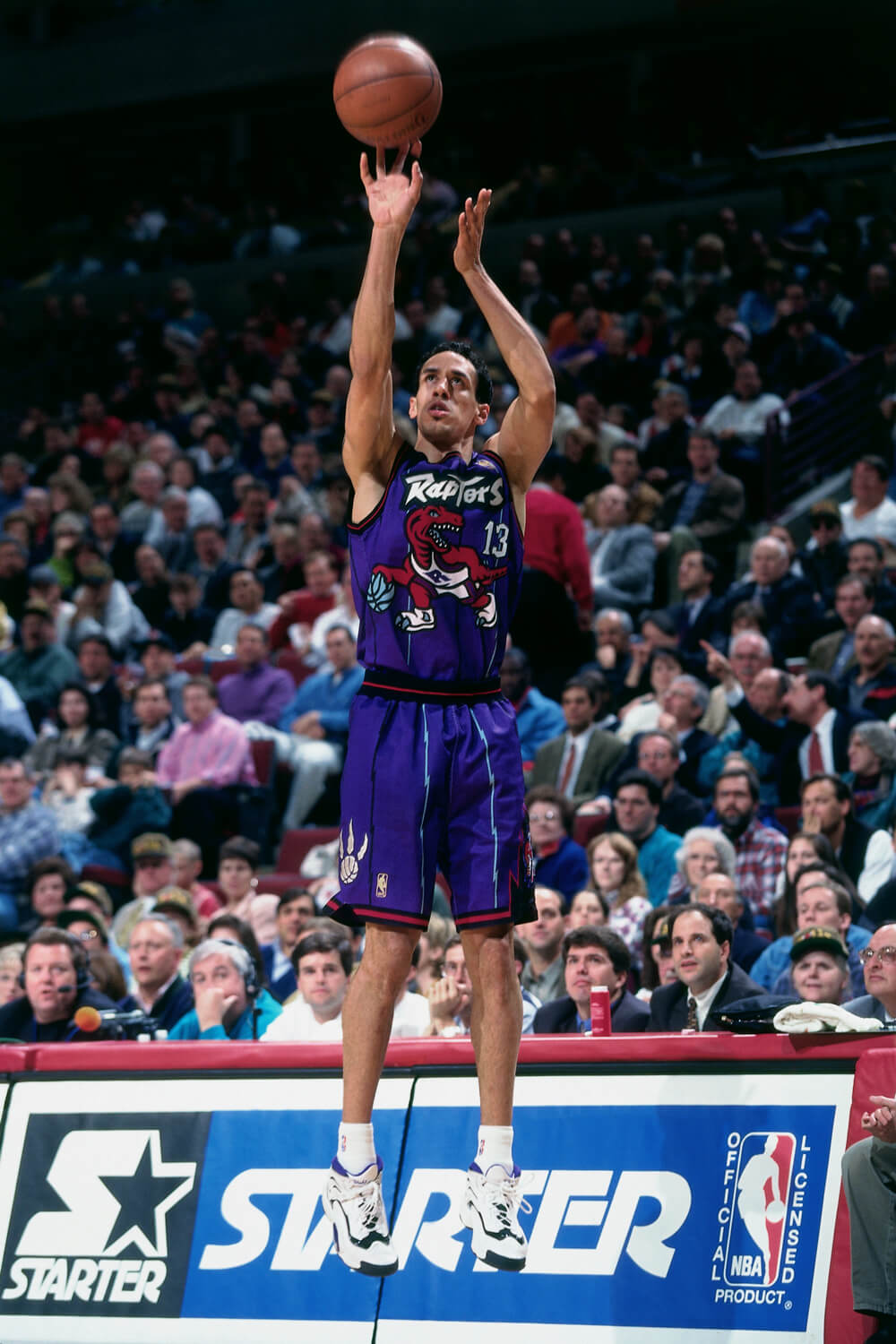
With a minute left in the game, Stoudamire responded, driving to the basket, drawing a foul from Jordan, and sinking his first free throw to set a career high with 30 points. The second free throw bounced off the rim, but there was Christie, jumping over two players for the offensive rebound and getting a foul call. He missed both free throws, but Stoudamire chased down the rebound along the baseline, finding Miller for a two-handed slam. The wild sequence tied the game with 50 seconds left.
106–106.
The crowd was on its feet and cheering on the expansion team to pull off the upset. A hush fell over the stadium on the ensuing possession. Jordan caught the ball at the top of the key, took a dribble to get inside the arc, and hit another fadeaway jumper to put the visitors back ahead. Timeout, Toronto.
108–106.
On the inbounds play, Miller threw a perfect pass to Murray as he curled to the basket for an open layup. It was delirium again.
108–108.
On the next possession, it appeared Jordan was going to put the Bulls ahead. He drove to the basket and saw an open lane for a layup. Christie was there to chase down the attempt and swat the ball right into Miller’s lap. The Raptors bench roared in approval. The decibel level at the SkyDome was at a record high. Jordan committed a loose-ball foul in the process. Miller stepped to the line and hit one of two to give the Raptors the lead. Timeout, Chicago.
109–108.
The game would come down to the final play.
On the sideline, Malone huddled up with his players. He grabbed his whiteboard and started diagramming their defensive strategy. Every player sitting on the bench knew where the ball was going. Malone decided to play man-to-man and told each player to stay on their assignment.
We’re not double-teaming Michael. We’re going to make him take a tough shot.
The challenge of guarding Jordan had been shared by Robertson and Christie throughout the game.
“Those two guys did the best job they could,” Murray says. “Whether he’s hungover or not, that’s the baddest man on the planet you’re guarding. This is what people don’t understand. The hardest part about guarding Michael Jordan is the 35 shots he’s going to shoot. You know that every time he touches the ball, there’s a possibility of the ball going up. You have to keep him from shooting the ball, and if he does shoot it, you just gotta make sure it’s not a good look.”
Malone wanted Robertson to take the assignment on the final possession.
“Coach said, ‘Alvin, I want you to stick Mike,’” Christie recalls. “The huddle got quiet, and Alvin goes, ‘Coach. I think the young fella’s been doing a good job on him. Let him go ahead and guard him.’ For me, that was a defining moment in my career. That was your sensei telling you, ‘You’re ready.’ That’s everything you want as a player, for your coach to say, ‘We’re gonna do this,’ and then for the player you’re learning from to say, ‘No, we’re gonna do this.’ So I said, ‘I got him.’ I mean, it was Michael, and nobody’s got Michael like that, but I said it anyways.”
The game resumes and the seconds tick down on the game clock. Christie follows Jordan’s every step as he calmly dribbles the ball past the Raptors logo at centre court.
14.9 seconds.
Bill Wennington runs to the top of the key to set a screen. Miller switches on Jordan. The Bulls guard loses his dribble as he tries to drive past the Raptors big man.
8.3 seconds.
The loose ball ends up in the hands of Steve Kerr. Christie has switched over and is right up on him.
6.9 seconds.
The ball swings to Scottie Pippen on the perimeter. He passes it back to Kerr.
4.7 seconds.
As Kerr rises to attempt a go-ahead shot, Christie runs over and contests the three-pointer as it’s in the air.
2.9 seconds.
The shot is short.
It takes a bounce off the side of the rim, right to Jordan, who is standing wide-open on the baseline. He catches the ball and, in a single motion, rises and banks in the go-ahead shot.
0.0 seconds.
No one in the stadium knows how to react. Did the Bulls escape with a buzzer-beater?
The referees quickly step in and wave off Jordan’s shot. It had left his hand just after the buzzer sounded.
The Raptors had pulled off the season’s biggest upset by a fraction of a millisecond. Malone pumped his fist and acknowledged the home crowd. As teammates embraced one another, Stoudamire stood on the court and took in the enormity of the moment. “That was our championship,” he says. Murray hugged his teammates as the fans gave their home team a standing ovation. “There was a different type of energy in the building that afternoon,” he recalls. “Everybody was fired up. It was a different atmosphere. Even [Raptors PA announcer] Herbie Kuhn lost his voice by the end of the game.”
“It was pandemonium,” Christie adds. “I remember just thinking, ‘Did we really do it?’ The city was alive that evening. Think about how many fans left that night saying, ‘I’m going to buy a Damon Stoudamire jersey.’ So many kids probably watched that game at home and started playing basketball the next day.”
A year earlier, when Jordan returned to the Bulls and scored 55 points at Madison Square Garden in his fifth game back in the NBA, Christie had watched from the Knicks’ bench. After the game, his teammate Monty Williams had asked for Jordan’s game-worn sneakers and received them. Christie wasn’t going to make the same mistake again. After the victory, he walked into the visitors’ locker room and spotted a horde of reporters surrounding Jordan at his locker. The two exchanged eye contact. Jordan asked the media to clear a path for Christie. He explained the reason for the postgame visit. Jordan smiled. He was keeping the sneakers but agreed to sign a game program for Christie’s four-year-old daughter. The two exchanged handshakes before Christie joined his teammates in their celebration.
“There was champagne waiting for us when I got back to the locker room,” he recalls.

A fter losing at the SkyDome to the Raptors, the Bulls resumed their march towards the all-time regular-season wins record by winning 11 of their next 12 games. They would set the record in April at Milwaukee, winning their 70th game of the season. The Bulls finished the season with an astonishing 72–10 record. Before the start of the playoffs, Ron Harper went out to lunch with Scottie Pippen. The two bounced around ideas for a team slogan for the postseason.
“We were just throwing out ideas. 72–10 this, 72–10 that,” Harper recalls. “I said to Scottie, ‘I got one. 72–10 don’t mean a thing without the ring.’ He’s like, ‘That’s kinda hot.’ We were just playing around when we said it, but Scottie had a good friend who made t-shirts. So we called him up and told him about our t-shirt idea. We wore them throughout the playoffs.”
The Bulls swept the Miami Heat in the first round, eliminated the New York Knicks in five games, and swept Orlando in the Eastern Conference Finals to avenge the previous year’s defeat. Jordan scored 45 points in the clincher. The Bulls won the first three games of the NBA Finals and secured their fourth championship of the decade with an 87–75 win over Seattle in Game 6 at the United Center in Chicago.
They would become known as the greatest team ever, but when the 1995–96 Bulls are mentioned in Toronto today, the first thing anyone remembers is how the expansion Raptors made history at the SkyDome on that fateful Sunday afternoon in March.
“That game was special. We made the city so proud. It made us feel good to represent the city of Toronto and the whole country of Canada. We represented them that night with that win. It’s still a trademark win in the organization’s history. It’s part of NBA history,” Murray says. “They were 72–10, but they should have been 73–9.”
This story is an excerpt from Prehistoric: The Audacious and Improbable Origin Story of the Toronto Raptors by Alex Wong, now available at Amazon, Indigo, and wherever books are sold, reprinted with the permission of Triumph Books.