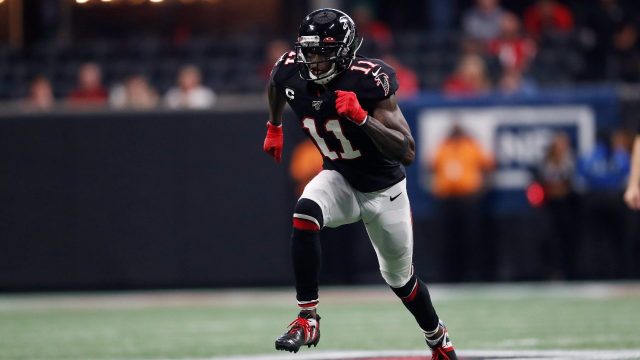
The Atlanta Falcons trading Julio Jones this off-season seemed like an inevitability, especially following his on-air conversation with Shannon Sharpe live on FS1’s Undisputed a couple of weeks ago when Jones said he was “out of there” after being asked about his future in Atlanta.
Fast forward to today and Jones is now a member of the Tennessee Titans, a team that is going to cause opposing secondaries some real headaches.
In addition to the trade’s on-field impact, it also made waves across fantasy football. Here’s a breakdown of the fantasy fallout for both Tennessee and Atlanta in the wake of the deal.
[relatedlinks]
Julio Jones
Tennessee ranked 30th last season in pass attempts per game but have the third-most vacated targets (224) available from last year. While it’s basically impossible to predict how those targets will be distributed, it’s a safe assumption that Jones is going to be getting a lot of them.
You don’t trade for Julio Jones and throw the ball 30.1 times per game like the Titans did last year, so 120 targets should be a pretty solid floor for the former Falcon in his new home.
Corey Davis, who Jones is essentially replacing (from a depth-chart standpoint) put up 984 yards on 65 catches while adding five touchdowns last season and did it in just 14 games. We know Jones is the better player and, if he is healthy, will be right in the mix is a high-end WR2.
Projection: 15 games, 120 targets, 76 catches, 1,155 yards and 7 touchdowns
A.J. Brown
There are way too many people who believe that Brown is actually hurt from a fantasy perspective by the acquisition of Jones and that couldn’t be further from the truth. No longer can teams double-cover Brown, who has thrived in the NFL despite any added attention from defenders. Now what happens when they can’t do that?
I will reiterate that you don’t trade for a player like Julio Jones to throw the ball the 30th-most times per game in a passing league. Let’s also not forget that this team is going to want to preserve Derrick Henry (who we will get to later on) and lessen his workload ahead of what this organization hopes will be a long season with a deep playoff run.
Some touted Brown as the WR1 overall heading into this season before the trade and while I don’t believe that will be the case (and didn’t before), he is firmly planted in the mid-range WR1 conversation.
Brown is an efficiency machine with consecutive 1,000-plus yard seasons since entering the league and has done so on just on an average of 61 catches per year. With the expectation that the team is going to throw more, Brown is a clear benefactor in this offence, especially with his ability to create separation.
Projection: 16 games, 138 targets, 88 catches, 1,355 yards and 10 touchdowns
Ryan Tannehill
Easily the biggest winner of this deal is Tannehill, who has been a totally different player since moving on from Miami and finding his long-term home in Tennessee. With the trade will come more expectations, but the former first-round pick has been able to pick up his game since arriving in the Music City.
Tannehill will be able to lean heavily on two of the better receivers that this league has to offer and his numbers will reflect that. After a fantasy finish of QB7 last year, we could absolutely see the 8th year signal-caller vault himself into the top-five this season.
His rushing ability also gives him an edge over a lot of other quarterbacks as evidenced by his (maybe surprising) seven rushing touchdowns last year.
As much as it pains me to admit this, Tannehill is going to be a league winner this coming season.
Projection: 17 games, 612 attempts, 397 completions, 4,883 yards, 42 touchdowns and 9 interceptions
Derrick Henry
This trade really makes it feel like the days of Henry getting a million carries are gone, but it doesn’t mean it’s going to make him any less impactful. This deal screams, “Let’s keep Derrick Henry as healthy and fresh for as many years as humanly possible.”
Among running backs with 180 carries or more, Henry faced an eight-man box at the fifth-highest rate (27.78 per cent) and did so with a total of 378 carries. That’s a lot of defenders to look at over the course of the season. The addition of Julio Jones should open things up for Henry to run rampant on opposing defences again, but he’ll likely have to do so on less than the 23.6 carries per game that he had last season.
Efficiency will be the key for Henry, but that shouldn’t be an issue for the reigning rushing champion, who has averaged over five yards per carry in each of the last two years.
Projection: 16 games, 307 carries, 1,657 yards and 18 touchdowns
Matt Ryan
The loss of Julio Jones is a massive one for Ryan, but there is at least some light at the end of the tunnel.
The Falcons’ defence isn’t all that great, so Ryan is going to be throwing the ball a lot, and in fantasy we don’t care about efficiency with quarterbacks.
Calvin Ridley is still there, Kyle Pitts is a nice shiny new toy, Mike Davis is serviceable and maybe Russell Gage is something. This offence won’t be that bad, much to the chagrin of many who want to tear them down. Let’s not forget that Julio Jones missed seven games last season.
Projection: 669 attempts, 430 completions, 4,773 yards, 30 touchdowns and 14 interceptions
Calvin Ridley
Ridley’s world should remain unchanged and is one of the only players who hasn’t been greatly affected by this deal.
Last year, Ridley was incredible last year, putting up 90 catches for 1,374 yards with nine touchdowns on 143 targets, good enough for a WR5 finish in PPR scoring. Expectations shouldn’t change for the fourth-year wideout because, as mentioned earlier, Atlanta is going to have to throw the ball a lot.
Ridley has had success without Julio Jones and that should continue, especially if Kyle Pitts is as advertised. All Ridley has done over the last two seasons is produce at a high level in this offence that, even without another top-end wide receiver, should still be able to produce viable fantasy options.
Projection: 16 games, 163 targets, 104 catches, 1,508 yards and 12 touchdowns
Kyle Pitts
Pitts’s rookie season will be so hard to predict because we don’t know just yet how he will be used. The guess is that he will be used on the outside, out of the slot and as an in-line tight end, and the team will create opportunities for him to succeed as a pass catcher.
Pitts just isn’t your typical tight end because he comes in with elite athletic traits which allow him the ability to not only win at the line of scrimmage but also to create separation with his speed and match up well against either cover linebackers or corners, big or small.
I guess what I’m saying is: Pitts is an absolute mismatch nightmare for opposing defences. With Julio Jones gone, it has now opened up even more opportunities for the rookie to shine.
If Atlanta uses him like we expect them to, it will be a prosperous season for Pitts and should make Falcons fans forget about the future Hall ofFfamer they just traded.
Projection: 16 games, 122 targets, 78 catches, 897 yards and 7 touchdowns
Honourable Mentions
Anthony Firkser
Many were hoping that Anthony Firkser would be a great late-round gem following the departure of Jonnu Smith, but with this trade he has become a late-round dart throw and probably no better than a back-end TE2 or high-end TE3.
Russell Gage
Russell Gage’s average draft position is on the rise following the trade, but it should be met with caution. In my estimation, Gage is probably the fourth-most targeted player at the end of this season behind Ridley, Pitts and running back Davis. He could be a bye-week filler or an interchangeable flex play, but nothing more.
Olamide Zaccheaus, Frank Darby and Tajae Sharpe
All three of these Falcons receivers are interesting late-round dart throws in dynasty formats but should be waiver-wire fodder in redraft leagues. Monitor them early on in training camp and into the season.

 2:10
2:10