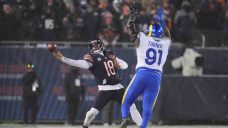
Last Saturday, the Chicago Bears did the unthinkable with their second-half surge to defeat the Green Bay Packers for the wildest of wild-card victories. On Sunday night against the L.A. Rams, on that same frozen stage in Chicago, they very nearly did the same in a Divisional Round thriller that won’t soon be forgotten.
While Caleb Williams’ overtime-forcing Hail Mary — as unlikely a play as you’ll ever see in the NFL — breathed new life into the Bears’ hopes of reaching the NFC Championship, there wasn’t quite enough football-fairy dust in overtime left to propel them to victory. It was the fifth-seeded Rams who claimed the 20-17 OT win, first on the power of their defence when they picked off Williams’ attempt to get the Bears into scoring position in extra time, and then by a methodical Matthew Stafford who deftly drove his team downfield to set up Harrison Mevis for the game-winning field goal.
The Rams’ victory marks their second straight nail-biter of a finish in these playoffs after the Carolina Panthers pushed them to their limits last weekend. They now have a date with their NFC West foes in Seattle, which is sure to ratchet up the intensity a few more notches considering how the divisional rivals have battled already this season.
Meanwhile, in Chicago, so ends one of the most magical, thrilling, and often times bewildering seasons the football world has ever seen. It was a season of comebacks and down-to-the-wire finishes, renewed rivalries and revenge games, a campaign that earned them the No. 2 seed in the NFC and saw them comes this close to a ticket to the conference championship in the first year of the Ben Johnson-Caleb Williams era.
No matter where your football allegiances lie, it’s hard not to have found yourself rooting for these Bears at some point this season, right?
For as unlikely as Williams’ overtime-forcing touchdown pass to Cole Kmet was, it also so perfectly encapsulated what this Bears team has done all season. No longer the Bad News Bears, a franchise defined by decades of disappointment, this team has played with an undying faith in their ability to bounce back from anything.
They’ve played with resilience and with grit and have demonstrated on more than occasion that sometimes, you have to take a step back — or, heck, turn your back on the defence and run — in order to find your footing and make magic happen.
Stafford’s late-game poise pays off in defence-heavy victory
For most of Sunday night’s game in Chicago, Matthew Stafford didn’t look like his normal poised self. The veteran was held in check by the Bears’ masterful defensive efforts, and by game’s end still didn’t have a touchdown pass to his name. Stafford finished with 258 yards, a completion rate below 50 per cent, and while he didn’t throw an interception he did get sacked four times. That’s a massive victory for this Bears defence, and surely a sign of dominance to come for an organization whose history is filled with stories of stalwart defenders. But on this night, none of that ultimately mattered to Stafford, because in the biggest moments the Rams QB stepped up and drove his team downfield.
Of course, he got a massive assist from his defence. As good as Chicago’s defence was, the Rams won this battle, intercepting Williams three times and holding strong in clutch short-yard situations that will likely haunt Chicago faithful. Stafford did enough to get the win, and he saved the best for last.
Just when it looked like Williams was going to carry his late-game magic into overtime and get the win by marching the Bears downfield to score, Kam Curl laid out for a game-changing interception to turn the tides and put the ball back in Stafford’s hands midway through the OT quarter. What followed was a signature Stafford series: clutch connections to Puka Nacua, Colby Parkinson, and Davante Adams to gain first downs and a little rhythm, then a third-down conversion to Nacua to get into scoring territory. The Bears held strong to keep L.A. out of the end zone, but not out of field goal range, and in the end Mevis made his 42-yard game-winner look easy.
Maye far from perfect, but Patriots’ masterful defence saves the day
We hear same refrain every year: Defence wins championships. And while we have yet to see how this season ultimately plays out, and whether the old adage will be proven true on football’s biggest stage in February, defence certainly claimed the spotlight on Sunday — not just between the Rams and Bears in Chicago, but in New England, too, as the Patriots toppled the Texans 28-16.
The conditions weren’t exactly QB-friendly, and it showed. On a rainy, snowy, sleet-y day in New England, Patriots quarterback Drake Maye completed just 16 of 27 passes for 179 yards, threw an interception, was sacked five times, and also turned the ball over on a fumble that led to a Texans touchdown in the first half. But he also stepped up under serious pressure, throwing a trio of touchdown passes and navigating his way through Houston’s terrifying defence to secure the Patriots a date in Denver next Sunday.
It was New England’s defence that won the day in this one, just as they did last weekend against the L.A. Chargers. Though, that doesn’t mean there weren’t some very wow-worthy offensive plays — none more so than Kayshon Boutte’s sprawling, one-handed catch in the end zone early in the fourth quarter to go up 28-16 and build up some serious insurance.
Stroud’s turnover troubles continue
While Maye’s struggles will fade to the background with his victory, C.J. Stroud’s troublesome numbers will be a focal point as the Texans reflect on Sunday’s loss.
Because considering just how dominant their defence has been all season long, they probably should’ve won this game. After all, when you’ve got a defence as elite as the Houston Texans’, you don’t need an A-plus effort on offence to win games. Unfortunately for Houston, however, Stroud didn’t post a passing grade.
Stroud completed just 20 of 47 pass attempts Sunday afternoon against the Patriots, throwing four interceptions — all in the first half, including a pick-six. He registered 212 yards, one touchdown, suffered three sacks, and earned a passer rating of just a 28.0. Those numbers, however dismal, still don’t really tell the whole story. Stroud’s play on Sunday made his electric rookie season (just two short years ago) feel like a distant memory — that first-year QB was unflappable, sharp, and rarely made mistakes. The Stroud we saw Sunday in New England looked out of place, under-throwing his receivers often and putting the ball in harm’s way with some head-scratching throw-and-a-prayer tosses.
As an isolated outing, you could chalk it up to a bad performance at the worst time for Stroud, who entered Sunday’s matchup with legitimate hopes of securing his franchise its first-ever berth in a conference championship. But this wasn’t a one-off. Rather, it comes on the heels of Monday night’s dreadful trip to Pittsburgh, which would’ve seen Stroud fumble away the game had the Steelers’ offence not fared even worse. Stroud threw one interception as part of a three-turnover game won almost entirely on the power of the Texans’ dominant defence.
That defence was outstanding again Sunday in New England, bailing out their QB early and often. Case in point: Despite the Patriots winning the turnover battle, they only scored once as a direct result; that was a second-quarter pick-six, with Houston’s defence only able to watch from the sidelines. Overall, Stroud’s errors were too much for this defence to overcome.
It should be noted that Stroud was playing shorthanded on Sunday, with Nico Collins sidelined with a concussion and tight end Dalton Schultz exiting the Divisional matchup early on with a calf injury. It’s also noteworthy that Stroud did play cleaner football in the second half after a woeful first two quarters. But considering his mediocre regular-season numbers, and his dismal stats in two post-season games (a combined five interceptions and five fumbles), this is a troubling trend for the Texans who now have a long off-season to help their franchise QB get his groove back.

 4:07
4:07