
It’s been a tough year to be a Philadelphia Eagles fan. But they’re used to it. The fan base is the embodiment of the “tough times don’t last, tough people do” mentality.
If any group of fans knows that it’s never over until it’s over, it’s the fans from the city that gave us Rocky Balboa. Although things look bleak now, the Eagles have rallied to win in similar circumstances not that long ago.
Which is the genesis of the documentary “Maybe Next Year,” which is now available on Apple TV, Prime Video, Vudu, Google Play and Vimeo On Demand. The documentary’s director, Kyle Thrash, is a New York-based filmmaker, born in Philadelphia and raised in the country of rural Pennsylvania.
https://www.youtube.com/watch?v=UFfvQBVvYjo
He’s now known for his revealing documentary projects, and the subject of the latest is the Eagles’ run to the team’s Super Bowl LII win through the eyes of the fans who had waited their entire lives to see it happen.
Sportsnet recently spoke to Thrash about documenting the magical championship run of the Philadelphia Eagles and why the relationship between the team and city is unique in North American sports.
Sportsnet: Why did this type of storytelling intrigue you?
Kyle Thrash: Well, I grew up outside of Philadelphia and I kind of had been exposed to these kind of larger-than-life, huge sports fans down at Veterans Stadium at a young age and felt like there was something really unique about sports fans in Philadelphia.
So, it started out as a character study of me just kind of exploring the tailgate and the fans and going home with the fans and kind of understand the psyche of them, where all that passion comes from, why they get a negative reputation.
So, it really was a character study about sports fandom, and then it turned into recapturing the most magical year in Eagles history.
SN: In terms of creating content, your timing couldn’t have been better. Why did you choose that time and the personalities and the characters that you used to tell the story? How did you land on them specifically?
KT: I was looking for a project, and I chose that year with what I felt like would be a good year with the team looking good on paper.
When I was deciding what to do in terms of looking at different sides of fandom to explore, I felt like the four characters that I chose kind of represented different types of fandom, that I felt like you were interesting and felt authentic to me. So, whether it’s Shirley with her unabashed passion, calling into the radio station, running a women’s group – I feel like she has this tremendous spirit and tremendous passion for the team. Very, very optimistic, but almost brutally honest at the same time. She’s someone that says we boo because we care.
Someone like Brian, who goes on the other side of that coin – just unabashedly negative, just very, very honest about how he expects more from his team and looking at where all that anger comes from, from his videos.
Then someone like Barry spends his retirement money on this love. And for his team, it almost becomes this idea of obsession that he creates just two thousand square foot shrine to have people come over and create the No. 1 man cave in America and have people come over to watch the games with him and kind of revel in that obsession, that common obsession for the team.
And then someone like Jesse, who represents legacy, who has a father who’s sick and a son who has special needs and what it’s like to pass on something that you love and share in that legacy. And sharing that love that you have for your team with your family that I felt was something a lot of people have in common, me included, with both my parents being really big sports fans.
So, I feel like those four characters kind of represented different parts of what it means to be a fan.
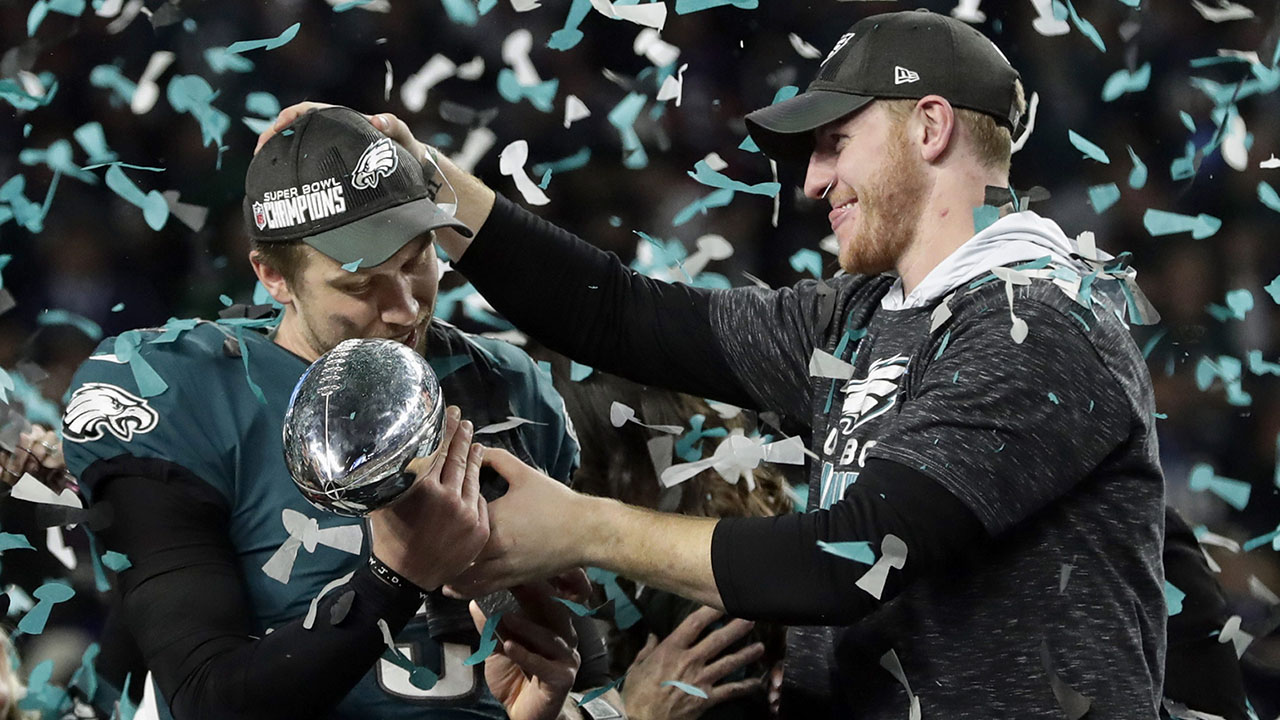
Philadelphia Eagles quarterback Carson Wentz, right, hands the Vincent Lombardi trophy to Nick Foles after winning Super Bowl LII against the New England Patriots, Sunday, Feb. 4, 2018, in Minneapolis. (Frank Franklin II/AP)
SN: You know, “fan” is obviously short for “fanatic,” and we see the passion through those characters and lots of people in the film. But as you’re documenting it and putting together the story, did you have a sense of how healthy is this? Is this a positive and additive thing in their lives or is it a negative?
KT: I try to keep it objective in that way that I’m hoping the viewer can make their own assessments. I feel like obviously I have my own views about it. I’m a fan myself. So, I feel like it probably is a bit subjective at times, but what I hope the viewer does is make up their own judgments about these characters.
But it definitely can be unhealthy, I think in some ways, just like anything – whether you love a band or you love food. It’s like anything that you love; too much of anything, I think, can kind of tip the scale in the wrong direction. So, I think exploring some of those things with his wife or his personal life, I think that’s what we’re trying to see if it is unhealthy.
SN: My favourite production choice was, near the end, the cutting of fans screaming “Oh my god” back-to-back. Earlier in the film you show a priest and the juxtaposition of him talking about faith and talking about football. Is the importance of the sport congregation similar to the importance for many to religion? Is it literally a religion for some in Philadelphia?
KT: It is, I think. It’s a collective identity; it’s something that the city really holds, has a lot of pride for its teams.
I think it’s something that we take a lot of pride in, and saying that these teams represent who we are. I think that comes from a number of different places. I think we’re a city that has been overlooked as a city. The Declaration of Independence was signed here, but we’re not the capital, and the banking and entertainment goes to New York.
The people in the city sometimes have a chip on their shoulder and saying, “Why aren’t we considered that?” And if you think we’re not the best, then we’ll prove that. And I think that they’re blue-collar, hard-working people and they want the same from their team. So, I think that kind of creates an identity in some ways.
[relatedlinks]
SN: Who is that central character and theme in the story – is it Philly, the Eagles, the NFL, football?
KT: I think it is about Philadelphia. It’s about being a sports fan, but it’s also about what it means to be a sports fan in Philadelphia. But Philadelphia is definitely the fifth character, the fifth main character in the movie, that kind of talks about it in a way that, again, kind of tries to look at the city as a whole and some of the things that have happened.
But also, like I’ve said, really, when it comes to sports and how we’ve learned to love our sports teams like the “Broad Street Bullies” in the ’70s with the Philadelphia Flyers. Decades of being like, these are the types of players we want. We want guys that are going to go out and fight. Guys are going to go out and be in the community. We want people that help the city on and off the field, and we want people that work as hard as we do.
So, I think Philly is definitely a main character in the film.
SN: So could you bring this story to another sports team in Philadelphia or through a football team in America, or is it really unique to Philadelphia?
KT: I do think it’s unique. I feel like what happened that year with the dog masks and backup quarterback. I think the story is unique and special in its own way. But just the way the community came together, I think is special.
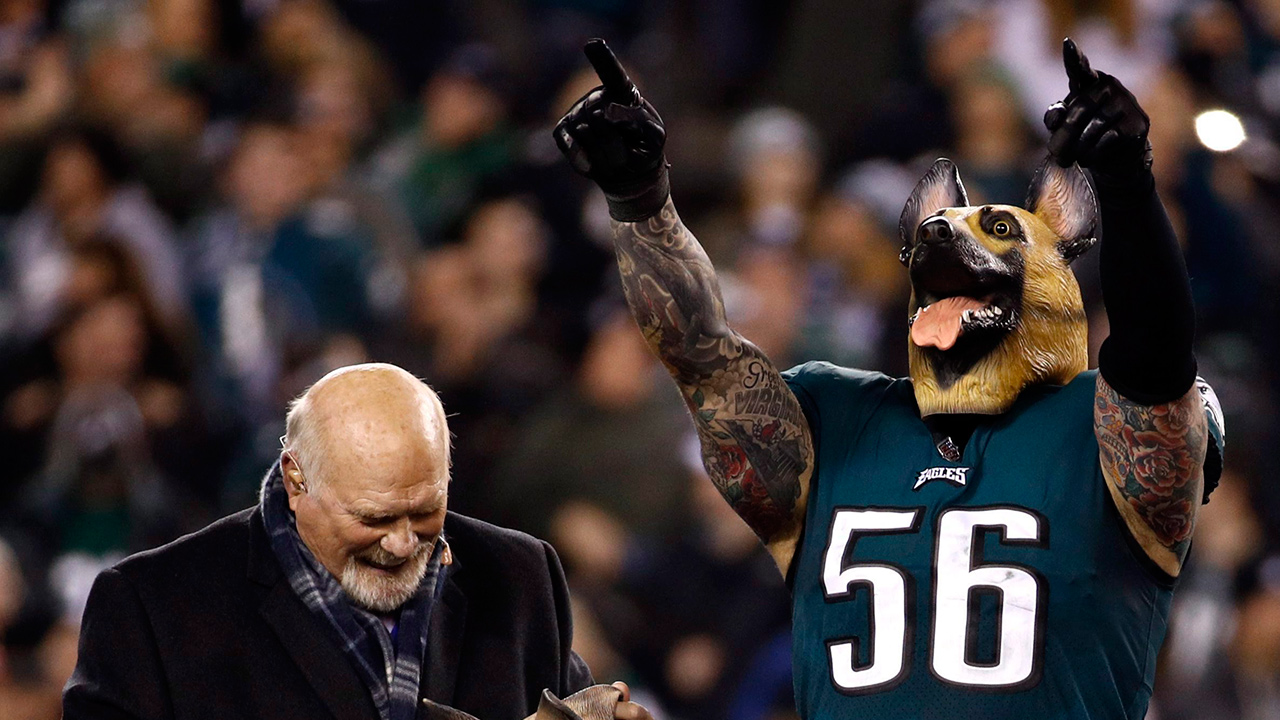
Philadelphia Eagles’ Chris Long wears a mask after the NFC championship game against the Minnesota Vikings on Sunday, Jan. 21, 2018, in Philadelphia. (Patrick Semansky/AP)
That being said, there are rabid fan bases. Buffalo got to four Super Bowls in the ’90s and lost them all and still show up on Sundays, jumping through folding tables, showing up in the cold, love for their team. Again, a town that has been hit really hard with industry leaving. And again, feels like they don’t always get the best players.
The first thing you think of in New York State is New York City instead of Buffalo – I love Buffalo and I love its people. And I did a project there that means a lot to me. And I think if I were to pick another project, I think something special could happen with the Buffalo Bills, for sure.
SN: So like everything now, I couldn’t help but watch this film through the lens of COVID-19 and how many of the scenes would look different if it were to happen now. Do you now retroactively think about how this pandemic is impacting all of the things that you brought up?
KT: Community is a big, big theme of the movie, and how a city can collectively come together. And I think people in cities all around the world right now, I think feel this distance. And I think whether it’s sport or live music or other events where people come together for a common interest, I think that it makes us feel connected and closer to each other. And I definitely feel like people are missing that right now. I definitely think sport plays a part in that.
I think what makes the film unique is that it’s pulled from the fan’s perspective. I think it’s obvious that us – me and Wavelength Productions, who made the film – we took a risk in making the film – also 9.14 Pictures and Bow + Arrow Entertainment that all helped make this film – because it’s not mainly traditional in the sense that there’s not a lot of football in the movie. It’s really about the fans and about what happens off the field.
SN: So, if an NFC East rival or a Steelers fan in Pennsylvania was skeptical, what would you want them to take away from the project and the people in it?
KT: Probably that we’re all closer than you think. I don’t want to be controversial when I say that I don’t look at any Cowboys fans or Giants fans as an enemy or anything like that. I may root against their team. I may not like some of the players. I may not like the organization. I may not like how they conduct themselves. But, you know, we’re all very similar sports fans, whether it’s up in Canada or over in Europe with soccer, you said, the word can come from fanatical.
So, I hope that if you’re a rival, I hope the film will show that we have much more in common. So maybe it would bring rivalries or just a better understanding of each other and take it easy on each other the next time they see each other at a game.



 2:19
2:19