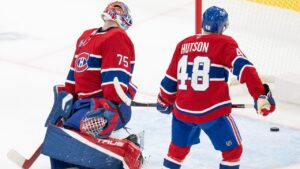
MONTREAL — The Montreal Canadiens were up two goals on the Buffalo Sabres when they had a shift that typified why they’re now up 2-1 in a series they could easily be leading 3-0.
The puck was in their end for almost two full minutes while the Sabres were pressing for a way back into the game, and the Canadiens held them to just one measly shot attempt, which was blocked by Alex Carrier.
It was Carrier and Mike Matheson doing the heavy lifting for the entire shift, while forwards Jake Evans, Alex Newhook and Ivan Demidov took care of the first minute and then left the second one to Alex Texier, Phillip Danault and Josh Anderson. All in all, they were eight players doing everything the Canadiens needed from them to preserve a healthy lead, defending a desperate team that’s arguably more dangerous with the puck than any other team in the league, and there was nothing surprising about it.
That’s who the Canadiens have become.
They were once a mess in their own zone, but they are no longer. They started the year as a team that could outscore that problem, and they did exactly that before figuring out how to solve it. They buckled down defensively after the trade deadline — and not just in their own zone, but all over the ice, properly managing the puck and immediately defending without it — and their first-round, seven-game series with the Tampa Bay Lightning forced them to get to a whole new level in that department and prepared them to play the Sabres.
“You go seven games, one-goal games, the margin of error is thin,” said Canadiens coach Martin St. Louis, “and sometimes it’s not necessarily the offensive things that are going to get you the win.”
That was Sunday morning.
By the end of Sunday night, if you missed the game and only looked at the 6-2 score, you’d have easily concluded the offensive things got the Canadiens the win.
Even if you watched, that could’ve been what you took away, after the Canadiens scored some tic-tac goals and generated so many of the chances that made you marvel at their talent.
But they won this game on defence, which is exactly where the Sabres lost it — just like they lost Game 2, and just like they could’ve lost Game 1 had the Canadiens been more opportunistic.
Yes, these Sabres are lethal with the puck.
But they are absolutely killing themselves with — and especially without — it, hence Montreal’s 21 high-danger shot attempts through two periods of Sunday’s game.
The Canadiens were up 4-2 at that point and, if not for Sabres goaltender Alex Lyon, they could’ve been up 8-2.
Buffalo’s porous defence and its mismanagement of the puck are two of the biggest reasons this series hasn’t been as close as the 2-1 score would indicate.
“We made some ill-advised plays,” said Sabres coach Lindy Ruff. “Some bad decisions we haven’t been making.”
And the Canadiens?
“They made us pay for our mistakes,” Ruff said.
The Canadiens made some mistakes, too, particularly after that two-minute fire drill in their own end early in the third.
But that’s when Jakub Dobes came up with the three best saves of his 26 on the night.
With Lane Hutson in the penalty box for interference, Sabres forward Alex Tuch got a rebound chance stuffed by Dobes. Zach Benson then got clean shots from both sides of the goal line, and those were the other two snuffed out by the 24-year-old rookie goaltender.
But after that sequence, the Canadiens regained their structure. They buckled down defensively. They killed yet another penalty.
And then they collected the puck in their own zone, burst up the ice two-on-one, and got a goal because Kirby Dach was faster to a loose rebound than Bowen Byram and Tage Thompson.
Thompson scored on Buffalo’s first shot of the game, which was generated because Cole Caufield tried to flip a puck out of Montreal’s zone and instead flubbed it.
But from that point forward, it was almost all Canadiens — with Alex Newhook tying the game, with Caufield finally converting on the power play, with Zach Bolduc and Juraj Slafkovsky also scoring before the end of the second period, and with Newhook awarded an empty-net goal after Rasmus Dahlin couldn’t catch him and decided to take a penalty against him.
It all started without the puck.
“The defence is the biggest part of playoffs,” said Newhook. “We’re finding offence right now, but we’re defending hard, we’re making it hard on them to get inside. On the looks they’re getting, Dobes is coming up big obviously. But I think when we need to defend, we’re doing that, and that’s gotta be the biggest part of our identity moving forward.”
It was the Canadiens’ defining trait against Tampa.
“They forced us to play a tight game,” Newhook said, “but I think it prepared us for what’s ahead. Playing a veteran team like that, you’ve gotta defend at key moments at the series. I think we did that against Tampa to be able to move on, and we’re carrying that into this round.”
The Sabres, to a man, thought the Canadiens wouldn’t.
Speaking with them in the leadup to last Wednesday’s Game 1, they talked about how they’d be given more space than Boston gave them to play the rush game they enjoy so much because the Canadiens are young, fast, and just as aggressive as they are.
It was a miscalculation.
“Give them a lot of credit,” said Ruff. “I said before this started, they beat a hell of a team. They are a hell of a team. Don’t take them for granted. Now, if we don’t realize it now, we’re never going to realize it.”
He played NHL hockey from 1979-1991. He’s been a head coach since 1997. He knows what wins at this time of year, and it isn’t high-octane, go-for-broke offence the Sabres are pushing for.
So does St. Louis, the Hall-of-Fame-player-turned-coach.
He’s been teaching the Canadiens the details of how to play the right way for the better part of two years after his first two years as coach were spent mostly just teaching different general principles.
“I think we started a lot last year into understanding that defensive hockey is a big part of a winning recipe,” St. Louis said earlier on Sunday. “You need to score goals, but I feel we’ve progressed, and progressed, and progressed throughout the last two seasons, and I don’t feel our offensive game hurts because we’re getting better defensively.
"I feel we’re learning to manage games better, and when it’s time to defend we can defend. We talk about defending so far from our end zone and to me when you lose the puck anywhere, you’re defending. And I feel like we’ve gotten really better at that so that hopefully you have to defend less in your zone. And I feel when we have to defend in our zone, we’re engaged there too.”
That’s what happened during that crucial, game-defining sequence early in the third period, and it’s what will have to happen again against an even more desperate Sabres team in Tuesday’s Game 4.
But if Buffalo keeps defending the way it has, this series won’t go the distance.



 1:09
1:09