It was a tough afternoon for the Montreal Canadiens, but a great one for Team Canada.
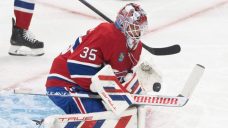
They named Jordan Binnington to their Olympic squad Wednesday, and on Saturday, in his second start since the announcement, he played like the guy they hope to see come February in Milan — and much less like the guy in St. Louis, who’d posted the worst goals saved above expected of 85 goaltenders to play at least one game through the first half of the NHL season.
In Saturday's 2-0 win for the Blues over the Canadiens, Binnington stopped what appeared to be several sure goals. He made 25 saves — nine of them on shots from 15 feet or less — and he took what both the Blues and Team Canada would hope were his first steps towards putting an entirely forgettable first three months behind him.
“Give him credit,” Canadiens coach Martin St. Louis told reporters at Enterprise Center. “He played super well.”
In the process, Binnington also stuffed Brendan Gallagher’s attempt to springboard away from his lamentable first half-season.
But the 33-year-old heart-and-soul winger shouldn’t get stuck on the all-too-familiar result of being held off the scoresheet because his process gave both him and the Canadiens something to take away from this game.
Seeing Gallagher notch a game-high six shots on net in his long-awaited reunion with Phillip Danault led to a dominant night for his line and offered some hope that both he and Danault can redeem some of their offence if they stick together. It also provided some hope that the Canadiens can recreate a dynamic that helped propel them to an unlikely playoff berth last spring, a dynamic they’ve been searching for ever since the puck dropped this past fall.
When the Canadiens lost Christian Dvorak to the Philadelphia Flyers over the summer, it went away. Dvorak’s line with Gallagher and Josh Anderson had been labeled — and frequently referred to by St. Louis — as “an identity line.” It was a line that consistently gained, carried or recaptured momentum by establishing and re-establishing the team’s forecheck, and recreating that dynamic this season proved impossible before Danault recently returned in a trade following four years away with the Los Angeles Kings.
St. Louis tried Anderson and Gallagher with Jake Evans on two separate stints earlier this season, but having three righties together just didn’t work.

32 Thoughts: The Podcast
Hockey fans already know the name, but this is not the blog. From Sportsnet, 32 Thoughts: The Podcast with NHL Insider Elliotte Friedman and Kyle Bukauskas is a weekly deep dive into the biggest news and interviews from the hockey world.
Latest episode
“I feel ideally you’ve got both sticks on the line, because I feel you can be a threat from both sides more, and you’re not going to get stuck,” explained St. Louis on the morning of Dec. 20, just hours after Danault was acquired for a 2026 second-round pick. “Not that you can’t do it with three lefties or three righties, but I feel it’s a little bit harder just attacking from both sides, especially with the amount of pucks that go below the goal line now. And you want to be able to have, at times, the right stick in the slot for a one-timer. It draws coverage, it opens up other things, and I’m not talking power play, I’m talking five-on-five. So ideally, if I’m building lines, I’d like to get at least one righty, one lefty on each line. That’s the best-case scenario.”
It worked out particularly well for Anderson and Gallagher last season.
The former bounced back from the toughest season of his career, while the latter notched over 20 goals for the first time in four years, and that was just the byproduct of the way they played with the left-handed Dvorak.
But neither Anderson nor Gallagher has been as effective without Dvorak. Even if Anderson is on pace for more goals than the 15 he had last season, he hasn’t been as consistently threatening on the forecheck as he was then. And neither has Gallagher, who had just two goals and 13 points through the first 40 games — most of which were played on the fourth line.
On Saturday, Gallagher played on the third with Danault and former Blue Zach Bolduc because Anderson wasn’t available to play. They were held off the board by Binnington alone, and Gallagher finished minus-2 because Bolduc needlessly threw away the puck for Jonatan Berggren to score the Blues’ first goal, and Lane Hutson coughed it up on the shorthanded goal that Robert Thomas scored.
But Gallagher rekindled the chemistry he had for years with Danault, and he provided incentive for St. Louis to keep them together and pair them with Anderson upon his return.
There’s no telling if it’ll be in Dallas on Sunday. Anderson is day-to-day with an upper-body injury, and he might not be able to play against the Stars.
But provided Anderson is back soon, the Canadiens could redeem what they had for all of last season by uniting him with Gallagher and Danault. It has the potential to make them that much stronger, with their top two lines performing particularly well, and it could give Anderson, Danault and Gallagher the offensive spark all three of them have been looking for.
Anderson may have nine goals, but, just like Gallagher, he’s also stuck on 13 points. And Danault had zero goals and just five assists in 30 games with the Kings before failing to hit the scoresheet in five games with the Canadiens.
Together, Gallagher, Danault and Anderson can give the Canadiens a line that can cycle; a line that can create or sustain pressure and momentum; a line that can grind down the opposition and make them more vulnerable to the other more offensive lines on the team. And they’re bound to do better offensively playing against goaltenders who won’t all be as hot as Binnington was on Saturday.