While working as a video scout, it blew my mind a little to discover that you can re-watch a game five times, concentrating on a different skater each time, and walk away feeling like you watched five different hockey games.
It blew my mind a little more to discover that closely concentrating on a goalie will leave you feeling like you watched a different sport entirely.
Goaltending is the art and science of managing chaos. It’s the beautifully bizarre convergence of three disciplines on steroids: biomechanics (technique), geometry (angles), and mindfulness (focus).
At the NHL level, the difference between stopping the puck and fishing it out of the net lies in the tiniest details of these disciplines, many of which seem insignificant on the surface as they’re tough to discern: the part of a goalie’s body leading his movement, the angle of his routes, the way he positions his head to track the puck, the timing of when he enters his stance, and a slew of other variables.
We all see the outcome – the puck goes in or it doesn’t – but don't often realize how the netminder’s process contributed to it. In other words, we don’t understand what the heck is really happening back there.
In the case of a netminder who’s been one of the best in the league for years and is amid a campaign some may deem MVP-worthy, it doesn’t appear much is happening. Boring, patient, and efficient are all descriptors Connor Hellebuyck has associated with his playing style. The 30-year-old, who’s set to make his fourth All-Star appearance in his ninth season with the Jets, offered insight into his approach as a guest on After Hours earlier this season. Here’s part of what he said:
“I’m using my mind and I’m really reading the game and I’m not overdoing anything. [...] When I’m watching video and I see a game and I see a lot of saves look easy, that’s exactly what I want.”
This approach is one he began developing while studying games in high school, per a quote from a feature written a few years back by Kristina Rutherford:
“I was realizing how often the puck just barely misses you, or all these goalies that go into desperation, and they might make the save, but they didn’t need to go into desperation — or, at least, I didn’t think they needed to,” he says. “I started morphing my game into staying calm and trying to get ahead of it and trusting you’re going to get there. I was watching a lot of goals go in and analyzing what the goalies did for them, and started to realize that you can just move and stay in position and still give yourself the best chance of making saves.”
Alongside his brain and drive, which are clearly on another level (he also studied stick blades as a kid so he could anticipate where shots were headed), Hellebuyck’s positional details serve as the foundation of his success.
We’ll explore four of those largely powering his results this season, specifically through the lens of how they limit his exposure. An overwhelming portion of goals in hockey involve a netminder exploited in transition – while moving horizontally or vertically – but Hellebuyck’s strong fundamentals minimize his movement and thus how frequently he’s caught in an “in between” state.
Staying on his feet
As danger approaches, a goalie must possess significant poise and self-trust to refrain from entering “holy frig!” mode and dropping to the ice prematurely when the play is in front of him. When a goalie goes down early he not only loses coverage of the upper part of the net, but also makes himself more susceptible to being exposed when standing back up or maneuvering from his knees.
When a goalie tries to correct this miscalculation by standing again, he faces the tricky task of doing so without the puck slipping under his pad as he lifts it or squeaking through his body as he rises. That’s the first challenge and it requires careful timing, as demonstrated by the netminders who fell victim in the first two examples below.
The second challenge is to stay ahead of the play. Regaining your feet takes time and the milliseconds lost in this transition can result in a goalie falling behind enough that he’s a hair late to his next spot, as seen in the last two clips.
The alternative to standing back up is to try and operate from your knees (translation: yikes). Compact and precise movements are tough to come by in this stance, and it’s easy to pull yourself out of position or fail to move quickly enough to close openings given how much harder it is to reorient your body and control your momentum. Below are some examples leading to goals against.
Moral of the story: staying on your feet from the jump is the most effective way to eliminate unnecessary movement that can leave you vulnerable and this practice is a pillar of Hellebuyck’s game.
In contrast to the examples above, watch how he stands his ground for as long as possible in the following clips, which allows him to make saves in similar contexts (slot scrambles, delayed shots, attacks with speed/traffic).
Taking efficient routes
Hellebuyck’s ability to keep up with the puck while staying on his feet (versus sliding) in those examples involving east-west passes is partially a credit to his routes. He's excellent at choosing paths that maximize his readiness to make the next save, both in terms of timing and positioning.
There are three basic facets of positioning for a goalie:
1. squaring up to the puck (rotating head, shoulders, and toes to face it)
2. cutting the angle (moving laterally to cover the middle of the net relative to the puck)
3. adjusting depth (moving closer to or further from the goal line vertically to assume a more aggressive or passive approach)
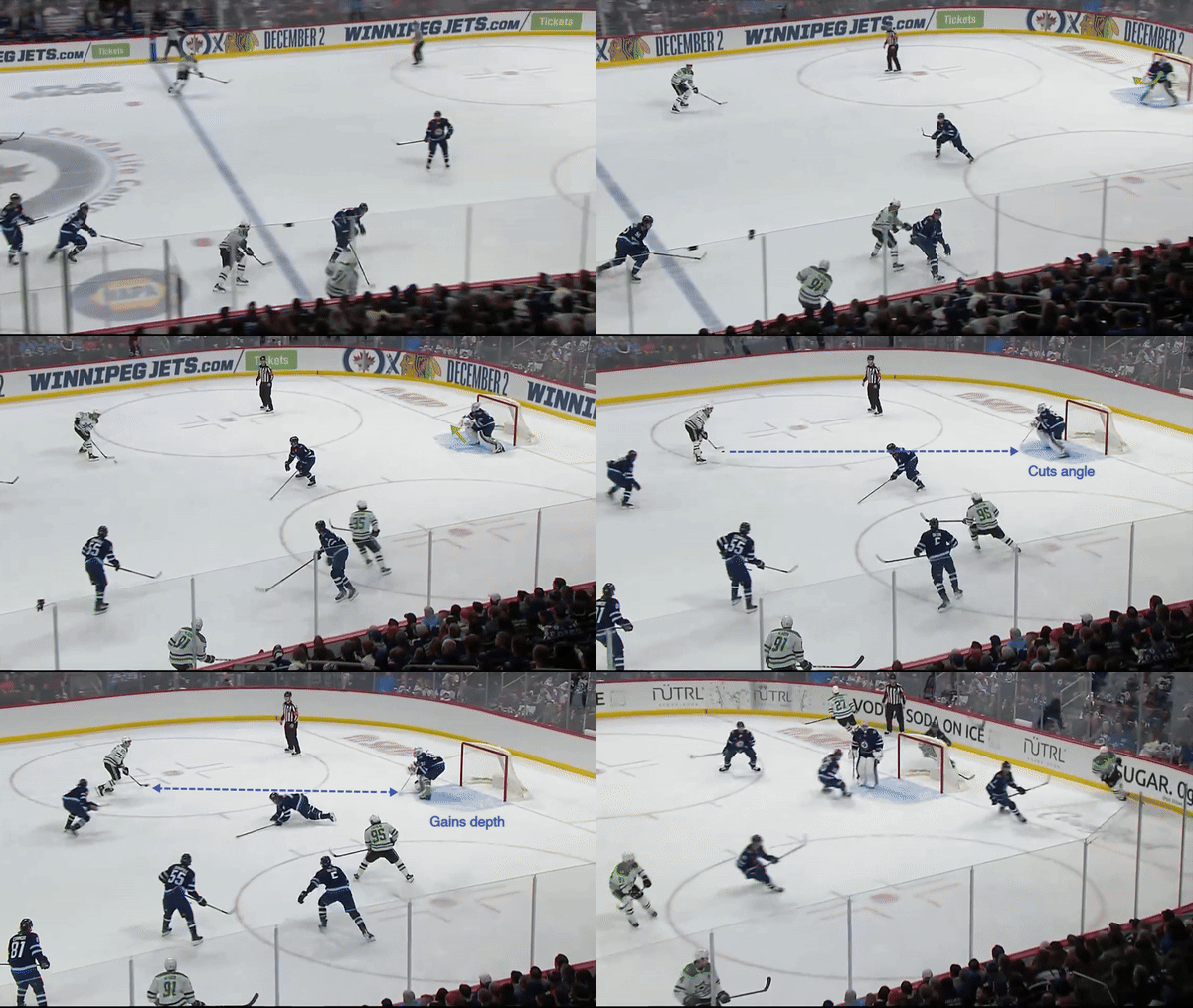
Hellebuyck tends to prioritize the first two and is less concerned with the third, particularly in terms of gaining depth – moving to or beyond the top of the crease to challenge the shooter and eliminate more of the net. He generally likes to play at a shallower depth and will sacrifice the opportunity to challenge more in favour of ensuring his body is aligned with the puck when a scoring chance is imminent.
This preference and strategy allow him to consistently make difficult saves (on initial shots and rebounds) as the distance he needs to travel laterally to establish his angle is shorter than goalies who play more aggressively. Since he’s in motion for less time and can arrive at the required destination sooner, the window for pucks to slip through him during this transition -- or sail by him due to tardiness -- is smaller.
Here are several pairs of clips showing how Hellebuyck's depth (see line across toe caps for reference point) unlocks efficient routes and enables him to make saves that are more challenging to those who play further out in similar situations:
Here’s another collection of contrasting clips, this time showing how he elects to stay closer to the goal line and prioritize lateral shifts in lieu of larger movements that involve pushing out to challenge the shooter. As the puck is released, he’s much more set than those who opt for the opposite strategy, which gives him an advantage.
Rob Gherson, a former AHL netminder and current Ontario Junior Hockey League goalie coach, previously highlighted the depth/route distance relationship on social media, referencing Hellebuyck among others. He's posted about optimal routes as well, suggesting that sliding back to the post rather than out at the puck (see both below) offers goalies the best chance of making saves in many instances involving lateral plays. Hellebuyck also operates according to this principle.
Based on Sportlogiq’s tracking, around 30 per cent of goals in each of the past five NHL seasons (since 2019-20) were preceded by a lateral pass, defined as a pass across the middle of the ice anywhere above the goal line in the offensive zone. And around 25 per cent of those per season were seam (cross-slot) passes.
The latter are understandably a nightmare for goalies and the .760 league average save percentage on these shots in 2023-24 is evidence of it. Hellebuyck is sporting an .827 seam save percentage and the factors we’ve outlined are major reasons why.
Hard stops on arrival
As previously alluded to, setting your feet before the puck is fired boasts major advantages. You’re more in control of where/how the puck hits you, making it easier to absorb shots cleanly and manage rebounds. Again, less movement generally equals less exposure and sharper reads since your sight is steadier. It also means fewer goal sirens.
Hellebuyck’s habit of fully halting his momentum rather than allowing himself to drift allows him to reap these rewards. Here’s an example of each for reference:
Stance and scanning habits
While hard stops are valuable, they only serve the Winnipeg netminder because he arrives at his spots with enough time to use them, which speaks to two other habits.
The first pertains to his timing when lowering into his “ready position” from an upright posture.
Assuming this stance a split second late when an attack is developing can cause a goalie to fall behind the play, both mentally from a puck-tracking and processing standpoint, and physically from a reaction time one. The chances of being caught in movement increase substantially as a result.
Hellebuyck typically assumes his stance early enough that he’s able to avoid these situations and remain in control.
In the first two comparisons below, he makes straightforward saves because he’s ready in advance, while his counterparts struggle to contend with their own downward momentum as the puck is released. His early stance in the third example positions him to stay ahead of the rest of the sequence, unlike the goalie in the clip prior, whose chase does not end favourably.
The second habit fuelling the timing of Hellebuyck’s game pertains to how often he scans his surroundings, which is no surprise if you’re familiar with his eye warmup ritual, where he follows the world’s most intense imaginary ping-pong rally.
When Hellebuyck's between the pipes, his head is constantly on a swivel to identify where everyone is located, detect potential threats, and recognize the patterns taking shape. The rate at which he gathers and processes information allows him to anticipate the play and move before he’s vulnerable, as evident in the following three examples.

Conclusion
Everything we’ve discussed can be summed up nicely by something Hellebuyck said during an InGoal Radio Podcast interview a few months after he won the Vezina Trophy in 2020:
“If your mind’s ahead of the game and your feet can do what they need to do, you will get in the right position.”
Riding a stretch of 27 consecutive games allowing three goals or less (21 of which were two or less), his mind and feet are clearly doing their thing.
Goaltending obviously does not exist in a vacuum and the Jets have done a great job this season of creating conditions that support Hellebuyck and his skillset, but he’s been a wall back there when needed.
A walking embodiment of the term “less is more,” there’s a lot to appreciate about Hellebuyck’s game once you understand what he’s doing...and equally as important, what he’s not doing.
He’s spectacularly unspectacular, in the most impressive way.
Vanessa Kezwer worked as a scout for the USHL’s Chicago Steel for three seasons and was a video analyst for TMU’s women’s hockey team.