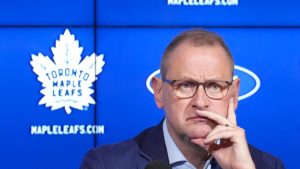
TORONTO — What seemed inevitable for much of this Toronto Maple Leafs campaign became reality Monday evening. The Brad Treliving era in Toronto has come to a close. Now, only uncertainty remains.
As the club’s lost season approaches its final weeks, the Maple Leafs’ brain trust is turning its attention to the future. Much is still to be determined. At the heart of it is the fundamental question of who continues on past 2025-26. Treliving’s time has come to an end. It’s a fair bet head coach Craig Berube will soon follow. But a decade into an era that’s brought only two post-season series wins, some have questioned whether we’re reaching the point at which deeper surgery is required, whether Toronto’s star-studded core has run its course, too.
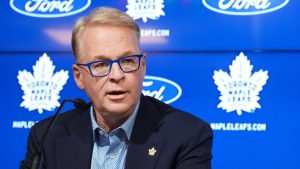
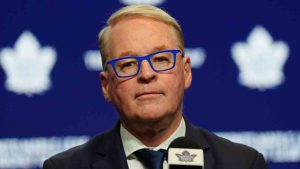
Tuesday afternoon, the man tasked with providing some direction for this wayward franchise — Maple Leafs Sports and Entertainment president Keith Pelley — took to the mic to shed light on the state of the organization. Asked about the path ahead, Pelley showed no desire to significantly upend the top of the Maple Leafs’ lineup.
“A rebuild is needed when you are starting from scratch. We all know the Toronto Maple Leafs have foundational pieces in place,” Pelley said in a press conference held on the Scotiabank Arena concourse. “If we’re able to surround them with the right culture, with the right structure, with the right personnel both on and off the ice, then I would say that we would be in a retool, not in a rebuild.”
Speaking to the gathered media after the press conference concluded, Pelley doubled down, making clear he believes righting the ship involves continuing to build around Auston Matthews, William Nylander, Matthew Knies and John Tavares.
“We have generational pieces in 34, in 88, in 23, in 91. We have strong goaltending. There’s a lot of positives,” he said. “We now just have to surround those individuals with better pieces, and that will be a decision and the task of the new head of hockey operations.”
Pelley spoke at length Tuesday about the club’s search for that new hockey operations leader. No decision has been made on exactly how the club will structure its front office moving forward — the MLSE president said the organization could hire both a general manager and a president of hockey operations, or may amalgamate the roles into one. However, there is one specific requirement the Maple Leafs will be focusing on in their GM search.
“They have to be data-centric,” Pelley said. “They have to really understand data and the importance of data and where data is moving. We have just completed a complete rebuild of TFC, all using data, combined with cultural checks. That’s what we will do — every single decision that we make will be evidence-based.
“Evidence-based decisions are never wrong. That’s not to say that there’s not room for the heart, that doesn’t mean that there isn’t room to check culture, but it’s evidence-based.”
Pelley heaped praise on Eric Tulsky when asked about the Carolina Hurricanes GM — undoubtedly the most data-focused manager operating in the league — and said the organization is similarly open to hiring a new leader without prior GM experience if it means focusing the organization around this approach.
“It all depends on what the structure is,” Pelley said. “Eric Tulsky obviously has a very decorated background in terms of data and he certainly has a level of intelligence that is beyond the norm in that particular area. … Everyone now has access to data, and everyone’s going to have access to AI — it really comes down to how you utilize it, and how smart you are with it. Eric Tulsky is very smart with it. But Eric Tulsky also has strong hockey people with him.
“I’m open to any structure. However, I can tell you that you need strong hockey operations people, with strong hockey backgrounds, that are going to make key critical decisions on the future of the Toronto Maple Leafs.”
More than a few times Tuesday, Pelley spoke of a lack of “alignment” between the different factions of the club’s front office this season, and the need to rethink the overall structure of the organization. That said, he made clear he does not intend to be a central part of the Maple Leafs’ brain trust himself.
“I’m not here to be a scout, I’m not here to be a coach, I’m not here to be a general manager, and I have no desire on giving any input on who should play left wing,” he said. “I am here to create the overall vision, the strategy, put the structure, put the process, put the pillars in place, to develop the right culture for us to have a winning and contending team year after year.”
The fate of the club’s head coach would seem to be crucial in determining how the club’s culture will or won’t change moving forward. Pelley said Tuesday that the decision regarding the coach will fall to whoever is tabbed to lead the team’s front office. As for shifting the culture in the dressing room, that will be a more complicated process to navigate.
“I’m not in the dressing room on a daily basis, so I can’t talk about the culture inside the dressing room. … (but) I think culture goes through an entire organization. I don’t throw around the word ‘accountability’ lightly. It’s critical,” Pelley said. “You have to have a culture in place where you can have courageous conversations with everybody in the organization, and the first reaction is not defensive.
“You saw it last year with the Blue Jays. They had all the pillars in place — the pillars of being able to have open conversations, the pillars of having accountability, the pillars of having a team ethos, what you stand for, what you believe in, what wearing that Toronto Maple Leafs jersey means. All of that leads to the culture.
"Some of the things that happened this year shouldn’t happen in the Leafs’ culture. And it won’t, going forward.”
Some would argue that the Maple Leafs’ culture has been shaped largely by the stars who’ve led this era in Toronto, that significantly changing that culture will be difficult while the core of this team remains unchanged — a core that has won little over the past decade, with different coaches and managers at the helm, with different iterations of groups built around them.
Still, Pelley stood firm in his belief that the path forward depends on building better around this veteran core.
“I don’t think you can pin that on the foundational pieces,” he said of the club’s lack of post-season success. “I think to be successful, you need to be a full-rounded team. Florida’s a perfect example of that. … You can’t just have one or two superstars and expect to win a Stanley Cup. Everything has to be firing on all cylinders. That means everything from on-ice to off-ice. And we’re not there yet."
The path to getting there seems murky, still, especially if significant roster surgery doesn’t appear to be on the table. The Maple Leafs have been mired in years of half-measures, tweaking here and plugging holes there. Now comes a crucial opportunity for more decisive change.
“We all know that we need to acquire more draft choices, we need to acquire more prospects,” Pelley said. “We have to find a way to increase and improve that lineup. And we need to do it rapidly. But we have the foundational pieces in place, which gives me the confidence that we can contend very quickly.
“If we put the right person in place, with the right structure in hockey ops, then I’m convinced we can do it.”