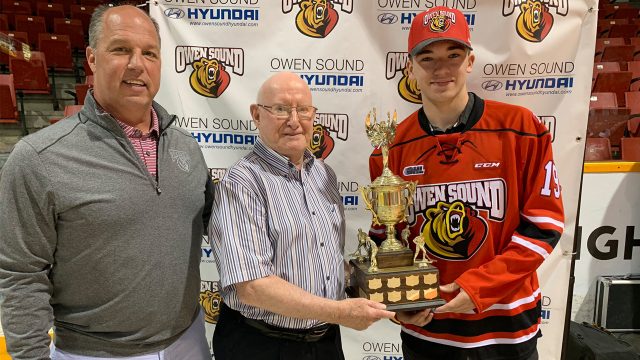
Ray McKelvie did more to bring and keep major junior hockey in Owen Sound than anybody, so it stands to reason he basically never missed a Platers or, later, an Attack game. But invested as he was in the clubs, he was prone to missing chunks of the action.
“His seat was in section T, which is just inside Owen Sound’s blue line, right across from the press box,” says Ray’s grandson, Mark McKelvie, who is always up in that box providing the play-by-play call. “Many second and third periods, we’d be a minute or two or three into the period and he wouldn’t be in his seat. Sure enough, I’d find out after he just got caught talking [and would realize], ‘Oh, they dropped the puck, I gotta get back!’
“You could kind of say he was like the most popular kid in school.”
All the love Owen Sound and its sports community had for Ray was reciprocated and then some. Just over six weeks ago, on Dec. 1, McKelvie died of cancer at the age of 88. Regardless of the state of his health in his final years, though, McKelvie remained a fixture at Attack games basically until the day he passed.
“On a typical Saturday he’d go down to the arena in the morning, make sure everything was in order, see how the ticket sales were going. They’d get everything ready for that night,” Mark says. “He’d come home and he was just itching to get back to the arena. It wasn’t too often you’d catch him taking a nap in the afternoon ahead of going back to the rink; he just wanted to get back down there and he’d head back several hours before the game.”
It's safe to say there likely wouldn’t be any major junior games at all at the Harry Lumley Bayshore Community Centre if not for the accountant by trade who was the driving force behind the Platers moving from Guelph to Owen Sound in 1989. McKelvie was running the Jr. B Owen Sound Greys at that time, but knew in his bones the small-by-OHL-standards town he called home could take it a step further. “He was hellbent on figuring out a way to do it,” says Dale DeGray, the Attack’s general manager since 2007.
The path to his goal meant convincing the Holody family, with whom McKelvie had a pre-existing relationship, that shifting the Platers two hours north to Owen Sound was a venture that could work in the face of wider skepticism. McKelvie was basically involved in every aspect of the club through the 1990s and when the Holody family was ready to sell at the end of the decade, McKelvie — who had a minority stake in the club —once again moved heaven and earth to find the local investors who would keep the team there and re-brand it the Attack.
“I think he knew if Owen Sound lost that team, the city was going to lose a bit of its identity,” Mark says.
Instead, the squad stayed, as did McKelvie in the role of business manager. When DeGray was approached about leaving his job as an area scout for the Florida Panthers and taking the reins of the Attack, he kept hearing the same thing in the discussions leading up to his hiring: You’ll have to meet an older gentleman who works in the office.
“Of course, I found out who he was,” DeGray says.
DeGray lost his dad when he was just 21 years old, and McKelvie filled a role for him — if not a father figure, than certainly a mentor. The GM would use him as a sounding board, drawing on the man’s decades of experience in the game. “One of the things we talked about a lot was just the people in Owen Sound: What they like; what they want; why do they come?” DeGray says.
MORE FROM SPORTSNET


Their daily conversations certainly extended beyond the nuts and bolts of running the Attack. A fellow people person, DeGray would ring McKelvie up in the middle of the day just to tell him he was having an egg-salad sandwich, knowing it was the old man’s favourite. McKelvie might well at that point tell DeGray about a 10-year-old kid he saw playing baseball or lacrosse the day before. Major junior may have been what he was most associated with, but his support for sports ran the spectrum and extended right down to the grassroots. If someone in the coffee shop told him their niece was playing soccer the next day, there was a good chance Ray and his wife, Georgina, would make their way over to the pitch.
“Silently, a lot of the times behind the scenes, he was doing his best to help support some of those athletes to make sure they had equipment or they could pay their registration,” Mark says.
Though Ray’s manner with people was anything but quiet, if you were around him enough, you could see his disposition change in the aftermath of losing Georgina nearly two years ago. “They were just soulmates,” says Mark. “You definitely could tell he lost a piece of [himself]. His attitude never changed; he was always very positive and outgoing. But you could tell, just the little things, those quiet moments that something was missing. It was really tough on him and I think it’s safe to say if it hadn’t been for the Attack and having hockey in Owen Sound, I’m not so sure we would have got almost another two years with him.”
DeGray, who spoke at McKelvie’s celebration of life, is certainly saddened that he now has to change his answer to one of the most common questions he’d get out on the road. Inevitably, he’d be scouting a tournament and somebody with even the loosest association to Owen Sound hockey — maybe they played 15 games for the team 20 years ago — would approach him. “They would see the Attack logo and one of the first things they’d ask: ‘Is the older gentleman still working in the office?’” DeGray recalls. “I’d go, ‘Ray McKelvie?’ They’d say, ‘Yeah, is Ray still there?’ I’d say, ‘Damn right he is.’”