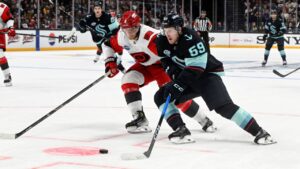
TORONTO — If the 2026-27 Toronto Maple Leafs were a weeklong getaway with the boys, they have already reached the sluggish morning of Day 6.
The giddy vibes, friendly chirps, and dreams of high-level adventure that fuelled excitement at the outset have given way to tired and banged-up bodies, hushed voices, and sober realities.
“Guys gotta look in the mirror and just ask a little bit more of themselves and take on a little bit more,” said Auston Matthews, far and away the club’s best and most pivotal player.
Urgency did not wait until the second quarter to strike a bottom-of-the-pack team in a smoking-hot division.
The Maple Leafs have dropped six of seven games with all the defeats coming in regulation. As a result, the Leafs have fallen to seventh in the Atlantic Division and have a worse record through 20 games (8-10-2) than last season, when they finished 28th overall.
A rebuild was not — and still is not — the plan here, and trading for immediate help feels unlikely considering the organization’s depleted assets and cap crunch.
The men in the mirror need to hop on a Q2 heater to keep pace with a league threatening to speed away from them.
“We’re all just trying to stick together,” said Easton Cowan, whose team hosts the Minnesota Wild on Thursday (7 p.m. ET, Sportsnet / Sportsnet+). “Little adversity here, quarter of the way into the season. So, better deal with it. Better to deal with it now than later. So, just got to keep pushing, keep sticking together.”
Most encouraging development: Papi’s back (pun intended)
Auston Matthews credits the longest summer of his NHL life — six-plus months from March’s MCL injury to puck drop — for granting him the time necessary to get not just his knee but rest of his body and mind in a better place for the rigours of the regular-season grind.
The captain assures this is the best he’s felt physically since 2023-24, when he ripped a career-high 69 goals and finished third in Selke voting.
The numbers and eye test back it up. The way Matthews is scoring goals (11) and racking up points (28), he ranks sixth overall in both categories. He’s winning faceoffs (54 per cent), setting the tone defensively (plus-9), and happily taking a mentorship role with superstar-in-the-making Gavin McKenna. He’s back to form, and the Leafs need him to stay that way.
Most concerning development: They’re not a strong even-strength team
It’s not mediocre goaltending or bad luck holding the Maple Leafs outside of the playoff picture. It’s that they are generally on their heels when it comes to controlling play, dominating possession and dictating pace. It’s that they transition poorly, are prone to careless errors, and can’t lock down chaos in their own end.
No Eastern Conference team has given up more goals at 5-on-5 (50), and the Leafs’ under-the-hood metrics paint a less-than-kind picture.
With the injury bug nipping them and otherworldly special teams easing back down to earth — eight power-play goals allowed and only one scored in their past eight games — this 5-on-5 mediocrity has combined with untimely turnovers and penalties to keep the Leafs out of the win column.
Top-six forwards: Grade B-
Matthews has been a refreshing revelation. Speedy running mate Jack Roslovic is off to the best start of his six-team, 11-year career. William Nylander is producing a shade below a 100-point clip yet is still a minus-7 player. And while Kirill Marchenko and John Tavares have been as expected, both missed significant time in Q1 with lower-body injuries.
When healthy, Toronto’s top line, driven by the Matthews-Roslovic combo, is elite. Ditto the power play. But coach Jim Hiller’s second line remains a work-in-progress through 20 games. The aging Tavares and confounding Nylander, the battery of Line 2, are simply giving up way more than they produce — despite their heavy O-zone deployment.
Bottom-six forwards: C
“We need guys to step up,” Hiller announced amid the club’s current 0-4 homestand. “That’s the bottom line. You need your top players to continue and then you need (help) from underneath, whether it’s Gavin (McKenna) or Cowboy (Easton Cowan) or I could go down the lineup. But you just need these other guys, who contributed pretty good so far this year, to keep going. It’s a lot to ask those young players, but we need them.”
Sophomore Cowan has spelled into the top six and is tied for third (with Nylander) on the Leafs with 14 even-strength points. McKenna, 18, sits atop the rookie scoring race with 13 points.(Counterpoint: McKenna’s dash-11 rating is second-worst among freshmen.)
We’re not putting Toronto’s lack of second-wave offence on the two youngest Leafs. None of Colton Sissons, Nick Paul, Brandon Duhaime, Dakota Joshua, Teddy Blueger, Zack MacEwen, and Dakota Joshua are on pace to chip in more than eight goals all season. Many of these role players are strong penalty killers and decent checkers, but the team allotted a big chunk of cap space to forwards who struggle to produce.
Defence: D+
The NHL’s oldest defence corps is showing its age, allowing a division-worst 3.45 goals per night.
Morgan Rielly, 32, was quietly enjoying a nice bounce-back campaign until falling to a non-contact injury. The respected and effective Chris Tanev, 36, is battling health issues again, to the point where the team has instituted load management. And Oliver Ekman-Larsson, 35, and Jake McCabe, 33, haven’t performed nearly as consistently as they did last season.
Darren Raddysh (23:54) and Troy Stecher (19:07) have provided maximum minutes but are being leaned on for too much. Overtaxed and slowing down, Toronto’s D struggles with clean zone exits and against the rush. They aren’t fleet enough to cover active offences with their man-on-man strategy.
That outside of Stecher (two goals), not one of the Leafs’ top six defenders has a plus rating — nor had scored until Raddysh’s bomb on Tuesday — is also worrisome.
Goaltending: C+
Sergei Bobrovsky has probably been shouldered with an unfair portion of first-quarter blame. That he has allowed three or more goals in 12 of 13 starts, has gathered only three wins, and routinely allowed the untimely goal, though, is ample ammo.
When you zoom out, Toronto’s team save percentage of .883 rates 21st league-wide. (The NHL average is .891.) Subpar, no doubt, but better teams like Anaheim, Utah, Tampa Bay, and Washington are all getting by with worse.
Bobrovsky and his 5-2 backup Anthony Stolarz — looking generally excellent in lesser usage — aren’t the only reasons Toronto is scuffling.
The oldest tandem in the league operates in a challenging environment; the goalies need to elevate to a Grade A if this team is going to make the postseason.
Quarter-mark awards
MVP: Auston Matthews
Most improved player: Auston Matthews
Best defensive player: Troy Stecher
Best newcomer: Jack Roslovic