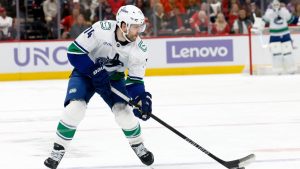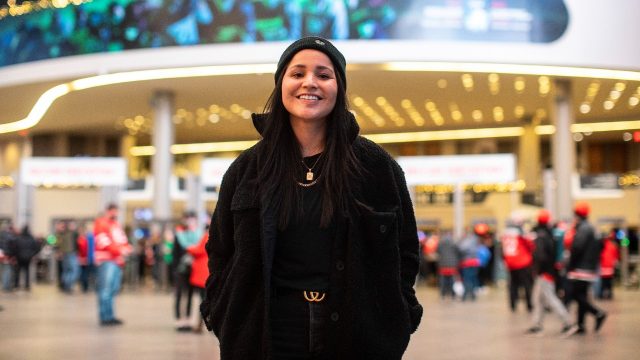
A day after the NHL celebrated the league’s best in Nashville during the NHL Awards, the league announced an investment in the game’s future.
The National Hockey League and National Hockey League Players’ Association are coming together to launch the NHL Player Inclusion Coalition. The coalition is a group of current and former men's and women’s professional hockey players working on equality and inclusion initiatives. The NHL and NHLPA have set aside more than $1 million to support grassroots organizations and player-perspective storytelling.
The co-chair of the group are alumni turned broadcasters Anson Carter and P.K. Subban, who are joined by 18 other members, including Ethan Bear, Blake Bolden, Zach Whitecloud, Ryan Reaves, Meghan Duggan, Sarah Nurse and Georges Laraque among others. The coalition was initially launched in 2020 as the NHL Player Inclusion Committee.
During a recent episode of the Going Deep podcast, I caught up with two other members of the coalition: Brigette Lacquette, the first Indigenous player to represent Canada’s women’s national team in Olympic competition; and Mark Fraser, who currently works for the Toronto Maple Leafs as Manager, Culture & Inclusion.
This conversation was edited for brevity and took place before NHL commissioner Gary Bettman announced that NHL clubs will no longer be wearing specialty warm-up jerseys on themed nights, including Pride Nights.
Theoretically, the controversy we’ve seen around Pride jerseys and the more important response beyond jerseys to equity-deserving groups within the sport are the types of things this coalition can have influence over.
MORE FROM SPORTSNET


Each coalition member has selected an organization that supports diversity and inclusion in hockey to receive a $5,000 in grant money from the NHL Player Inclusion Coalition Action Fund.
Fraser selected the ever-popular Seaside Hockey, a program that aids visible minority youths in the Greater Toronto Area to help more diverse children play hockey and gain life skills.
Lacquette is supporting Siksika SN7, which provides hockey programming in Siksika Nation, which is located in southern Alberta, just east of Calgary.
Sportsnet.ca: What is the need that is in your mind being addressed by the coalition?
Mark Fraser: In reflecting certainly over the last few years of where hockey's been (and) where we want hockey to be able to go, there's a lot of growth. There's a lot of education still needed.
And to be able to have, importantly, a player perspective to solve some of these problems and how to be able to grow the influence that our game can have and the opportunities that it provides.
When we're talking about trying to grow our game and to be, more inclusive and have diverse perspectives be considered more often, there's no need to wait. Now is the time.
There was a player inclusion committee previously. What tangibly is the change from shifting from a committee, that was meeting internally, to having a more public-facing inclusion coalition?
Brigette Lacquette: It's having a platform.
It's having that communication, not only with our immediate circles, to have more of an outreach. The committee has done a great job within terms of diversity inclusion across North America.
Like Mark said, we have a ways to go, there's a need for inclusive spaces.
SN.ca: There's a fiscal part of it as well, the tangible resources that have been earmarked.
MF: That's one of the great parts of becoming a member of the coalition is. The first message you get is, there's now a $5,000 grant going to a community group of your choosing. We now have the opportunity to choose things that are personally connected to us.
Whether they identify like us or not, just the fact that the first thing we get to do is make an immediate investment, is literally putting our money where our mouth is.
And so I'm happy to be able to contribute in that sense. We've all grown up in the game, we've all been able to, whether through privilege or not, understand what barriers and challenges are out there for the youth who do look like us.
I think that's just a great initial way to make an impact before we actually get into any of the planning or advising that we could maybe serve, for the league.
SN.ca: Tell me about the group that each of you chose and why.
BL: Siksika SN7, a nation, just outside of Calgary. Since moving to Calgary in 2016, I've had nothing but support from the surrounding nations, even though I'm not, originally from them.
It's a way of being able to give back. And especially with the program, it's totally youth run. They've done an outstanding job so far. I want to be able to help them in any way possible.
It's definitely very special.
MF: I chose Seaside Hockey. They're a Toronto-based organization that works primarily with the Black and racialized youth, giving them mentorship, giving them hockey skill development. It's an organization that completely subsidizes the ice, the equipment, everything that the Black youth or racialized youth would need to be able to just have the opportunity to hop on the ice and learn this sport.
And I just think that's such a beautiful thing. That's not an easy thing to accomplish. And then obviously needs support from partners and needs funding to be able to provide such opportunity to the kids. I've been fortunate to be able to work with Seaside in other ways and know their founder, Kirk Brooks.
The socioeconomic challenges are something, to be honest, I do not have a solution for when it comes to the game of hockey. So just knowing that there's organizations out there that are completely trying to remove that financial barrier, to allow other individuals to just grow up with learning the game, and having the opportunities that Brigette and I and others have had through this sport, is why I chose Seaside.
SN.ca: What sort of unique challenges are there on the female side of the game that the coalition might be able to address?
BL: Obviously it's the equalization of the sport and, especially with the group that I've been a part of — the PWHPA — been striving to make a women's league that has high talent, high performance and treated like professionals.
Obviously, hockey is, for lack of a better term, a white man's sport. Growing up as a female and Indigenous, it was pretty tough. It was pretty tough to go through the minor-hockey system and then have to try out for teams and everything like that.
SN.ca: So tangibly, what does that look like moving forward? Is there a cadence in terms of how often the coalition will meet? Are there specific events or times of the year that the coalition is focused on?
MF: Connect with each other consistently on a monthly basis. We also generate new ideas for each other in a lot of the roles that we have right now within the game. An example that I'm proud of: I was able to meet Meghan Duggan through this coalition and was able to leverage her. She's director of hockey operations and player development for the New Jersey Devils, U.S. team captain, and gold- and bronze-medal Olympian.
To be able to have her work with a different organization even, but to be able to work with Maple Leafs and the players and provide education heading into our Pride night, that's what, this group is capable of doing. What's really important as well for our players is they heard from a peer. But it wasn't a male peer. They were able to hear from someone who is very much looked at as an equal in our game.
Whether it's an event, whether it's hitting the community, whether it's bringing hockey and accessibility to the game, to the youth in different areas of North America and our markets where our teams are, and creating opportunities for us, sometimes to just collaborate on a monthly cadence. To be able to share ideas and think: where can the next growth opportunities go?
It's still somewhat in its infancy of what we can really contribute to, to be honest. The sky’s the limit of what we're capable of doing and influencing. And creating and inciting change throughout the league, the union and the sport in general.
SN.ca: There's been a bit of an aversion to speaking on issues around diversity, inclusion in the game. Is that something that the coalition can help navigate in terms of best practices and approaches?
MF: I certainly think so.
You're asking a lot of people to change. You're asking a lot of people to consider new perspectives that they haven't before. You're asking an entire institution not to completely dismantle itself, but to consider new practices and perspectives that they've never had to before. And that means change.
And change, understandably for many, is difficult. So being able to come up with ideas where we can serve this up and have conversations, and participate in leading training for teams or for individuals, or for different organizations in a really digestible manner. That's the important part. And that's why I think it's important for individuals like Brigette and myself, having the player perspective.
We know what it's like being in a locker room and trying to be coached on something. We understand that, what that feeling of team really feels like. And we also can appreciate what it's like to understand particular teammates' experiences or negative experiences that we might not have had understood before, and how that can create learning opportunities.
It doesn't need to be really classroom-like and formal and dry. And it can be dry in this topic at times. I think we bring a really unique perspective of … we all have the lived experience of being in the locker room at an incredibly high level. And pretty much everywhere we would've walked into professionally, we were always the only one.
And so, having experience with that I think, yes, this is a fantastic group to be able to leverage our experiences and resources. To be able to educate and to be able to deliver such messaging that will a hundred per cent take a lot of time to really see the fruits of its labour when it comes to building a new systemic practice or change. And changing fixed mindsets to growth mindsets.
But again, who better else than the folks who have been there, done that and had experiences that you can't read or write about? We've lived it.
SN.ca: Moving forward and looking forward in 10, 15, 20 years, what are the measures of success for the Inclusion coalition?
BL: Working with the youth for the last five years and since making the Olympic team, that's kind of when my platform, … because I became the first to make the national team. And it wasn't something that I had asked for or dreamed of doing.
So, the way I measure my impact is reaching out to one kid. If my message is able to reach one of the kids in these First Nation Indigenous communities.
That is success. It wasn't until, I think it was just recently, I had this interaction with this young kid out of Fort Frances, Ont. The kindest kid made such an impact on myself and my partner.
He didn't have any equipment or anything like that, but he wanted to be a part of the camp. And he was just biking by and he was curious as to why we were out there playing games. And the kids were like, 'Oh no, you're not part of the camp.'
And then my partner, who was running the office, was like, 'Oh no, you can be a part of the camp.' He was like the light of the entire camp. Every room that he walked into, he just had a smile on his face.
Even beating us to the rink and then being the last one to leave. It was adorable and I felt so inspired, you know? It was just, it was such an incredible feeling, empowering feeling. So just making impacts like that and being able to influence any kid with our message or with what we want to do moving forward.
There's nothing like that feeling. So that's how I measure my success.
MF: Working in this space 365, it's sometimes hard to articulate or measure what success looks like, or at least hard to quantify it.
What I envision honestly, if I'm being real and then I were to close my eyes and think, what does success look like? It's being able to walk into a minor-league hockey arena or a professional hockey arena and have the audience, have the environment, have it feel like the other spaces I walk into, like our schools or our malls, our shopping centres, where there's just diversity all around.
We are all of us working on this. Again, whether you're the first or you're the only one that was in the room, seeing more of that around is how we get there. There's a lot of different ways to get there. But when I happen to be in Toronto, it's the most diverse city in the world. But when I come to work, it is not at all reflected that way.
Success for me is when I can sit back and bring my kid or a friend to a hockey game and the environment, the energy, the celebration of individual personality, enabling that to shine through, the expressiveness that we'll want to encourage and, just you be you.
And we're not trying to all march in the exact same beat of the same drum and look the exact same and have to dress the exact same and all these various things. The worlds all of us live in, a lot of us have been the only one.
But when we go outside, we might still be a minority, but we're certainly not the only one we see ourselves representing all over the place. Be reflected in the game of hockey is what success looks like to me. To Brigette’s point of the impact you can make in just one individual life.
I want to bring a six-year-old biracial Black kid to their first Leafs game. And then I want to hear 40 years later them saying, 'I've been coming to Leafs games since I was six years old.' That's what I want to see happen. We know the fandom is there. We know because we love the game and all of us are part of the game. We know the fandom is there, but the connection from fans into the arena, to be confident that this is a space where they're welcomed, where it's familiar to them, where the music, the food, the merchandise speaks to them, and not singularly to an older white audience or demographic.
That's what success looks like to me. When I can be in a Toronto Maple Leafs game and the audience feels and looks like a Toronto Raptors game and the city that Toronto is, that's what success will be for me.