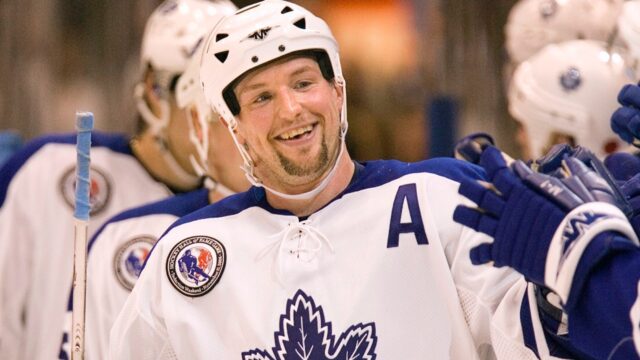
Over the course of my NHL career, I’ve been fortunate to work alongside some outstanding people. I’m extremely lucky to have been mentored by David Poile, Dale Tallon, Nick Beverley, Scott Luce, Erin Ginnell, Al Tuer, Brian Skrudland and Chris Pronger, to name a few of my past colleagues.
It’s an impressive list of executives and former players, but the person I became closest with over the years is former Maple Leafs defenceman, and former Director of Player Personnel/Development with the Panthers, Bryan McCabe.
McCabe joined the Panthers after my first year with the club in the summer of 2011, breaking into our player development department as an assistant to Skrudland. To say our players were fortunate to have two former Panther captains guiding them through their introduction to pro hockey is an understatement. Eventually McCabe took on the role of Director of Player Development on his own after Skrudland slid behind the Panthers’ bench as an assistant coach.
Fast forward to today and McCabe finds himself poised to take on the next challenge in his NHL executive journey after declining an extension to remain in Florida when his contract expired on July 1. He’s a two-time Stanley Cup champion who has travelled the world identifying up-and-coming talent and helping develop future NHL players from junior, college, and minor pro ranks.
As the new season inches closer, I had an opportunity for an exclusive sit down talk with McCabe to have an honest discussion about his NHL executive journey and what he hopes to accomplish at the next stage of his career.
Jason Bukala: How soon after you retired did you start to plan the next phase of your hockey career in player development? How many years have you been involved in player development now?
Bryan McCabe: I’ve been involved for 15 years now and I’m looking forward to my 16th. Time flies.
When I retired, I wasn’t sure what I wanted to do exactly, but about six months into retirement as a player I ran into Dale Tallon and he asked what I was up to, what I wanted to do in hockey, and if I had interest in coming on board in Florida. Initially I shadowed the pro scouts, amateur scouts and the player development departments. I decided player development is what interested me most, which led to Dale officially hiring me.
JB: Looking back on the past 15 years, who would you say mentored you the most for your new role?
BM: I consider myself fortunate to have worked with Brian Skrudland. As you know he is one of the most passionate people you will ever meet. The way he interacted with prospects was exceptional. He taught me a lot about the importance of the role and how to plan and communicate with our prospects.
JB: What has changed the most over the years in relation to player development? Have you adjusted your approach?
BM: The core values of my approach haven’t changed. I would say the process the players go through before arriving at the pro level has certainly evolved but, honestly, I pride myself on building trustworthy relationships with our players. I take time to get know what makes each player “tick” and understand they are going to have good days, great days and bad days. I’ll give them a hug when they need it, but there are moments when they also need a reality check. It’s part of becoming a good pro.
One of the areas I have evolved in is in analytics. I take time to incorporate data to back up “the eye test.” The prospect has to trust our process and I owe it to everyone involved to communicate what I am noticing. The amount of trust that goes into the process provides the core building blocks for player development.
32 Thoughts: The Podcast
Hockey fans already know the name, but this is not the blog. From Sportsnet, 32 Thoughts: The Podcast with NHL Insider Elliotte Friedman and Kyle Bukauskas is a weekly deep dive into the biggest news and interviews from the hockey world.
Latest episode
JB: Prospects today seem to have access to more inputs than, say, when you were a prospect. What stands out for you from a player development perspective?
BM: Prospects today, from a young age, have strength and conditioning coaches, skating and skills coaches, mental performance coach, etc. They are more prepared than they have ever been in many categories, but player development is different at the NHL level. The player and the development team have to evolve year over year and take stock of what’s working and what areas need to be addressed to maximize the potential of the player.
JB: What lessons did you take from your playing career into your role in player development?
BM: I played with some of the best players in the world at the junior level, NHL and Olympics but my strongest lessons came from my time playing in Toronto.
When I played for the Leafs we had some very good teams and were close to getting over the hump. We made some deep runs in the playoffs. The best players on our team bled character, hard work, intelligence and were awesome teammates behind closed doors. Mats Sundin, Wendel Clark, Doug Gilmour are examples of the players I’m describing. They always had the good of the group in mind and would commit to whatever was necessary to push the team towards success.
JB: What stands in the way of a prospect maximizing his ability once he turns pro?
BM: Identity. It’s the biggest hurdle a prospect has to overcome once he arrives in an NHL organization. I’ve had several hard discussions over the years with prospects who have been captains, top point producers, first-unit power-play contributors etc. But the reality is there are only so many spots for those kinds of players on an NHL roster. If a prospect isn’t competitive in all facets of the game and doesn’t buy into the idea of evolving other areas of his game, he’s not likely to have a long career. They need to evolve, but that’s also part of my job. I need to understand what makes them tick and tap into those resources to push them along.
I’m speaking from experience when I provide direction to the prospect. I was an offensive defenceman but what made me a better pro was my competitiveness and edge. I had to embrace some change and add layers to my game to find my “fit” at the NHL level.
JB: After 15 years in player development is there a prospect/current NHL player who stands out for you in regards to their journey and the sacrifice they made along the way?
BM: The player who went through all the ups and downs is MacKenzie Weegar. You guys (scouting staff in Florida) selected him late in the draft (seventh round, 206th overall in 2013) after he had a strong year playing for Halifax.
When ‘Weegs’ first arrived at our development camp he was out of shape and out of place. He was coming off a junior season that resulted in points and he logged a ton of ice time, but his defending detail needed a lot of attention. He went back to junior for one more season before turning pro but spent almost a full year in the ECHL. He slowly started to buy into the process, was an ECHL All-Star, put in his time at the AHL level and eventually worked his way up to the NHL as a full-time contributor. It was so rewarding to see Weegar evolve. The way he matured as a pro was incredible. His professional wisdom that he learned along the way has resulted in a fantastic career. He does it all. His fitness is unreal, he’s deployed in all situations, contributes offensively, fights and he’s an outstanding teammate. He’s the poster child for perseverance.
JB: Looking back, what are some of your career highlights as an NHL player and executive so far?
BM: Playing my first NHL game and scoring my first NHL goal will always be highlights. I felt rewarded for my hard work and I always dreamt about being an NHL player. Another highlight was being named to the 2006 Olympic team. I set a goal to make that team and being named was a huge honour. As I mentioned earlier, my time in Toronto was my most rewarding as a player. We didn’t win a Cup but those deep playoff runs with that group were incredible experiences.
As far as my executive career goes, winning back-to-back Cups in Florida are obvious highlights. Defeating Edmonton in seven games to win our first Cup in 2024 was really special. We went up 3-0 in the series before the Oilers fought back to force Game 7. The way our group found a way to buckle down and win Game 7 is something I will never forget. That victory set us up for the following year. We knew we could overcome pretty much anything and we went on to win our second Cup.
JB: I appreciate you taking the time to speak with Sportsnet. In closing, what does the future hold? What are your future goals as an executive?
BM: I would obviously love to win more Stanley Cups! I loved my time in Florida but time had arrived for me to make a change. I’m looking forward to the next challenge and joining a new organization, getting to work alongside some new teammates and new prospects. I feel like I experienced the lowest of lows and the highest of highs in Florida and I’m better prepared for my next challenge as an executive because of it.
I’ve worked with some incredible people over my career, but I’m now at the stage that I want more of a challenge. I would like to work my way up the ladder and continue to evolve as an NHL executive. I’m looking forward to embracing something new and something more.




 0:25
0:25