Over the past week, I’ve spent some time looking at the Canadian NHL teams that failed to qualify for the Stanley Cup Playoffs and peered into what their options might be at the draft. I started with the Calgary Flames and followed up with the Vancouver Canucks.
Today, I’m looking at the Winnipeg Jets.
The Jets missed the playoffs for the first time since 2022 and, as of today, hold the seventh overall pick. That could still change at the draft lottery on May 5, where the Jets could still move up as high as the No. 1 overall slot, or fall no farther than No. 9.
WINNIPEG JETS OUTLOOK
Winnipeg had a down season in almost every statistical category compared to 2024-2025.

Their middle- and bottom-six forwards weren't able to produce the amount of offence or defend the way I had envisioned they could at the beginning of the season.
Nikolaj Ehlers signing in Carolina last summer created a hole and meant a player like Cole Perfetti, for example, had to produce more than he previously did. Perfetti’s 32 points, combined with a minus-9 rating, fell short of expectations.
Making matters even worse was the steep drop in overall detail from the top players in the Jets' lineup. Here’s a look at who their top scorers were this season:

Scheifele reached 100 points for the first time in his career and Kyle Connor just missed out on reaching the 40-goal plateau for a second straight season, but what really stands out is the fact that Winnipeg's top scorers were a combined minus-17 this season. Last year, their top five scorers were a combined plus-69.
In 2024-25, the Jets averaged 3.35 goals per game, had a 28.9 per cent power play and a 79.4 per cent penalty kill. This season, the Jets only averaged 2.79 goals per game, an 18.5 per cent power play and a 77.6 per cent penalty kill.
Their top five scorers still produced a similar amount to last year (370 points last season vs. 351 this season), but their defensive metrics fell off by 86 goals in the wrong direction, and the production behind them fell off a cliff.
It’s one thing to count on your scorers to contribute offence, but the Jets' leaders also have to play with more consistent detail defensively for a team that believed it had a chance to contend for a playoff spot.
Draft board and strategy
As it stands today, here's how the Jets' draft pick lineup looks for the next three years:
Note: Winnipeg doesn't have its own fourth-round pick this year, but do have a conditional one from the Luke Schenn and Logan Stanley trade with Buffalo. To complete that deal, the Jets will get whichever pick is the better one between Buffalo's and Edmonton's.
As far as the first round goes, if the Jets just stick with the seventh overall pick after the draft lottery, they will be staring at some very good players. Their options will include a mix of forwards and defencemen with a wide range of skill and size.
However, the team might be considering other options here, too.
Connor Hellebuyck’s comments on clean-out day certainly grabbed the attention of Jets coaches and management, and perhaps that will motivate them to find ways to improve the roster immediately this off-season. But Winnipeg needs to be careful navigating its draft capital in relation to the current roster.
I certainly understand the urge to investigate which teams have interest in the seventh overall draft slot. Trading that pick could land a very valuable NHL player in return, who could help with the “now” that Hellebuyck is talking about. However, in my opinion, Winnipeg needs an up-and-coming top-end forward or defenceman they can build their next wave of contention around.
The Jets can try to add to their team in other ways without sacrificing draft capital and team control over a young prospect who could be with the organization for years to come.
For example, free agency might help bring in a player to assist with their current shortcomings. It’s not a deep class, and the Jets might have to overpay to land someone, but I’m recommending they try to go that route.
The way I see this team, they need to keep their first-round pick and add a prospect this June.
All of the following prospects play the game fast and can be relied upon in a variety of roles:
Players to target at seventh overall
Viggo Bjorck, 5-foot-10, 172 pounds, right-shot centre, Djurgardens (J20/SHL)
Bjorck was outstanding for Team Sweden at the world juniors over the Christmas holidays, where he produced 3G-6A in seven games. He was deployed in all situations and never took a shift off. The same can be said for his overall approach at the pro level, playing for Djurgardens in the SHL. His offensive numbers don’t jump off the page like his teammate Ivar Stenberg’s, but he projects to contribute offence similar to Ehlers, he plays centre and he can kill penalties.
I value Bjorck's relentless approach. He has the type of 'A’ and 'B' game that Winnipeg could use in its top-six.
Here are two examples of what Bjorck can provide. Both clips have been identified from his games played at the pro level in Sweden.
The first clip displays Bjorck's attention to detail off the puck defensively, his ability to read how plays are developing, intercept passes, and his speed bursting up ice to finish the play:

The second clip also displays how Bjorck assists defensively and escapes from down low in the defensive zone, attacks off the rush and ends up as F1 on the forecheck before the puck ends up out of play:
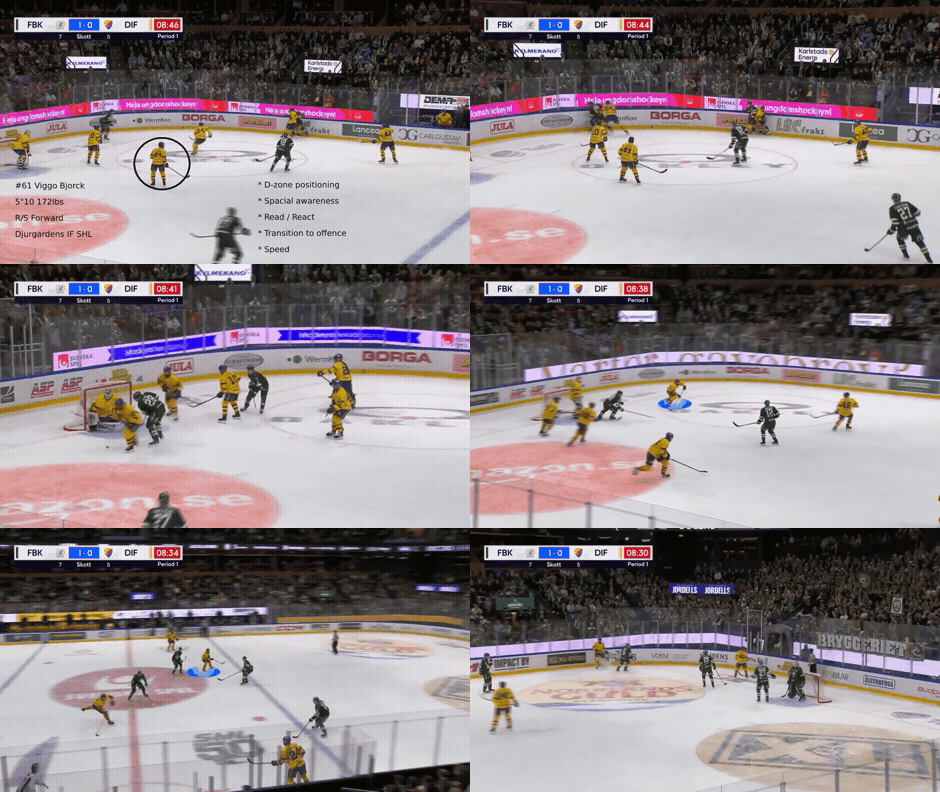
Note: Bjorck’s updated height and weight will be confirmed at the combine in Buffalo next month. He was listed at 5-foot-10, 172 pounds at the time these clips were created at the pro level.
Carson Carels, 6-foot-1, 198 pounds, left-shot defenceman, Prince George Cougars (WHL)
If the Jets are searching for a future top-pairing defenceman as Josh Morrissey edges his way towards his mid-30s, Carels is a prime target for the role.
Carels does it all at the junior level. He’s deployed in all situations, contributes offence (20G-53A in 58 regular-season games), and pushes back physically (66 PIMs). Carels is a fantastic skater who can escape pressure from the defensive zone and lead the rush, or use his small-area quickness and physicality to kill plays defensively.
As far as the Jets are concerned, it also doesn’t hurt that he’s a Manitoba native who hails from Cypress River. The stars could be aligning for Winnipeg when it comes to Carels.
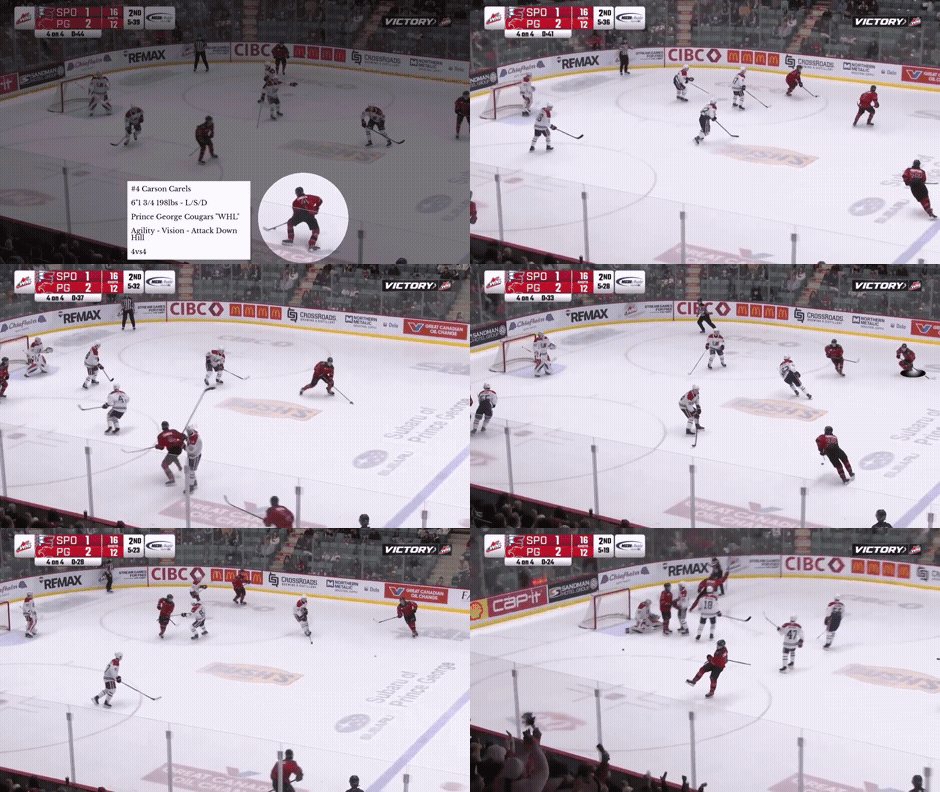
Here’s an example of how elusive Carels can be in the offensive zone. His agility and vision are on full display in this clip, including how he attacks the middle of the ice as soon as he sees an opportunity to snap home a puck from a high danger spot in the deep slot:
Daxon Rudolph, 6-foot-2, 206 pounds, right-shot defenceman, Prince Albert Raiders (WHL)
Rudolph is a highly coveted right-shot blue liner who can be deployed in all situations and has established himself as the top-scoring defenceman in the draft class. Rudolph contributed 28G-50A in 68 regular-season games playing in Prince Albert. Thirteen of his goals came on the power play. Rudolph is an excellent skater, sees the ice well and is a dual threat to distribute and join the offensive rush as an extra layer or beat goalies clean from distance with a hard and accurate shot. He could end up a top-pairing NHL defenceman as well.

Closing thoughts
The Winnipeg Jets could use a shot in the arm with a young, elite prospect joining their roster as soon as possible. Winnipeg has done a nice job securing some of their home-grown talent for several more years, but they have to convince themselves to move off of prioritizing veteran talent who are getting close to aging out of the league.
Any one of the three prospects I’ve proposed as targets for Winnipeg at the 2026 NHL Draft should be capable of competing for an NHL roster spot as early as next season.