With rookie tournaments wrapping up Monday and annual charity golf tournaments played on Tuesday, we’re out of the off-season and officially into the pre-season.
With physicals taking place Wednesday, some teams are beginning their journey towards a Stanley Cup parade, while others are beginning the “Battle for Bedard” and the first overall pick in next year’s draft.
The Colorado Avalanche look prepared to contend for back-to-back championships.
The Arizona Coyotes look positioned to be the front runners, along with Chicago, to land the first overall pick.
The Ottawa Senators are excited to begin the season with a revamped roster and have sights on making the playoffs next spring.
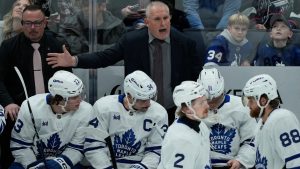
The Toronto Maple Leafs are all in and talking Stanley Cup contention…again!
The Edmonton Oilers went on a positive run in the spring and are looking to build off the experience.
The Calgary Flames had one of the most active summers of any NHL team in recent memory and look poised to contend.
We’re going to hear a lot of talk about fresh starts, or getting off on the right foot. But how do teams across the NHL prepare their training camps?
How do players, coaches and management strategize how to best be ready for regular season puck drop in October?
Here is some insight after speaking with some coaches, players, and hockey operations executives:
ON THE CLOCK
Some readers might already be aware of this, but NHL teams only have three hours of daily access to players at training camp.
They essentially clock in and clock out.
Teams coordinate their off-ice (fitness, video) and on-ice (skates) with the three-hour window in mind.
HOCKEY OPERATIONS
There was a time when most NHL teams had their scouting staffs in town to observe training camp and conduct pre-season meetings.
But with so few jobs being contested, mostly due to the salary cap, teams generally do not have their group come together for NHL main camp anymore. There are some exceptions. Some general managers like to have their pro staff attend camp to view their roster and meet to discuss potential fits from elsewhere in the league.
PTO’S
Unrestricted free agents looking to earn a contract will sign a Professional Tryout Agreement. Some interesting names on PTO’s around the league this year include: Sonny Milano in Calgary and Zach Aston-Reese in Toronto.
COACHES SET THE TONE
The NHL is a fast league. It’s a track meet. All teams are trying to play fast.
With that in mind, a former long-time head coach described his strategy:
“The goal for me and my staff is to set the tone of how we want to play as a group immediately. It sounds simple, but I want our teams to feel like they can play free in the offensive zone. Let their instincts and skill takeover. I don’t want them to be robotic or predictable.
“Conversely, the defensive zone and how we are going to defend is an area I will begin to work on from the first day of camp. Are we going to play man versis man in our zone? Are we going to press through the neutral zone (2/1/2 or 1/4)?. How is our battle game looking in the defensive zone? Do we need to engage in some 3-versus-3 battle drills to elevate our commitment?
“I want to establish our expectations as a coaching staff, but also do not want to slow down our practices. It’s important, in my view, to practice quick and fast. Do not spend too much time at the board. We should rarely have to come to a complete stop in a practice that might only last 35–40 minutes.
“Some of our special team strategies will be addressed in video sessions. We will set aside before practice time for our power play.
“Our goalie coach generally likes to work with his guys before practice as well.
“Players report to camp in phenomenal shape in today’s NHL. We set off-season standards for fitness. I can’t recall a single player reporting out of shape in recent years. In fact, these guys have got to the stage that we have to monitor and make sure they aren’t pushing their bodies over the limit. We need them for the grind of a full season.”
SKATERS
A former NHL player who played over 1,000 games in the league and is now working in player development described his preparation over the years as follows:
“As a player, a rookie especially, I was nervous as hell about testing! I wanted to be the hardest working player every day. I found a way to stand out. I was always talkative and tried to show leadership qualities.
“Once I was an established veteran player I was STILL nervous about fitness testing! I used my pre-season to get my timing back. I built my game up. It only takes three or four games to do that. I also made a point to include all the rookies in our team activities (lunches, dinners, etc.).
“In my current role I see things from a different perspective. I use camp as an evaluation to see where our prospects are in their development. It’s a great opportunity for teaching when a kid looks out of place or has put the cart before the horse.
“I want to see how kids react to the pressure of turning pro and their first camp. Who can handle the nerves. Who tries to do too much.
“The most important thing from a player development perspective is the message we send to the prospects when they get cut. How it’s relayed. Where he is going next and what our expectations are for areas of improvement.”
GOALIES
Former NHL goaltender Scott Clemmensen heads up the New Jersey Devils’ goaltender development and scouting:
“When I was a young player, my goal was to work my butt off every day and leave an impression on everyone. I wanted to prove to everyone I can play in the league.
“As I matured into an NHL veteran I treated camp differently. I wanted to make sure my game was in order through solid practice habits and exhibition games. I didn’t need to impress anyone. I just needed to prove that I was an everyday NHL goalie through my habits, preparation, and game performance. I wanted my coaches to know they could trust me to stop 25 out of 27 on a nightly basis for example.
“My biggest message to our prospects is they have to be ready. When you are young you better come to camp in shape and ready to prove to everyone what you are capable of everyday.”
GETTING STARTED
After their first skates on Thursday, teams will begin the exhibition phase of their training camps this weekend.
NHL rules for exhibition games state teams must dress at least eight veteran players.
Don’t be surprised to see young guns play like their hair is on fire, trying to stand out from the crowd, while veteran players strategize more and get their mind and body working at an NHL pace again.
Recognizing that some fans will be hyper critical of what they see early in the pre-season, it’s important to remember to zoom out. Perspective is key!