It’s hard to believe I’m entering the stretch drive in preparing for the 2026 NHL Draft. The season has flown by and the process of building my draft list has had its share of twists and turns.
The race for the No. 1 overall ranking has ping-ponged between three top players: Penn State forward Gavin McKenna, Frolunda forward Ivar Stenberg and North Dakota defenceman Keaton Verhoeff. With NCAA and European league playoffs already underway, and major junior playoffs on the horizon, my information gathering for this draft class is inching towards a conclusion.
With that, here is my updated rankings of the top 32 prospects, plus a few other prospects I'll be closely monitoring.
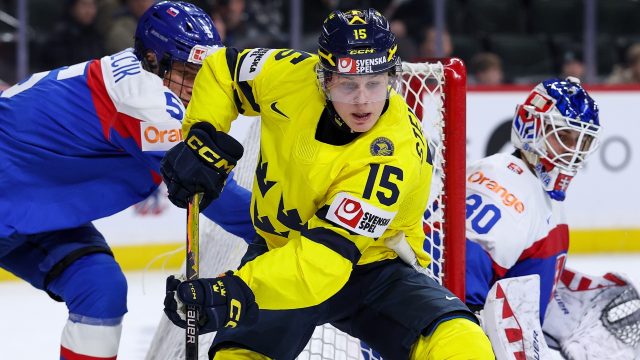
No. 1: Ivar Stenberg, LW, 5-foot-11, 183 pounds, Frolunda (SHL)
Stenberg’s production has slowed recently. He only produced three goals in his most recent 10-game segment, but his approach hasn’t changed. Stenberg was getting between 14-18 minutes per game in this segment, with all of his shifts coming at even strength or the power play. He didn’t kill penalties, but he has shown he is more than capable in the role over the course of the full season.
Stenberg’s three-zone detail is reliable. He never cheats the game defensively. Despite the fact his offence has been down recently, his plus/minus was even and he averaged 3.4 shots per game. His body of work this year has been exceptional. Stenberg has produced 11G-22A in 43 games playing in Sweden’s top pro league.

No. 2: Gavin McKenna, LW, 6-foot, 170 pounds, Penn State (NCAA)
For the first time in several months, I found myself really wrestling with my No. 1 overall ranking, and that’s because McKenna has addressed most of the concerns I've had about his overall game while launching his offensive impact into an entirely new level. In his last 10-game segment, McKenna produced 5G-13A, with 2G-4A coming on the power play.
He averaged over 24 minutes of ice time with the bulk of his shifts coming at even strength and with the man advantage. He very occasionally killed penalties. Over the segment McKenna’s rating was minus-2. He’s a dynamic offensive talent, but still has some growing to do defensively and it’s what continues to separate him and Stenberg at this stage of my process.

No. 3: Chase Reid, D, 6-foot-2, 195 pounds, Sault Ste. Marie Greyhounds (OHL)
Reid’s ranking has been on the rise since the beginning of the season and gained even more traction since the end of the world juniors. Reid is arguably the Greyhounds' most valuable player and one of the most impactful defencemen in the entire OHL. In his last 10 games he averaged nearly 26 minutes of ice time per game, including one game versus the Erie Otters where he was deployed for an incredible 33:20.
Reid has top-pairing NHL upside. He’s an outstanding skater who transitions pucks, joins the rush as an extra layer, quarterbacks the top power play unit, and pushes back physically.

No. 4: Keaton Verhoeff, D, 6-foot-3, 212 pounds, North Dakota (NCAA)
Verhoeff landing fourth in my ranking has less to do with the way he has performed this season and more to do with the uptick in trajectory from the players ahead of him. Verhoeff has top pairing, all situations, upside and potential to be selected ahead of this slot. He has adjusted admirably to college hockey after moving to North Dakota from the Victoria Royals (WHL).
He averaged 16:25 in his last 10 games, with the majority of his shifts coming at even strength and the power play. Verhoeff only contributed two assists in the segment, but what stands out is his plus-2 rating. He’s trustworthy, reliable and highly competitive.

No. 5: Caleb Malhotra, C, 6-foot-1, 182 pounds, Brantford Bulldogs (OHL)
Malhotra is part of the reason why the Brantford Bulldogs are one of the top-ranked teams in the CHL. He’s the second-leading scorer on a very deep team and is relied upon to contribute in a variety of roles.
Malhotra is a complete player. He got between 14-17 minutes of ice time and produced 3G-6A in his most recent 10-game segment, while illustrating the detail he plays with by way of his plus-7 rating over that span.
As the top centre on the board in this draft, there’s a realistic path to Malhotra potentially ending up as high as No. 2 on my board by the end of the year, but for now, this is my comfort zone for him.

No. 6: Viggo Bjorck, RW, 5-foot-9, 177 pounds, Djurgardens (SHL)
Bjork is on the rise and one of the most intriguing prospects on my list. Some people will shy away from his size, but Bjorck never shies away from battling in the hard areas of the ice. He plays quick and fast and his three-zone detail has resulted in his coaches at the pro level in Sweden trusting him in all situations.
Bjorck averages over 17 minutes of ice time in the SHL, where he's contributed 6G-9A in 41 games. Bjorck was exceptional for Sweden at the world juniors where he produced 3G-6A for the gold medal-winning Tre Kronor.
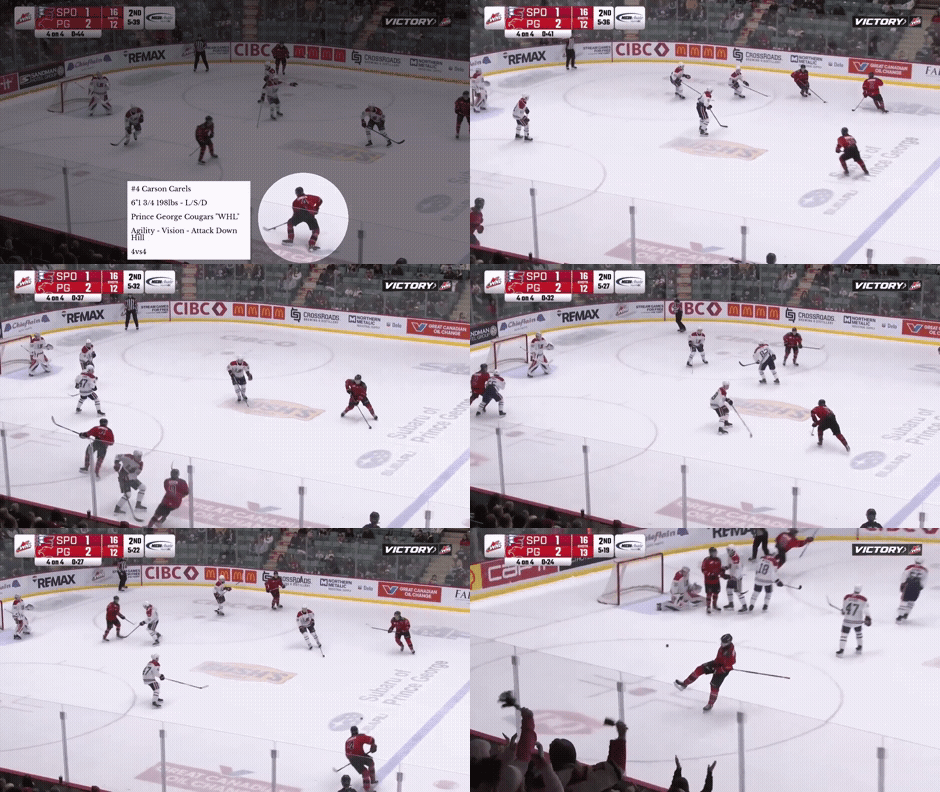
No. 7: Carson Carels, D, 6-foot-2, 202 pounds, Prince George Cougars (WHL)
Carels gets between 20-23 minutes per game for the Cougars. He’s an elite skater who projects as a two-way defenceman at the NHL level. I appreciate how hard Carels competes and pushes back physically when required. He’s hard to play against in his own zone, and is equally difficult to defend against in the offensive zone.
Carels is very aggressive directing pucks on net. In his recent 10-game segment, he averaged 8.5 shot attempts per game, resulting in 1G-6A.
No. 8: Daxon Rudolph, D, 6-foot-3, 206 pounds, Prince Albert Raiders (WHL)
Rudolph has been a workhorse for the Raiders all season long. He’s averaged 23:57 per game of ice time, while being deployed in all situations (3:15 PP/2:41 PK). Rudolph has produced 27G-43A already this year and he’s plus-23. His combination of size, skill, physicality and willingness to block shots are attractive attributes. The right-shot defenceman could develop into a top-pairing NHL blue liner in time.
No. 9: Alberts Smits, D, 6-foot-3, 205 pounds Jukurit (Liiga)
There isn’t a prospect in this draft class who has played more hockey this season than Smits. He’s suited up at the J20 and pro level in Finland for Jukurit, as well as representing Latvia at the WJC and the Olympics. He is now on loan to EHC Munchen in Germany’s top pro league.
Smits is a big body who moves very well and projects as a two-way defenceman who could produce secondary offence. Despite his young age, Smits averaged over 17 minutes of ice time for Latvia at the Olympics, while being used in all situations. He ended the tournament with a very reasonable two assists and minus-2 rating in four games.
No. 10: Marcus Nordmark, RW, 6-foot-2, 187 pounds, Djurgardens (Sweden J20)
Nordmark could be one of the disruptors in the first-round of the draft. He brings a combination of size, speed and willingness to make plays in traffic. Nordmark has been one of the most prolific scorers at the U18 level on the international stage, where he’s produced 15G-13A in 14 games representing Sweden. A high-end performance at the U18 World Championship next month in Slovakia could catapult him further up this list.
No. 11: Tynan Lawrence, C, 6-foot-1, 185 pounds, Boston University (NCAA)
Lawrence has had an uneven season overall, but he has the skill set to someday mature into a top-six NHL forward. He started the year playing for Muskegon in the USHL and contributed 10G-7A in 13 games before making the move to Boston University.
Things haven’t gone as well for Lawrence at the college level, where he’s contributed 1G-4A in his first 17 games with the Terriers, but it’s never easy for a prospect to transition to the college level mid-season. It would be irresponsible of teams to think he doesn’t have a projectable skill set. He plays with pace and leans goal scorer, but has the puck touch to distribute as well.

No. 12: Ethan Belchetz, LW, 6-foot-5, 228 pounds, Windsor Spitfires (OHL)
Belchetz is a towering winger with a powerful frame and a knack for scoring goals. He has historically leaned shooter more than distributor, and this year is no exception.
Unfortunately, Belchetz suffered a fractured clavicle in recent weeks and is projected to miss the remainder of the season. The Spitfires will miss him down the stretch and into the playoffs. Before his injury, he was leading Windsor with 34 goals, and his year-to-date totals were 34G-25A. Belchetz was seeing between 17-20 minutes of ice time per game. Almost all of his shifts came at even strength and on the power play. His size along the wall, and out front of the opponent's net is an obvious distraction.
No. 13: Maddox Dagenais, C, 6-foot-4, 196 pounds, Quebec Remparts (QMJHL)
Dagenais provides a combination of power, speed and relentless compete. His offensive production comes largely as a result of his dogged approach. He’s contributed 28G-31A so far this season while averaging 18 minutes of ice time. All of his shifts come at even strength and on the power play.
Dagenais averages eight shots per game and engages in 14 puck battles. Both of those statistics speak to the aggressive way with which he approaches the game overall.
No. 14: Adam Novotny, LW, 6-foot-1, 204 pounds, Peterborough Petes (OHL)
Novotny has adjusted very well to the way the game is played in North America, especially the comfy confines of the unique ice surface in Peterborough, and he has produced 32G-30A to date.
He impressed me at the world juniors playing for Czechia, with his commitment off the puck defensively. His entire game revolves around his powerful frame and ability to use his size and strength to slide into shooting lanes on both sides of the play. His goal-scoring upside is his most elite element overall.
No. 15: Oscar Hemming, LW, 6-foot-4, 198 pounds, Boston College (NCAA)
Hemming is another player on the list who is adjusting to college competition at a young age. His size stands out and he has a history of scoring goals. It’s going to take some time for Hemming to produce in the NCAA, but he’s contributed 1G-7A in his first 17 games. For his stature, he’s a solid skater on straight lines and he’s generally responsible off the puck in all three zones. His upside as a potential power forward who isn’t shy about battling physically is attractive.
No. 16: Ryan Lin, D, 5-foot-11, 177 pounds, Vancouver Giants (WHL)
Lin is a workhorse for the Giants. He’s averaged over 25 minutes per game this season while being deployed in all situations. Lin is easily defined. He’s a transitional defender who has the agility to escape pressure in his zone with the puck on his stick and lead the rush offensively. He’s especially creative on the power play. Lin is never going to be described as an elite defender, though. He has some risk/reward to his game, but his overall skill set wins out for me. Lin has contributed 13G-42A through 48 games.
No. 17: J.P. Hurlbert, LW, 5-foot-11, 183 pounds, Kamloops Blazers (WHL)
Several of the prospects on this list made the decision to move to the NCAA this year from the junior ranks. Hurlbert’s strategy was the opposite. He arrived in Kamloops last fall via the USNTDP and to say the decision worked for him is an understatement. Hurlbert has blossomed in the WHL. He’s one of the top scorers in the entire league (39G-54A) and could end up a lottery pick in the NHL Draft. Hurlbert plays with above average pace and has fantastic puck touch. I have described him as a shooter more than distributor in the past, but now believe he’s capable of doing both well.
No. 18: Nikita Klepov, LW, 6-foot, 180 pounds, Saginaw Spirit (OHL)
It will be very interesting to see which team steps up to select Klepov. I can see a scenario developing where a club in the top 12 calls his name much earlier than where I have him ranked. There’s no doubt Klepov’s elite element is his skill. He’s a play driver who craves the puck on his stick and is exceptionally dangerous ripping it from the weak side flank on the power play. His recent 10-game segment has revealed a spike in his ice time and more responsibility overall.
There have been several nights where Klepov has been deployed over 25 minutes and used in all situations. He will never be described as elite defensively, but he’s a threat to score shorthanded and has contributed 36G-52A so far this year.

No. 19: Liam Ruck, RW, 6-foot, 177 pounds, Medicine Hat Tigers (WHL)
Liam and his twin brother, Markus, are leading the way in Medicine Hat and battling each other for the league-wide scoring title (41G-56A). Liam has averaged 18:06 of ice time over the course of the season while being deployed in a variety of roles. He’s trustworthy defensively, tracks back to assist in his own zone on time, and is especially dangerous off the rush and on the power play from his strong side.
He’s going to eclipse the 100 points threshold, averages 5.5 shots on goal per game and engages in 13 puck battles. Ruck’s combination of energy and offensive impact leads to positive results for his group.
No. 20: Elton Hermansson, RW, 6-foot-1, 176 pounds, MoDo (Allsvenskan)
Hermansson has had a productive year playing pro in Sweden’s second division with MoDo. He averages around 15 minutes of ice time with all of his shifts coming at even strength and the power play.
Hermansson is creative off the rush and a crafty playmaker from the weakside flank with the man advantage. He’s quick to space and displays an extra gear off the rush. Hermansson is wiry and hard to check. He has loads of room to add more strength to his frame as he matures.
No. 21: Nikita Shcherbakov, D, 6-foot-5, 187 pounds, Ufa (Russia)
Some teams might shy away from the big Russian defenceman due to the fact he hasn’t produced a ton of offence so far (4G-14A in 53GP combined across leagues), but you can’t teach size and coordination. Shcherbakov is an outstanding skater. He adds a layer offensively and has the small-area agility to escape pressure and outlet pucks accurately. His length is a bonus when he moves laterally to kill plays on the half wall in his zone as well. At worst, Shcherbakov projects as a two-way/shutdown defenceman, but he has top-four NHL upside.
No. 22: William Hakansson, D, 6-foot-4, 207 pounds, Lulea (SHL)
Hakansson fits the needs of almost all NHL organizations. He’s big, physical, a solid skater, and a prospect who plays within himself. He doesn’t stray away from his strengths. Hakansson projects as a top-four NHL defenceman who is best paired with an active partner (think Lane Hutson). But he’s also more than capable with the puck, sending outlets accurately and on time.
No. 23: Juho Piiparinen, D, 6-foot-3, 201 pounds, Tappara (Liiga)
Piiparinen has some similar traits to Shcherbakov. He’s not quite as tall, but he has more weight on his frame and he moves just as well. Piiparinen isn’t going to move the needle a great deal offensively, but he gets to pucks ahead of opponents most of the time, launches the attack via stick-to-stick outlets and has the agility and vision to make subtle plays in the offensive zone. Not to mention the fact he’s a highly coveted right-shot defenceman with size and length.
No. 24: Markus Ruck, C, 5-foot-11, 167 pounds, Medicine Hat Tigers (WHL)
As I previously mentioned, Markus and his brother Liam are chasing each other for the WHL scoring title. The twins play together on the same line in Medicine Hat and Markus is the centre. He’s a distributor more than a shooter and possesses fantastic vision and puck touch. His skating will have to continue to evolve before he arrives in the NHL, but his competitive approach combined with his skill are attractive in this area of the first round for me. At the time of writing, Markus was leading the WHL scoring race with 19G-79A.
No. 25: Wyatt Cullen, LW, 6-foot, 176 pounds, USNTDP (USHL)
Cullen is an intriguing prospect who has the speed and skill to drive play for his linemates. He’s highly competitive and difficult to defend in small areas. While Cullen’s stats don’t jump off the page as super elite (8G-28A in 35GP) they are a byproduct of a USNTDP roster that isn’t as dynamic as it has been in recent years. Cullen is a University of Minnesota commit. He’s battled some injuries through his development, but I’m banking on him maximizing his skill set at the college level before turning pro.
No. 26: Ilia Morozov, C, 6-foot-3, 205 pounds, Miami-Ohio (NCAA)
Miami of Ohio is a program on the rise, and Morozov is part of the reason why. He was tasked with playing centre on one of Miami’s top lines as a very young college, and draft-eligible, prospect whose birthday lands on August 3. He’s one month from being too young for this draft cycle altogether.
Morozov’s size, skill, and evolving defensive game project well. He’s produced 8G-12A as a true freshman, and his plus-2 rating speaks to his overall attention to detail when he isn’t scoring. Morozov needs time, but the fact he can be used in all situations is a bonus.
No. 27: Oliver Suvanto, C, 6-foot-3, 207 pounds, Tappara (Liiga)
Suvanto is an imposing power forward who’s very hard to move off the play along the boards and out front of the net. He creates space for his linemates and has evolving goal-scoring potential. Suvanto isn’t a burner in open ice. He’s an average-plus skater on straight lines with room to add more power as he matures. Suvanto’s value is felt most when games get harder and heavier overall in scenarios like the playoffs.
No. 28: Alexander Command, C, 6-foot-1, 183 pounds, Orebro (Sweden J20)
Command has played the bulk of his games at the U20 level in Sweden and produced 17G-27A in 30 games. When he suits up with the U18 national team he provides middle of the lineup speed, skill and physicality. Command has contributed 3G-4A in eight games with the U18 squad.
Command is flat out a “hockey player”. He doesn’t have any holes in his game, but he’s also not exceptionally elite in any one category. I value his consistency and the fact he can be deployed in all situations and on any line. Coaches love these kinds of trustworthy prospects.
No. 29: Niklas Aaram-Olsen, LW, 6-foot-1, 187 pounds, Orebro (Sweden)
Aaram-Olsen hales from Norway, but he’s developing playing in Sweden for Orebro. He provides a combination of speed and goal scoring. Aaram-Olsen leans shooter more than distributor, which shows when taking a look at his statistical breakdown this year. At the U20 level, he has contributed 20G-20A in 19 games, and when representing Norway on the international stage, he has produced 16G-10A in 13 games.
Aaram-Olsen has been rewarded with some spot duty at the top pro level in Sweden (the SHL), but has yet to find his range offensively. He needs time, but projects as a potential middle-six goal scorer at the NHL level. The bulk of his ice time will likely always come at even strength and on the power play.
No. 30: Malte Gustafsson, D, 6-foot-4, 201 pounds, HV71 (Sweden)
Gustafsson is another towering first-round draft prospect. He has a presence to his game. Gustafsson isn’t shy about engaging physically and pushing opponents off his crease to clear shooting lanes for his goaltender to see pucks clearly. He’s also capable of occasionally rushing the puck and pulling up to make plays in the offensive zone. Gustafsson projects as a potential two-way/match-up defenceman at the NHL level.
No. 31: Simas Ignatavicius, RW, 6-foot-3, 198 pounds, Thurgau (SUI)
Ignatavicius is a dual American/Lithuanian citizen who’s been developing at the U20 and pro levels in Switzerland. He’s an interesting prospect who contributed 7G-4A in his first eight games at Thurgau while seeing between 16-19 minutes of ice time. Ignatavicius is an excellent skater in open ice and equal parts shooter/distributor.
He’s especially creative on the power play, working off the weak side flank and up top in the offensive zone. When Ignatavicius isn’t producing offence, he makes sure he’s above the play and tracking the entire 200 feet.

No. 32: Ben Macbeath, D, 6-foot-2, 188 pounds, Calgary Hitmen (WHL)
Macbeath has been steadily gaining traction for me and has really been coming into his own in recent viewings. He’s a bit of a late bloomer compared to other names on my list. Macbeath is a rookie in the WHL after playing in the BCHL with Salmon Arm last year. At the time of writing, he had contributed 7G-38A for the Hitmen while averaging 23 minutes of ice time per game and being deployed in all situations.
There are parts of his game that remain a bit raw on the defensive side, but he’s an excellent skater who handles the puck extremely well. He’s quick to space, and his agility creates shooting and passing lanes in the offensive zone. He’s competitive and just scraping the surface of his overall trajectory.
Honourable mentions I'm closely monitoring...
I’m excited to see how NHL teams strategize their selections in the early stages of the second round. Especially organizations that have multiple picks in the 33-50 range.
Here are some additional prospects I’m keeping a close eye on:
Tommy Bleyl, D, 5-foot-11, 165 pounds, Moncton Wildcats (QMJHL)
Bleyl is a transitional defenceman and power play quarterback who has already produced 13G-64A. He’s a Michigan State commit for next fall.
Tomas Galvas, D, 5-foot-10, 168 pounds, Liberec (Czechia)
Galvas has gone through two drafts already, but his performance at the world juniors (3G-6A) where he was named to the tournament all-star team, combined with his results at Liberec (8G-16A in 32GP) have resulted in teams being more confident in his trajectory.
Mathis Preston, RW, 5-foot-10, 177 pounds, Vancouver Giants (WHL)
Preston had a fantastic summer tournament at the Hlinka-Gretzky (4G-3A in 5GP), but his regular season in the WHL included a trade from Spokane to Vancouver, and the production has been slower. It’s taken some time for Preston to get his footing, but he’s looked more like himself lately, a tenacious and energetic forward who produces offence. I’m assuming he will be part of Team Canada at the U18 Worlds next month in Slovakia, and I’m intrigued to see how he finishes his year.
Xavier Villeneuve, D, 5-foot-11, 162 pounds, Blainville-Boisbriand Armada (QMJHL)
Villeneuve is returning to the lineup after missing significant time with injury. He’s an undersized transitional defenceman and power play quarterback who has some Lane Hutson in his game. Before his injury, Villeneuve had produced 6G-30A in 35 games.
MORE FROM SPORTSNET






 2:28
2:28