When the Montreal Canadiens traded for Noah Dobson this off-season — after acquiring Alexandre Carrier during the season — it became clear that their immense depth in youth on the blue line would most likely lead to a trade. At the same time, the Canadiens had a clear and present need for more scoring up front.
Tuesday's trade with St. Louis saw that come to fruition, as the Canadiens sent 22-year-old defenceman Logan Mailloux to the Blues in exchange for 22-year-old winger Zack Bolduc. Both players were first-round picks in the 2021 draft, Bolduc 17th overall and Mailloux 31st.
The 2024-25 class of NHL rookie skaters was dominated by Lane Hutson, Matvei Michkov and Will Smith, but we should highlight what Bolduc delivered in St. Louis. The six-foot, 187-pound forward finished eighth in points and tied for fourth in goals among all first-year players. He finished one power-play goal behind both Michkov and Celebrini.
From the end of the 4 Nations tournament in February to the end of the regular season, Bolduc scored 13 goals in 26 games, which was a top 20 mark in the league among all skaters. And while he only averaged 12:48 of ice time per game with the Blues, he finished second on the team in goals per 60 minutes of five-on-five play. It's reasonable to suspect that more minutes and better opportunities could lead to a breakout season soon.
While Bolduc does not immediately fill Montreal's need for a second-line centre, it was a position he played in junior hockey, and the team could explore developing him in that way again. It'll be something to watch in training camp unless a further move is made this summer.
Heading the other way is Mailloux, who was controversially drafted into the league after asking not to be picked when news broke that he had been charged and fined in Sweden for distributing a sexual photo without consent. Then-GM Marc Bergevin selected him anyway. Mailloux played two OHL seasons after and has spent the past two in the AHL.
As an AHL rookie, Mailloux finished third among all defencemen in scoring with 47 points, but as the Canadiens sent him back in 2024-25 to work on his defensive game, his offence took a hit. He scored 12 goals and 33 points in 63 games for the Laval Rocket this past season.
Nevertheless, Blues GM Doug Armstrong sees an NHL player in Mailloux.
"We think he's NHL ready now," Armstrong said. "He has a job, now it's his job to come into camp and keep it. When you make a trade like this, it's an old-fashioned hockey trade. It was difficult to include Bolduc in any deal, including this one, but when I look at our depth on the wing right now, if you go Snuggerud and Kyrou and on the other side with Buchnevich and Holloway, it seems like an area of strength for us. And then you look at our depth on the right side of our D, our top four players are both in their 30s ... adding Mailloux fills a void in our group today and tomorrow."
Between Mailloux, Philip Broberg (offer sheet) and Adam Jiricek (2024 draft), the Blues have added three big, young, mobile defenders in the past year as they begin a transition from an older group of six.
For a closer look at both of the players involved in this trade, we turn to our scout Jason Bukala for his reports.
SCOUT'S ANALYSIS
The deal between the Montreal Canadiens and the St. Louis Blues is an even-up hockey trade in my opinion. Both players involved in the transaction have displayed considerable upside in their young careers. Bolduc has a head start on Mailloux at the NHL level, but it’s only a matter of time before Mailloux graduates to full-time NHL duty.
To Montreal: Zack Bolduc
Bolduc has always been viewed as a goal scorer. In his final two years at the junior level, playing for the Quebec Remparts and winning the Memorial Cup in 2023, Bolduc scored 105 goals in his 125 games played and 209 points overall.
Bolduc has made significant adjustments to his game at the pro level. He’s maturing defensively, added more strength to his frame, and is fully committed in all three zones. He finished this past season with a plus-20 rating and didn't sacrifice offence. Bolduc produced 19G-17A for the Blues while averaging only 12:48 of ice time per game. All of his shifts come at even strength and on the power play.
On the power play specifically, Bolduc is best deployed in the bumper role. He’s very proficient at identifying how plays are developing and jumping to open space on his forehand side to rip pucks on net.
Here are some examples to get at what I'm describing:
The first clip displays Bolduc’s one-timer from the weak-side bumper position on the power play. He has exceptional hand/eye coordination. Pucks are always on and off his stick in a flash, and he shoots them accurately.

Bolduc has shown considerably more detail defensively as well. He doesn’t cheat for offence when his group doesn’t have control of the puck. He reads how his group is positioned and reacts accordingly.
Here’s an example of Bolduc “protecting the house” when the Blues overload their defensive zone coverage. Bolduc is aware of what is going on around him and eventually takes advantage of a puck that spills into the neutral zone.

Bolduc is already showing that he will be a goal scorer and offensive threat at the NHL level. His young career is just beginning, but Montreal has acquired at worst a middle-six forward. He's more likely a top-six centre or winger.
To St. Louis: Logan Mailloux
Big, strong, smooth-skating, right-shot defencemen are very valuable to NHL clubs, and the Blues are receiving a top-four defence prospect with the addition of Mailloux.
Mailloux is an exceptionally strong skater. He has a long stride in open ice, and his edge work allows him to escape pressure and return to defend his net quickly in his own zone. However, his elite element is his shot. Mailloux can quarterback the power play and shoots the puck a ton from the middle lane.
Here’s an example of Mailloux blasting home an opportunity from the middle lane on the power play for AHL Laval this past season:

More often than not, NHL teams are now activating their defencemen in the offensive zone to create chaos for opponents. Five-man units are constantly in motion, and Mailloux is very hard to defend when engaged in the strategy. He cycles pucks from low to high and back, and attempts to separate from checks with his edge work.
Here’s an example of what I’m describing when Mailloux is involved in the offensive zone and in motion:
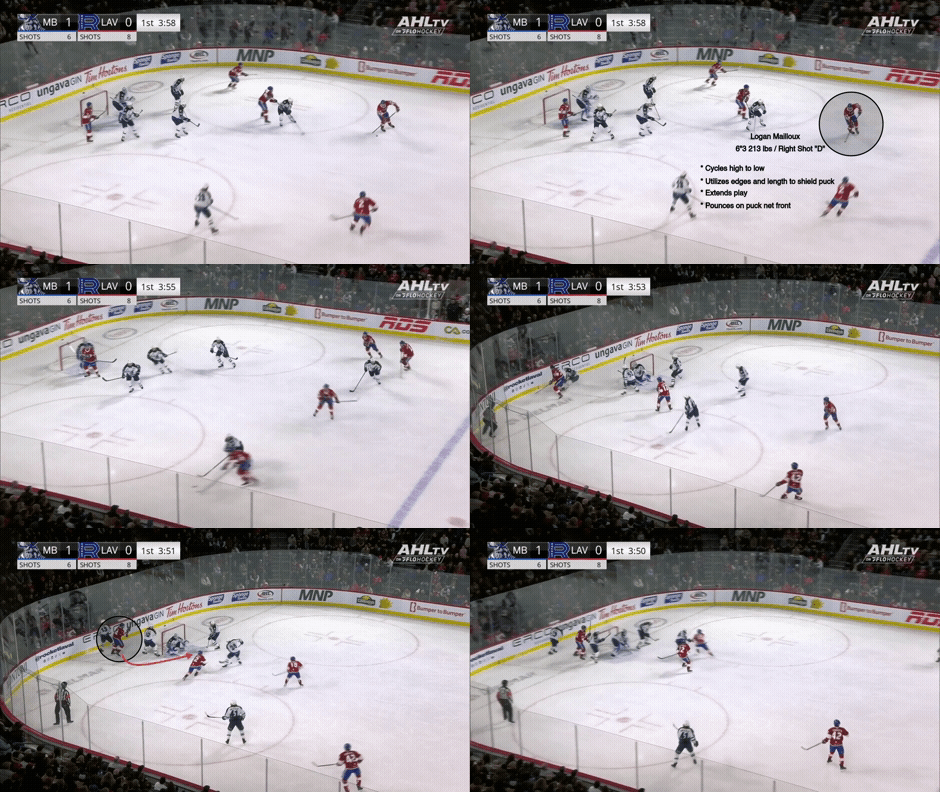
Mailloux is a towering six-foot-three, 219 pounds. As described, his elite element is his offensive upside combined with skating ability. His defensive detail is a work in progress, but he competes in his zone and simply needs to work on timing his gaps and containing opponents more efficiently.




 1:32
1:32