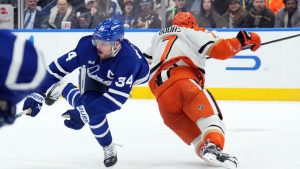
After serving his (controversial) five-game suspension, Radko Gudas is expected to return to Anaheim's lineup Tuesday night in Vancouver. Gudas, who injured Auston Matthews with a knee-on-knee hit that knocked the Maple Leafs captain out for the season, put renewed focus and pressure on the NHL's Department of Player Safety and debates on if punishments should be more stiff.
Matthews' agent, Judd Moldaver, was the most outspoken player representative following the Gudas hit, saying he was "disappointed and shocked" the league would rule the way it did.
This was a major topic at least week's GM meetings and prompted George Parros, the head of the department, to speak to the gathered media and defend his group. Then, later in the week, Florida's A.J. Greer hit Calgary's Connor Zary from behind and a few feet from the boards in what is generally regarded as the most dangerous play in hockey. Greer was suspended three games for that play, which led to further uproar from fans seeking steeper punishments.
But, as much as this is an issue for the player safety department, we can't overlook the part the players have in this as well. The NHLPA represents players on both sides of every bad hit and has appealed long suspensions in the past, sometimes successfully. The NHL is mindful of this and, without the PA also pushing for stiffer punishments, it's hard to see how anything will change by next season.
"The players have their meetings with the PA usually in June; we're going to find out then if they have any real appetite to change it," Sportsnet's Elliotte Friedman said on The Hockey Show on Monday. "I think that's the only way it can change, if the players say, 'We want it to,' and then the union is willing to go to the league and say, 'We want to negotiate this.'"
Sportsnet's reporters have asked players over the past week for their opinions on suspension lengths and if they'd like to see any change in the process.
What the players say about NHL suspensions
Nick Suzuki, Montreal Canadiens: “Obviously, they have a very tough job and I feel like they try to go off history of relatively close plays in the same category. There’s been some dirty plays, and I don’t know how many games the players in the league want to give guys. Every time a suspension comes out, someone’s not happy. I don’t know what more they could do or what their process is. They’ve been doing it a lot longer than all of us, so you have to trust them and see what happens.
“Hockey gets emotional, but at the end of the day all of us have families, and all of us have things that we like to do outside of hockey, and we don’t want to go out there and try to hurt guys. Things happen in this game, and you go out there knowing it’s a possibility. But there’s definitely an unwritten code to try to protect each other out there and not try to go out and intentionally hurt guys.”
Mike Matheson, Montreal Canadiens: “I think it’s a difficult job for them to do to be able to take into account every single thing that happens and really be able to take two events and compare them, but I think there’s definitely an opportunity for some more consistency and some more communication back and forth between the players and DoPS to kind of inform us a little bit more. I’m sure there’s things they see from their side that we don’t understand, things about the process that they go through that we don’t understand. Having said that, I feel like there could be more consistency.”
John Tavares, Toronto Maple Leafs: “It’s pretty evident that discussion should be had. When things get reviewed or looked upon — which the PA and the league do constantly; that's why we have a competition committee and why a lot of things are always being analyzed — clearly, this is something that should be on top of the priority list. Just always continue to make sure that we're doing the best job possible, that that department is at a certain standard, just like the rest of the game and the rest of the sport. So, yeah, especially when a lot of people within our locker room and someone like Connor (McDavid) speaks up and other people, I think it shows just the importance of having the discussion and pushing it along and make sure that it continues to evolve, like the rest of the game.”
Jake McCabe, Toronto Maple Leafs: “This game is a tough game. It's a physical game; it's a fast game. So, certainly, things do occur out there that you can't protect, that's just part of the nature of our game, and why fans enjoy it, and why we enjoy playing it. And it's a physical, rough game. But when it's one of your own (who gets injured), it's obviously a little tougher.”
Connor McDavid, Edmonton Oilers: “I think Player Safety has done their best. It’s not an easy thing to do. With that being said, I think there is reason to take a look at how the whole process works. If every time there’s a suspension, everybody complains about it, why don’t we take a look at the process and figure out if there’s a better way to make sure both parties are happy? It seems like there’s a lot of frustration there.”
Mattias Ekholm, Edmonton Oilers: “(Parros) has one of the hardest jobs in the NHL. There's always going to be people comparing this with that, and it gets out of context and whatnot. So, it's always going to be controversial — you can’t do that job where everybody's just OK with every suspension that happens.
“Do I think (Parros) is perfect? No. Do I think he's horrendous? No. I think he's doing an OK job. I agree with Connor the other day. Sometimes you need to review your thing and just go through the process to see if there is anything we can do better. I'm sure they do that on a yearly basis, and hopefully they keep continuing to try to get better.”
Marcus Pettersson, Vancouver Canucks: "Yes, I do have confidence in them. I think they're trying as hard as they can. It's not easy for them. I've seen some guys’ comments (but) there's always going to be a side that's not happy with the outcome of every situation. But, you know, they're there to protect us, and I think they're trying as hard as they can to protect us. So I have no problems with them."
Jake DeBrusk, Vancouver Canucks: "It's tough when there's a season (-ending) injury. Obviously, it's a hot-button topic with Matthews right now. There's usually one of those a year, in some sort of fashion. They (DoPS) obviously have a certain system that they go through. In this situation, (Gudas) only gets five games, but I think it's hard ... when someone's out full time. But I've always had that thought, even before I was playing. But there are certain protocols, they go through certain things like history, they do the videos to explain their reasoning. Obviously, you can't get back a player of that magnitude if he's out the rest of the year. But that's the tough part about our game; sometimes those things happen.
"Sometimes, I think it's a little egregious, sometimes think there could be a couple more games. But sometimes it's the other way around, too. Obviously, the optics don't look that great when it's been a couple times (the same player has been suspended). That's where I think the outrage comes from, especially in Toronto. I understand that."
Brock Boeser, Vancouver Canucks: "I think they do a good job (but) in some cases where a guy misses serious time (due to injury), I think there maybe could be bigger consequences. If a guy's missing a month or two months, maybe the other guy should miss at least half the time. It's hard to say in some of those cases but, you know, when I get hit in the head, I'm missing a month."
Teddy Blueger, Vancouver Canucks: "Obviously, not a very good hit (Gudas on Matthews). I'm sure there's a lot they take into account. It's hard for me to really know the process and judge whether it's good (five-game suspension) or not. But I think they’ve done a decent job. There's not too many times where I think that they were way off."
--with files from Eric Engels, Mark Spector, Luke Fox, Iain MacIntyre