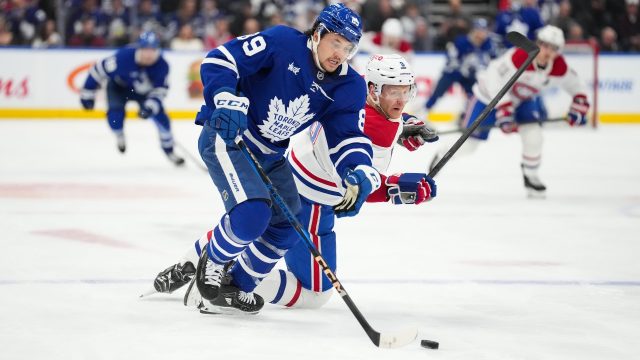
If you’ve followed hockey with some attention in the past, you’re familiar with how the Atlantic Division usually ends up.
At the conclusion of the 2017-18 regular season, the division was led by the Boston Bruins, Tampa Bay Lightning, Toronto Maple Leafs, and Florida Panthers. The next season Montreal finished fourth, but other than that little blip, it’s been nothing but the same four dominant teams until Ottawa climbed into fourth in 2024-25 and Boston finally took its long-awaited fall after an incredible run of success.
Heading into this season, I don’t think many people would’ve forecasted things too much differently, with the two Florida squads and Toronto hanging on to the top, some rising rivals in Montreal and Ottawa, and the potential for maybe, possibly, eventually, Detroit or Buffalo coming on to challenge.
Three weeks and about 10 games apiece into the season, and that’s … not exactly what we’ve seen so far.

Just two of these Atlantic Division teams have a positive goal differential -- a measure I value as much as anything so early in the season -- and that's Montreal and Detroit.

So, are we seeing a changing of the guard? Is it time for the rest of the division to chase Montreal and Detroit, while those who have had a sustained run of success slowly begin to drop, like Boston?
Let’s dig in to what's real, and what's not, in the Atlantic so far.
The Canadiens have, unequivocally, taken a step. The additions of Lane Hutson and Ivan Demidov massively and immediately changed the course of the franchise in a way I can’t remember seeing from two players who are so young and weren’t No. 1 overall picks.
The addition of those two, plus trading for Noah Dobson, plus the development of Cole Caufield and Nick Suzuki (and slowly Juraj Slafkovsky too), have taken the Habs from a scrappy worker team with a low ceiling to a talented group teams struggle to contain. They can beat you on pure skill now, which hasn't been the case for a long time.
But...
A lot has gone right that could’ve gone either way thus far, and the Habs still have a ways to go to get into the class of the league’s elite. As we change our expectations of them from “Maybe playoffs?” to “Can they become a Cup threat?”, there are some notes.
They’ve played the NHL’s softest schedule to date, or at least close to it, depending on which site you use. With that in mind, through 11 games they’ve captured just four wins in regulation, which isn’t quite juggernaut status. They’re 22nd in expected goals percentage (5-on-5), but have the sixth highest “PDO”, which combines shooting and save percentages (simply trying to capture teams that have been on the luckier side).
They’re good, they’re talented, they’re a playoff team, and they’re leading the division right now. But, realistically, they're probably a team knocking on the door of the NHL’s top-10, or maybe have a toe just inside.
Detroit is maybe the most surprising team of the year, save for Utah. They sit second in the Atlantic at 7-3-0 and that doesn’t seem overly lucky, at least not by the numbers. Their schedule has been medium-to-hard, PDO is actually bottom-three in the league (they still can’t buy a save, even though they literally tried to), and they really work.
The biggest note for me is that Detroit's young players, whether they’re just OK or actually good, are a clear step up from some of the dead weight they’ve had on the roster in past years. It feels like a lot of addition by subtraction, and Todd McLellan deserves credit for getting them on the right track in his first full season.
I don’t think they’re as talented as a Montreal, but the underlying numbers look pretty good, and I wouldn’t be shocked if they’re sniffing around the wild card chase in March and April. Maybe it’s a year they add at the trade deadline?
Toronto Maple Leafs
The Leafs have had an extremely soft schedule to start, so it’s not great they haven’t taken advantage of it. After a year where their power play was red hot and their goaltending was even better, those two things have abandoned them: Toronto's power play is 27th in the league (below 15 per cent) and their team save percentage is bottom-five in the league. That's not great when you’re on the wrong side of 50 per cent in expected goals to begin with.
While that sounds like a lot of doom and gloom, the Leafs haven’t played themselves into real trouble yet, and they’ve got a very similar shape to teams that’ve won a bunch in the past. If Joseph Woll can get healthy and help, if Scott Laughton and Chris Tanev can get right, and Auston Matthews can get back into his groove, they’ll be competitive up to the trade deadline (where who knows what they’ll do), lurking between the top-three spots and the wild card race. If teams in the division or conference struggle around them as it appears many may, it could go even better than that.
Florida Panthers
The Panthers are .500 in a year they’ve lost Matthew Tkachuk, their captain Aleksander Barkov, and numerous others. They’re top-three in expected goals percentage, they’ve had some bad luck to date, and they’ve got a very recent history of being an excellent team.
The number one fascination this year will be: Will injuries derail them to the point of missing the playoffs as the teams around them in the Atlantic rise up, or do they have enough in the tank to just get in? If they do just get in, they’ll be as scary as ever, assuming they get the big guys back.

Real Kyper and Bourne
Nick Kypreos and Justin Bourne talk all things hockey with some of the biggest names in the game. Watch live every weekday on Sportsnet and Sportsnet+ — or listen live on Sportsnet 590 The FAN — from 4 p.m. to 6 p.m. ET.
Full episode
Perhaps the division's biggest wild card, they could go in either direction, and fast. In a way, that's a compliment, as not many teams could go up fast. But the Senators are a top-10 expected goals percentage team (via Natural Stat Trick), and are one of seven teams in the preferred quadrant of Sportlogiq’s expected goals for/against graph. So, they control play well. Unfortunately, they’re getting terrible goaltending again (third worst team save percentage in the league), and have the league’s third worst PK.
Those are simple things, right? The Vezina-winning goalie stops playing like an AHLer, and the PK gets back towards its roughly 78 per cent kill from last year (they’re below 64 per cent now), and they’ll be better. They'll eventually get their incredibly influential captain Brady Tkachuk back, and it’s not hard to see how they could win a pile of games from there.
Now, if Ullmark continues to play poorly, injuries and bad vibes pile up, the Senators could do the opposite. But with that defence core, led by Jake Sanderson, they should be OK.
The Sabres are not a punchline this year. Unfortunately, it’s tough to have faith in them making the right moves to climb into playoff contention, but they’re not that far off. They’ve got talent and can look dangerous off the rush, a truth that has them seventh in expected goals for (via Sportlogiq).
What’s crazy is they’ve got a ton of talent on their back-end, but it’s pretty heavily offensive talent, so they still give up way too much. They need those guys to commit to dominating the back-end by keeping the play in the offensive zone.
Josh Norris’s injury obviously hurts, though some might call that self-inflicted since the Sabres traded for a player with such an injury history. In all, there’s just not enough here to call them a playoff threat. They need a bigger, more direction-changing move.
Tampa Bay Lightning
Earlier I said Ottawa was the team with the biggest range of potential outcomes, strictly because it’s hard to see Tampa Bay being Actually Bad. The outcomes for the Lightning are mostly in the “they’ll get better” direction. If you took Brayden Point, Brandon Hagel, Jake Guentzel, Nikita Kucherov, Anthony Cirelli, and Victor Hedman, and surrounded them with a dozen players from the Syracuse Crunch, you'd think they’d make the playoffs. Add Andrei Vasilevskiy in there too. They’ve won three straight since their toe pick out of the starting blocks, but this is a good team.
They’ve been at the bottom of the division so far, and they’re listed seventh here. But if I wrote this column again in a month, and they weren’t in the top three, I’d be surprised. Tampa Bay is still controlling play, is well-coached, and have too much talent to miss the playoffs.
It ain’t happening, not yet anyway.
Boston Bruins
What a weird team. I just did the thing with Tampa where I listed good players and, well, the Bruins aren’t devoid of talent either. Prime David Pastrnak and Charlie MacAvoy sure don’t hurt, nor do Lindholms Elias and Hampus.
But so far this year they can’t control play, and they’re getting the league’s fourth-worst goaltending, a position they thought they paid Jeremy Swayman to solidify for years to come.
The Bruins won’t hand anyone any free wins, and will probably be better than they ought to be ahead of a draft where Gavin McKenna looms. I don’t know if they’ll finish eighth in the division or not, but I do know they won’t sniff the playoffs.
Conclusion
What’s fun is, I don’t know if this exercise answered a lot of questions. Any of Montreal, Detroit, Toronto, Florida, Ottawa, and Tampa Bay could very well make the playoffs, and in any order of finish. There are questions everywhere, as the long-time division leaders take a step back, and others climb for a step forward.
The Atlantic is no longer the NHL's best division – it used to compete with the Central for that title – but it’s solid all the way through.
Points won’t be easy to come by, and drama will remain high. Stay healthy and get saves, and you’re probably in.
Miss on either of those goals, and you’ll probably find yourselves on the outside looking in.