EDMONTON — Back in the Raffi Torres-Matt Cooke era, when predators roamed the National Hockey League’s 200x85-foot earth, decision makers decided that hits to the head were getting out of control.
So they devised Rule 48, and though we’ll never extract every head shot from the sport, the kind of hits that posed the greatest threats have pretty much disappeared from the game.
In a far more protracted process, the NHL slowly reshaped its rulebook to make fighting more punitive. Today, though we still have fights, the job of the one-dimensional heavyweight who would come off the bench for about 2:30 per game has been eliminated.
So, think about this for a moment, if you will:
The checking-from-behind penalty was given major and game misconduct status for the 1991-92 season.
But why is it that today, more than three decades later, we still have so much checking from behind?
“So, body checking,” began cerebral Tampa head coach Jon Cooper. “The back is part of the body. So, when you turn at any moment, as fast as this game is, your back can be exposed.
“I don't know a player in the league — well, maybe a couple — that would go around thinking they're going to hit a guy in the back. There's way too much respect among the players. Because it's played so fast, some of those checks are going to happen. But I just don't feel that guys go in and hit a guy deliberately in the back.
“I just I have not seen it, whether it's my team or other teams.”
After a skein of such hits — from Evander Kane on Jonas Brodin, to Nick Cousins on Erik Gudbranson, to Eric Robinson on Justin Barron — we spent time talking to a few NHL players off the record. Then, we put our questions to Cooper, one of hockey’s smartest coaches, and one of its most thoughtful defencemen, Mattias Ekholm.
Our initial takeaway?
All of us folks on the outside of the game are more worried about this so-called “problem” then are the people who actually play and coach the sport.
Don’t take it the wrong way. Everyone expresses a genuine wish that nobody gets hurt and that those players who do check a particularly vulnerable player are made to pay a price.
And perhaps it is those flagrant hits that the checking-from-behind rule has at least lessened in frequency.
“The guy who is bent over, head-first facing the boards, that type of violent stuff,” Ekholm described. “They still happen, but it's not (as often). There's been less when the guy is in a vulnerable position.”
However, adds the big Swedish defenceman, “Hockey is never going to be a completely safe game.”
Of the recent string of hits, and we’ll never expect partisan fans to agree with our assessment, we thought Cousins on Gudbranson was the most egregious and deserving of suspension. I thought Barron possessed the puck in a dangerous place for nearly two full seconds, giving both he and the oncoming Robinson time to make a safer play.
And I judged Kane on Brodin, by comparison, to be a “hockey play” more than the others. Brodin braced for the hit, while Kane hit his numbers — and should have received a two-minute minor. Brodin suffered a leg injury on the play, not the injury that typifies what the checking-from-behind rule is meant to eliminate.
“It's a skill to protect yourself. It's a skill and to sense danger. It's a skill to be able to take hits a certain way,” Ekholm said. “I've played with guys who, they're too proud. They have to take every hit — and that's not good either.
“Sometimes you’ve just got to take a hit, fly a couple feet and go down. It looks tough, but you get back up, and your body's still intact.”
The question around checking from behind is, always, did the defenceman turn his back — or change the angle — at the last second? The way Chris Tanev did the other night in Colorado. He was injured on the hit, but no penalty was assessed to Ross Colton. It was a mistake by Tanev, in our eyes.
“There's a line there. Some people may want to be hit from behind because they know how to take it, but then it also draws a penalty and a power play,” Ekholm said.
A defenceman who played in the ‘80s once told me, “When we saw a player with his back to the rink, it was an open invitation to hit him as hard as you could.” As such, defencemen back then made sure they retrieved pucks in such a posture that their numbers were almost never visible to the oncoming forechecker. They hugged the boards and braced for hits.
Today, with the checking-from-behind penalty a fixture in the game, some defencemen have offloaded the responsibility of protecting themselves to the referees and the rulebook. Others have learned to take that hit, come out of it fine, and often still draw the two-minute minor.
“I'm not saying that we're taking advantage of it, but you got to know how to take a hit,” said Ekholm. “And you have to expect to get hit .
“If you have the puck behind your goal line with your back (facing) the play … if you have a few seconds (like Baron had), you should be great. You should just turn and go. But if (you have less time), then you should be ready for hit.”
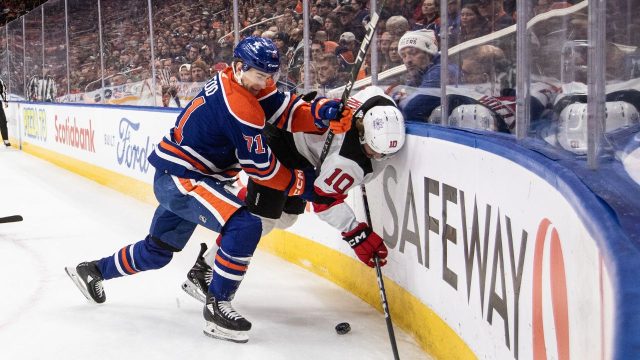
We all know this: the distance from the boards and whether or not the defender is bent over are the two most important factors in separating a normal hit from an injurious one. The increasing speed of the game dictates that both the hitter and the hittee have less and less time to take stock of those factors before a hit happens.
Because the hits, they are going to happen.
“You have to look at players’ histories and say, ‘Has this guy done this before? Is it part of his repertoire?’ Then you’ve got to make the judgment for yourself,” Cooper said. “But, you'll never do away with it, because backs are part of the body and body checking is alive.
“Until you get rid of body checking, which I hope never happens, it's always going to be an issue.”