Assembling a deep NHL roster takes hard work and patience. The process of tearing down a roster and rebuilding the group through the draft, trades and free agency takes time.
The Toronto Maple Leafs 2025 playoff roster took several years to take shape. Their core group – Morgan Rielly, Mitch Marner, William Nylander, Auston Matthews and John Tavares – provided a foundation the organization hoped would contend for a championship. But it hasn’t worked and the time has come to pivot in a different direction.
The Leafs haven’t lost in the playoffs because they've lacked skill players. They’ve lost because they haven’t found the correct combination of “skill and will”. Their defeat this year against the defending champion Florida Panthers further emphasized that the Leafs require more players who are willing and able to adjust to the way the game is played in the Stanley Cup playoffs.
The good news is that we learned in this year's defeat that Toronto does have an emerging homegrown talent who embodies exactly the kind of player required to win games at the hardest time of the year.
Matthew Knies has made a strong case why he should be part of whatever the Leafs' new core will be from here.
Power Forward Identity
It’s early in his career, but Knies is proving to be a rare breed in NHL circles. He’s a power forward who can be deployed in all situations. He contributes offence at even strength and on the man advantage. And he applies his physical will on opponents to open up space for himself and his linemates.
Knies took a big step in his second NHL season, scoring 29 goals and 58 points in 78 games. He averaged 18:30 of ice time per game, took 152 shots and delivered 181 hits. It's worth noting that only three other players in the NHL scored more than 25 goals and dished out more than 180 hits this season -- Tom Wilson (33/233), Brady Tkachuk (29/228) and Vincent Trocheck (26/214).
Knies ended up averaging 2.32 hits and 0.74 points per game during the regular season.
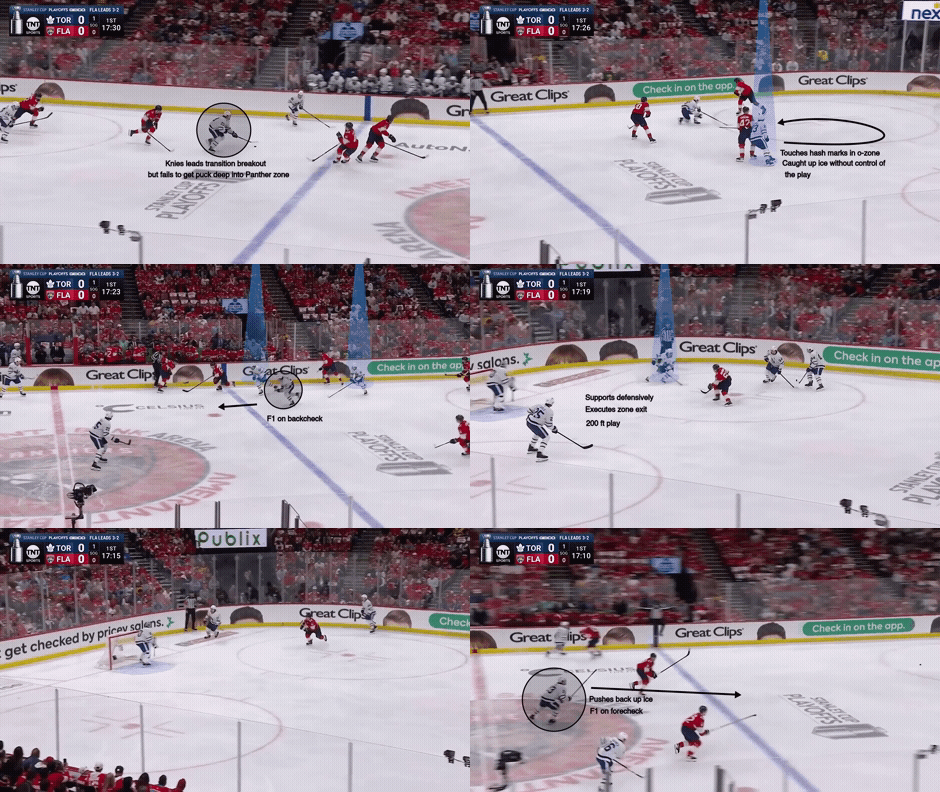
What I really appreciate about Knies is that his game doesn’t change much come playoffs. It’s generally more difficult to score in the post-season, but he still averaged 0.53 points per game while his physical approach didn’t fall off at all compared to the regular season. Knies averaged 2.38 hits per game versus Ottawa and Florida.
Player Comparables
Knies is just 22 (turning 23 in October) and listed at 6-foot-3, 227 pounds, which makes it difficult to find an exact comparison to match him with.
• Trocheck is 31 and stands 5-foot-11, 188 pounds, while Wilson is also 31, but stands 6-foot-4 and 225 pounds. Brady Tkachuk is closer in age (25) and also listed at 6-foot-4, 225 pounds.
• Knies is the only NHL player who scored more than 25 goals, dished out 180 hits and is under the age of 25.
• The next-closest player -- and he’s not far off -- is New York Rangers forward Will Cuylle who’s 23 years old and also an RFA this summer. Cuylle’s game is trending up as well and, like Knies, he’s a handful to play against. Cuylle averaged 15:04 of ice time and was deployed in all situations this past season. He produced 20G-25A and dished out the fifth-most hits in the league (300). He’s listed at 6-foot-3, 212 pounds.
The bottom line is there aren’t many players in the NHL who bring the combination of size, skill and physicality that Knies does to the Maple Leafs.
Contract Status
If unsigned by July 1, Knies will be a restricted free agent. His qualifying offer is set at $874,500. It’s going to be interesting to see how things unfold between Knies and Leafs management regarding his extension.
Keeping in mind the salary cap is set to rise significantly, which will obviously drive up the cost of doing business across the league, here’s a look at what some other players signed for after their entry-level deals expired:
• Cole Caufield, Montreal Canadiens: $7.85M x 8 years. Expires 2031.
• Juraj Slafkovsky, Montreal Canadiens: $7.6M x 8 years. Expires 2033.
• Matt Boldy, Minnesota Wild: $7.0M x 8 years. Expires 2030.
• Matt Coronato, Calgary Flames: $6.5M x 7 years. Expires 2032.
• Quinton Byfield, LA Kings: $6.25M x 5 years. Expires 2029.
The players listed above play different roles for their teams than Knies does for the Leafs. Caufield and Slafkovsky, for example, don’t kill penalties while Boldy saw his role increase in the playoffs to include all situations.
The closest comparison, role-wise, is Byfield who averaged 18:37 of ice time while being used in all situations and producing 23G-31A. An area of Byfield’s game that pales in comparison to Knies, despite being listed at 6-foot-5, 225 pounds, is his physical play. Byfield was only credited with 80 hits this season.
It’s at this point of my exercise that I ask how much value do you put on what Knies brings to the Leafs roster in comparison to these player examples I’ve provided?
My feeling is Knies is every bit as important to Toronto as Caufield and Slafkovsky are to Montreal. The fact he also kills penalties and can be trusted in key matchups defensively brings even more value to the negotiation table.

With the salary cap rising in the coming years, and my belief that Knies has real potential to become 35-goal scorer while continuing to play a power game, I’d be willing to offer him an eight-year extension that carries an AAV of $8.5 million. I have very little concern about the contract aging poorly. He would only be 30 years old when it expires, which would leave plenty of runway for him to cash in on another lucrative contract when he’s a veteran.
The Leafs have the cap space this off-season to allocate those dollars for Knies and, in my opinion, he should be their biggest priority to lock up. According to Puckpedia.com Toronto has $25.71 million in cap space this summer, without Tavares or Marner under contract. Signing Knies to what I've suggested would still leave $17.21 million for Toronto to spend on other players.
Offer Sheet?
Several NHL executives, including Jeff Gorton from the Canadiens, have recently stated they believe it's a real possibility that teams will look to utilize offer sheets after the St. Louis Blues found success doing so on Dylan Holloway and Philip Broberg last year.
Knies would be eligible to receive one, but I don't see the Leafs being backed into a corner by a competing team. The Oilers had limited cap space last summer and had already spent money on a number of UFAs. The Leafs have the cap space to make sure it doesn’t happen to them with Knies. But to keep the flexibility they need to adjust the roster in other places through free agency or trade this summer, they should sign Knies quickly and not risk an offer sheet coming at all.
Conversely, I could see a team trying sign Cuylle to an offer sheet that would make things difficult on the Rangers to match unless they are able to dump a significant amount of salary ahead of free agency. As of today, New York only has $8.4 million in available space to work with and they have to sign Cuylle, defenceman K’Andre Miller and forward Matt Rempe, amongst other restricted free agents on their roster.
The worst outcome for the Leafs would be putting Knies on the back-burner, letting his RFA status carry into July and start addressing other roster needs in the meantime. That could put them on a path similar to last year's Oilers, where an ambitious team could swoop in with an offer sheet higher than $8.5 million to make things uncomfortable for Toronto.
As a reminder, here are the compensation thresholds for 2025:
Knies is exactly the type of player Toronto needs to eventually get over the hump. He's a unique talent who's already a proven NHL power forward and still getting better.
The Leafs are facing a difficult off-season, no doubt, and have difficult pathways to navigate if they're to come back stronger next season. But getting Knies signed to a new deal should be their primary focus.