Konrad Nagy, a Hungarian speedskater, did not qualify for these Milano Cortina Olympics. He didn’t qualify in 2022 either. Instead, he spent those Beijing Games at the house of his buddy, who just so happened to own a beer tap. And there, Nagy did what many of us would: he picked up a keg of Stella and watched two weeks’ worth of speedskating.
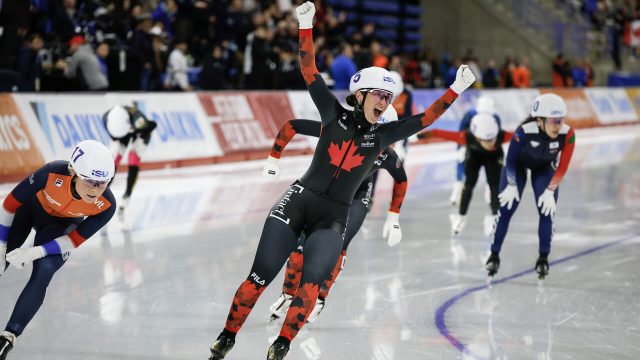
It was through his friend’s TV set that he witnessed his wife Ivanie Blondin’s Olympic breakthrough — a gold medal in the team pursuit, and a silver in the mass start.
“That was a good feeling,” Nagy recalls.
You can bet that all 60 litres of Stella were gone by the time the torch was snuffed on those Olympics.
Nagy’s setup will be a little different this time around — he’ll be in Milan to witness Blondin’s final Olympics firsthand.
Blondin, the Ottawa native and four-time Olympian, and Nagy are planning a full renovation of their Calgary home after Italy. They also hope to start a family.
“I'm not doing another quad. There's no way. Like, I'm 35, I'm going to be turning 36 in April,” Blondin says. “It's time for the next generation to step up and [for me to] kind of pass the baton over to them.”
First, though, there is the task at hand. Blondin will be among the favourites to return to the podium in both the team pursuit on Tuesday and mass start, which goes Saturday. Canada beat the U.S. in a team-pursuit semifinal to advance to the gold-medal race against the Netherlands on Tuesday at 10:47 a.m. ET / 7:47 a.m. PT.
While these may be Blondin’s final Games, she remains as intent as ever on reaching the top of the podium — especially after a streak of mass-start second-place finishes dating back to Beijing. Silver linings are nice and all, but nothing matches gold, and Blondin is among the favourites in Milan.
With the caveat that anything can happen at the Olympics, coach Remmelt Eldering says he “expects” medals in Blondin’s two main events.
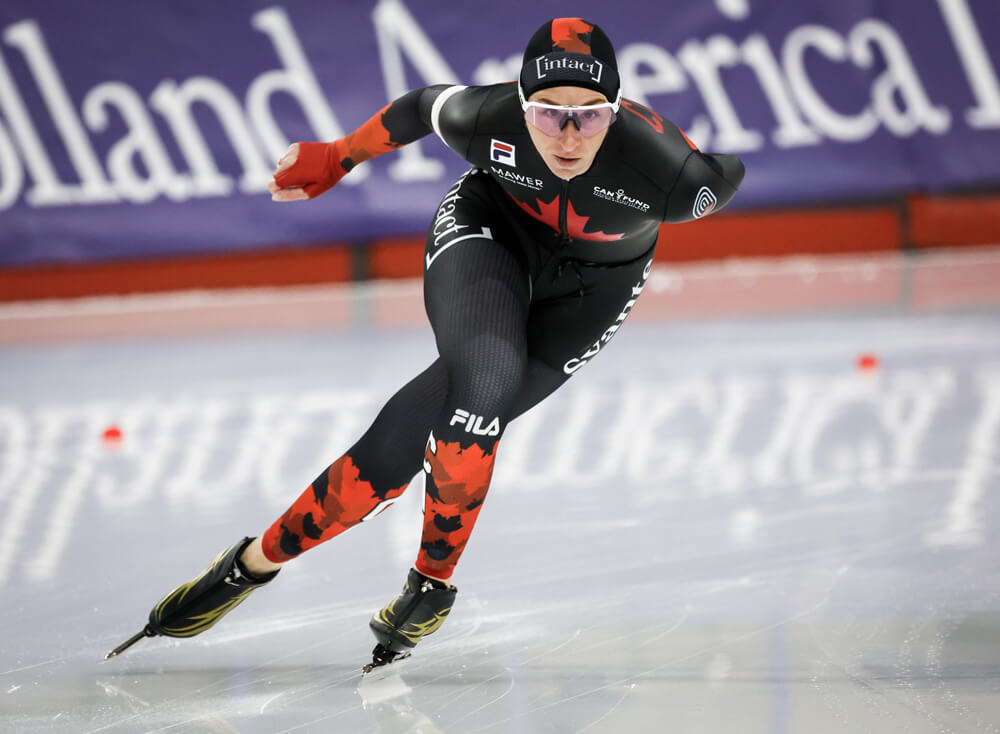
Blondin isn’t shying away from that bold prediction. After all, she is famously competitive.
The truck outside her home in Calgary is burnished with a licence plate that reads ‘BLONDIN,’ a purchase she made alongside Nagy. Surrounding those seven letters is a licence-plate cover, which Blondin bought for herself, that reads: “IF YOU AIN’T FIRST, YOU’RE LAST” — the famous quote from Talladega Nights, spoken into existence by Will Ferrell’s caricature of a NASCAR driver, Ricky Bobby.
“It's just the way I am, I guess. And it can have its positive moments. It can drive me; it can be a complete disaster sometimes. But that's the way I roll,” she says.
The way she rolls demands plenty of those around her, too. While Nagy is in Milan to support his wife, he’ll face certain restrictions.
“When I'm in race mode, he knows not to approach me. And especially after a bad race, he knows to give me my 10-minute window of like, do not approach whatsoever,” she explains.
Of course, across Blondin’s distinguished career, which dates to her world-championship debut in 2011, she has not needed many of those 10-minute windows.
In addition to her Olympic medals, she owns 17 medals from worlds, including five golds, success which appears to have whet her appetite but never fully satiated her hunger. Nagy sees it closest.
“Anytime I have a bad race, finishing 27th or something, and then she comes off the ice in second and then she's super mad. And I'm like, ‘You're on the podium. Like, you should be happy. I'm 27th. Look at me. I'm not throwing a fit,’” Nagy says.
“And then she's just like, ‘Yeah, I didn't win.’ I was like, ‘Yeah, but you still finished second. That’s something.’ And then she’s just mad because it's not second, it's last. She wants to win every single race.”
Still, despite those philosophical differences, Blondin appreciates the balance Nagy provides.
“He's very easygoing and chill. And when I'm like losing my marbles over something, there's just some sort of calm collectedness that he brings to me that calms me down. And it just works,” she says.
Calm collectedness is not how anyone would describe Blondin’s best discipline. The mass start, which made its Olympic debut in 2018, sees skaters race against each other instead of dueling the clock. As its name implies, skaters show up at the start line of the oval in a group, take off together and race 16 laps. It is easily the most chaotic long-track race, the one in which anything can happen rings truest.
Cruelly, for Blondin, it is also the one in which anything has all-too-often meant second.
On top of her Olympic silver medal, she placed second at each of the three world championships since. (She won gold medals in 2016 and 2020). For her World Cup career, Blondin has stood on the podium 41 times. Twenty-one of those instances have been silver.
“I think there's always a lot of fire in me when it comes to mass start. And I think that's why I'm a really good mass-start skater. At the end of the day, it's definitely been frustrating over the years. I've been second a lot,” Blondin says.
MORE FROM SPORTSNET
Blondin began her career in short track, where chaos reigns. Though she was quickly shuffled to long track, she never lost that desire for head-on action. After the 2022 Olympics, while contemplating her future, she returned to short track for a summer of training.
“I would jump on short track with the short-track group in Calgary, then I'd jump on long track and it was chaos, but it was organized chaos, which is what I thrive in,” she says.
Blondin has a strong finishing kick and is willing to bet on herself in a sprint to the finish. (According to Nagy, “no one” can match his wife’s speed.) But what really makes her excel in the mass start is, indeed, her competitive drive.
“That's the same as how she picked up [professional] bike racing. It's the same idea: You're in a bunch [of competitors] and then you just gotta cross the finish line first. And she loves this kind of stuff,” Nagy says.
The pivot to cycling isn’t a strange one for speedskaters, who often use the sport to cross-train. In hindsight, though, it makes particular sense for the fidgety Blondin.
“She can't really sit and chill. That's not in her,” Nagy says.
Nagy recalls a recent Sunday afternoon, when they were hanging out with their dog, parrot and various foster cats. Blondin was bored, so she suggested going fishing.
“The closest lake where we can fish is like a four-hour drive away. Just thinking about this now at 2 p.m., it doesn't make any sense,” Nagy answered.
They ended up going fishing.
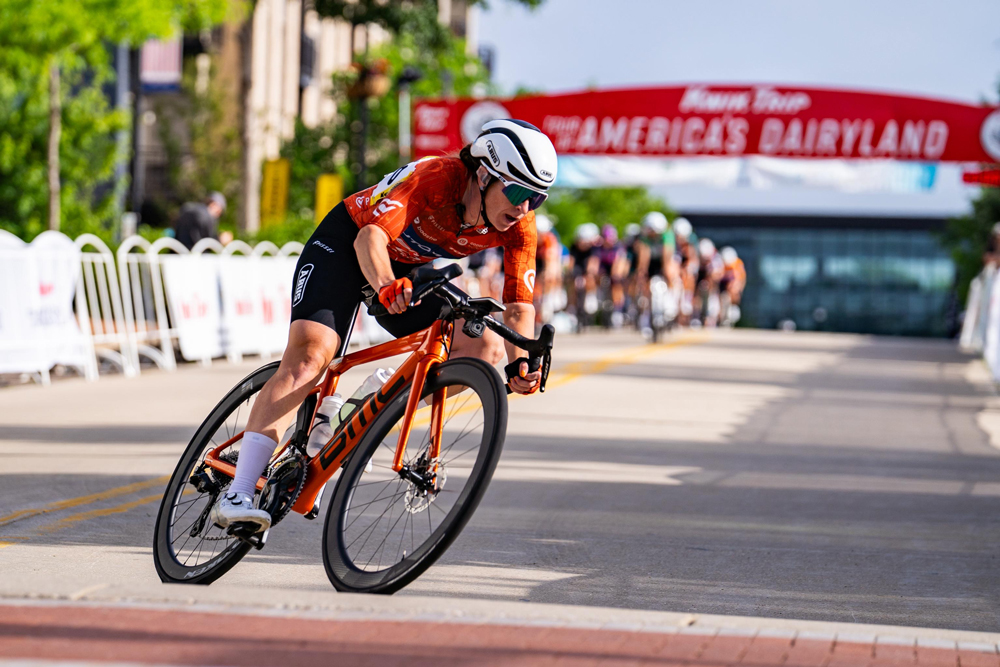
In a similarly restless vein after Beijing, Blondin picked up a bike, just for fun, at the suggestion of Canadian teammate Connor Howe.
She caught on quickly, finishing ninth in the road race at nationals that summer. One year later, she placed third at the international Gastown Grand Prix in Vancouver, leading to a spot on the Goldman Sachs pro team.
Despite the risk of crashes and injury, Speed Skating Canada allowed Blondin to continue her cycling pursuit.
“It's kind of like the NASCAR of bike racing,” Blondin explains, true to her Ricky Bobby roots. “So, it's kind of been fun in a sense that it's really hard training, really hard racing, but at the end of the day, after the races are done, we're all there tailgating.”
Cycling has become enough of an obsession that Blondin will go back for one last summer of competition after the speedskating season ends.
It’s a journey that never could have happened after the 2018 Olympics. She returned from those Games “ultra depressed” after entering as a multi-medal favourite and delivering fourth-, fifth- and sixth-place finishes, plus a mass-start crash to boot.
“She was really down and blaming herself, I guess you can say, to not medal. But it wasn't really her fault,” says Nagy. The two had been together for a year at that point, their relationship beginning with a romantic date to the Chinese embassy to get photos for their Visa. They married in 2020.
Nagy takes some credit for helping Blondin get through her rut, but both he and Blondin point to their animals as playing the biggest role in getting her through the disappointment of Pyeongchang.
Indeed, Gizmo the parrot, Brooke the dog and Boo the cat helped distract Blondin, along with a gaggle of foster animals. Nagy recalls one dog who came into their care with neurological damage. By the time it was adopted, thanks to Blondin’s nurturing, it was running five kilometres a day alongside Nagy.
“It's kind of like my time of peace, I guess, and stability in my life,” Blondin says of the time she spends with her pets. “And yeah, it kind of just helped me press the reset button.”
All of it has allowed Blondin to head to Italy without taking on oversized pressure to reach the podium. She’ll need the freed-up mental space to accomplish her goals, particularly in the mass start, with strategies and tactics at play, especially among countries who have multiple skaters competing. The Dutch have caused headaches for Blondin, led recently by Marijke Groenewoud.
“I'm really good friends with Marijke, which at the end, like I'm happy when she wins, but there's always that little broken piece in my heart of like, ‘Damn it.’ But yeah, I mean, to take a title in the mass start would be like a dream come true at this point. … I know I can do it,” Blondin says.
“I just have to have the perfect tactical race and everything kind of has to play. And I don't hold all those cards, right? I can control a race to a certain extent, but there's 24 girls on the line at the same time.”
Then there’s the team pursuit, where Blondin, Valérie Maltais and Isabelle Weidemann are defending champions.
It’s rare that any trio returns for another Games, with only some tinkering in its order. What’s perhaps even more surprising is that the Canadians made it through another quadrennial despite some friction.
“Beijing, even though we got a medal, it was quite messy in a sense that like outside of the ice, it was not great, I would say. But once we got onto the ice, everything was flawless,” Blondin says.
“Let's just say like we didn't necessarily get along super great off the ice and that made it a little bit difficult.”
But some bridges have since been mended.
“I wouldn't say we're like BFFs, but I definitely feel a lot more connected to my teammates than I did in the past. So, it's definitely a new era of our women's team pursuit, even though it's the exact same team, it was just ever-evolving,” she says. “I'm looking forward to it.”
Eldering says chemistry in the event is “pretty important,” but the Canadians have plenty of experience to make up for not being together all the time.
“We know that we already did it once. We've done it before. That means we can also do it again. And there is some pressure, but there also comes some good stuff with that,” he says.
Heading into her fourth Olympics, despite the intensity that’s never wavered, Blondin has learned to deal with the pressure a little differently.
“I could have a great day, could have a bad day, who knows? But yeah, team pursuit, mass start — definitely aiming for those medals,” she says. “Even if it doesn't happen, I'm still happy with the career that I had and I'll be disappointed, but it's not going to be the end of the world, you know?”
And come summertime? She’ll be back on her bike, ready to cycle off into the sunset in a way that only she can.
“You can hit the pavement and hit the deck or hit a concrete post because there's sometimes concrete posts in the [middle] of a race,” she says. “But I don't even think about that. I'm just full-send all the time. “Like, hold my beer.”