THE ASSOCIATED PRESS
LONDON — British rowing’s golden generation has arrived. And with less than six months to go until the London Olympics, the timing couldn’t be any better.
An international powerhouse in the sport, British Olympic champions past and present are united in saying this will be their nation’s most successful regatta in the modern era.
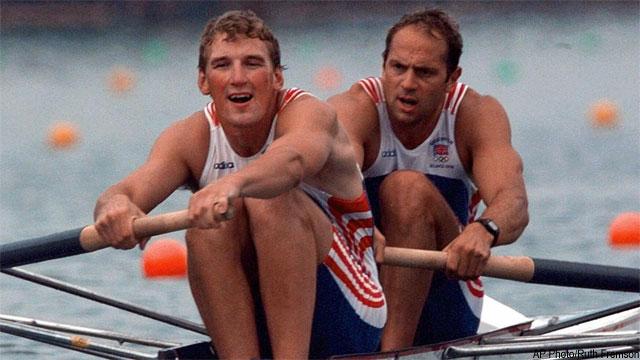
"We used to send teams along where the top boats were capable of winning but it’d be a good result for the bottom boats to get in the top 10," said Matthew Pinsent, who won three of his four gold medals alongside British Olympic great Steve Redgrave.
"But I asked Steve the other day, is there a boat outside the women’s singles that will be happy with a bronze medal? The men’s quad is the only possible one. That’s 12 out of 13 boat classes going, ‘I’m not happy with a bronze."’
That’s some billing.
Britain won two golds in a haul of six medals at the 2008 Beijing Games, the country’s biggest total since the 1908 Olympics — which were held in London.
Four years later and back on home soil, the expectation among a squad which topped the medals table at the world championships in Slovenia last year is for far more.
"The possibilities of what we could achieve are endless," Mark Hunter, the reigning champion in the lightweight men’s double skulls, told The Associated Press. "All of our boats have a chance of winning an Olympic medal."
Hunter and partner Zac Purchase are seeking a third straight world title this year and are shoo-ins for selection for the Olympics. But British coach Juergen Groebler won’t have it so easy elsewhere.
Groebler, a former East Germany coach who has been part of Britain’s coaching staff since 1992, has a deep pool of talent from which to choose. Some big names are going to be left disappointed.
"Juergen isn’t immune to all this. He’ll be tossing in his sleep now, there’s no doubt about it," Pinsent said.
The biggest selection problem for Groebler, who has led crews to gold at every Olympics since 1972, will undoubtedly come in the men’s four.
His main charges are Pete Reed and Andrew Triggs-Hodge, Olympic champions in the four at the Beijing Games who have found life more difficult as a pair.
Reed and Triggs-Hodge have lost their last 14 races to the New Zealand pair of Eric Murray and Hamish Bond, and could well be moved back to strengthen the fours. That would mean splitting up a crew of Ric Egington, Alex Gregory, Tom James and Matt Langridge, who went through 2011 unbeaten.
"It’s the hardest decision Juergen will have had to make since he’s been in the UK," Pinsent predicted. "But in some ways, the decisions at the top of the squad are nice decisions to have."
With Pinsent and Redgrave — the latter a winner of gold medals at five straight Olympics from 1984-2000 — long since retired, Britain no longer has the household names that made the country synonymous with Olympic rowing.
Britain’s closest thing to a star — at least domestically — is Hunter, who in tandem with Purchase is being widely spoken of as a surefire bet for gold on Dorney Lake in July and August.
The lightweight pair teamed up for the first time in 2007 and won Britain’s first ever Olympic lightweight title 12 months later.
After a year off, Hunter and Purchase returned to the water, shook off the rust and won two straight world golds in 2010 and ’11.
It’s no wonder the pressure is on the pair to be back on top of the Olympic podium this year.
"It’s very different to 2008, though," Hunter said in a telephone interview shortly after his return to the Leander Club in Henley following a punishing two-week training camp in Portugal. "Then, the country was quite down and miserable in terms of being at the start of the recession. The GB team was doing really badly, too.
"But then we go to the Olympics and do massively well, better than all expectations. From that moment, it built up the excitement and the pressure for 2012. The profiles of all rowers have got bigger and bigger because it’s a home Olympics. The anticipation is much different."
With a full crowd expected for every session, British rowing is going to be under the microscope like never before.
"We’re used to rowing heats in front of grandstands that have our parents and few dogs," Pinsent said. "At this Olympics, every session’s been sold out.
"They are going to turn up to Dorney and go, ‘Oh my God.’ And that’s when you are racing your heats. It’ll be like Saturday afternoon at the Henley Regatta every single race."