By Jennifer Lukas
CTVOlympics.ca Staff
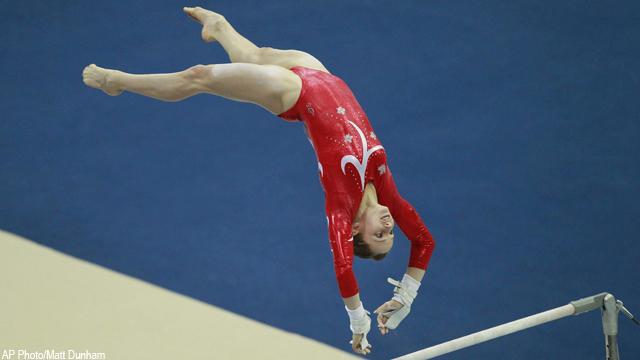
If you could send one message to your 14-year-old self, what would it be? For Canadian gymnast Kristina Vaculik, the answer comes easily.
“Have patience.”
The message may sound precocious, or perhaps somewhat ironic, coming from a teenage university student. But at 19, Vaculik is considered a veteran in her sport.
“I’m the oldest one now, so I kind of like to act as the team leader and be in the mentoring position as well. It fits well,” Vaculik said in a recent interview with CTVOlympics.ca.
“They called me ‘mom’ around the [Pan American Games].”
An Olympic hopeful who recently helped Canada qualify its first full women’s Olympic gymnastics team since 2004, Vaculik is preparing to pit herself against many of the country’s top gymnasts — and her occasional teammates — at this week’s Elite Canada gymnastics competition in Mississauga, Ont. She is among the more experienced Canadian competitors in the sport, with more than four years of senior-level competition experience under her belt. While it may not seem like a particularly lengthy tenure, it is a full career span for many elite gymnasts.
One hole in her resume is her lack of an Olympic Games experience; however Missing out on Beijing 2008 might just be the most useful experience of all.
“I was really hoping to go to the Olympics in 2008,” Vaculik said, and then paused.
“But it just didn’t happen.”
Canada did not qualify a full team for the Games that year, and Gymnastics Canada was faced with the difficult task of choosing just two athletes to compete.
At just 15-years of age at the time, Vaculik narrowly missed the cut. Although she was named to the reserve squad, a subsequent elbow injury pulled her out of that position as well.
“It was just from constant pounding and that year leading up to the Olympics was really not good for it because that’s when I was just competing, training. I competed every weekend up to the Olympics trying to gain points [to qualify]. By the time I was named as the reserve, my elbow was just not good. So I had to pull out and get surgery.”
The Whitby, Ont. native faced six months of recovery time before she was allowed to return to training. She worried she would miss out on university scholarship offers because she was unable to compete. And she spent the next two years regaining her skills and re-learning how to execute the tumbles and leaps she had grown up executing to perfection.
Patience was gained in spades during those long years.
“This sport is hard on the body … maybe if you’re injured and if you’re not patient with the recovery process you can get more injured and it’s pretty frustrating,” Vaculik said.
“When I’m training with a group of girls, I know that you look at one another and you look at how other girls are learning new skills and how they might be learning faster than you.
“I tell my [younger] sister things like that and girls in my club. I train with a group of younger girls. Ten-or-12-year-olds. I’ve told them things like that … that it’s all just a matter of time. If you’re patient, if you know that you work hard every day in the gym, it’s just a matter of practising and putting your best into it every day. Everyone learns at her own pace. That’s the patience part.”
The women’s gymnastics national team director, Kyna Fletcher, watched Vaculik go through the heartbreak of missing the Olympic Games her first time around.
“At that point, Kristina was really young, not that it means anything,” Fletcher said. “But to have a second go-around, she’s very, very fortunate. And we’re fortunate to have her that driven. I think that’s a huge example for us. She could have quit and walked away. Easily. And she didn’t.”
Ahead of the Olympic qualifying event in London last month, Fletcher brought up Vaculik’s experience with the team. If we don’t qualify a full team of five girls, she told them, you will have to go through that selection process again.
“As a team, we sat down and talked about it, ‘Ok, girls, which one are we going to send?'” Fletcher recalled.
“[Kristina] said to me, ‘There needs to be a whole team there. I don’t want to do this on my own.'”
The team succeeded at the January qualifier where the 2008 team did not. Their combined score of 221.913 led them to a second-place finish. It was more than good enough for full-team qualification.
Fifteen-year-old Victoria Moors — the youngest athlete from any nation to compete in the London event — was among the athletes that helped Canada to its qualifying finish.
“When I was 10 years old, I watched Canada on YouTube. I would just, go on the gymnastics website and kind of be like, ‘Oh, I want to be like them one day.’ But now I’m competing on their team. It lights me up completely,” Moors said at the time.
“This is actually my first big competition so I haven’t really had anything like that before. People are coming up, asking me for my autograph and I’m just like, ‘well this is a first.’ It’s really cool.”
Moors is a budding talent that greatly impressed Gymnastics Canada at a selection camp ahead of the competition, but she had never before competed at a senior international level. The leap upward could have been overwhelming, but Vaculik made sure that Moors knew her door was always open.
“Basically, if she was uncomfortable in any way, she had us to come to. …We all have each other’s back,” Vaculik said.
“I know it’s hard being younger and being with a group of older girls because you feel pressure and like you have to live up to standard, but it’s not really about any of that. It’s about going out there and doing what you know you can do."
Teammate Peng Peng Lee, 18, watched and admired as Vaculik took the 15-year-old under her wing at that competition. Moors went on to finish second in the floor exercise final.
“I look up to Kristina. She’s a team leader,” Lee said. “She keeps us going. She always makes sure that we’re on track and we’re focused. There are a lot of gymnasts I look up to, like [four-time Olympic medallist] Shawn Johnson, and all those big names. But Kristina always makes sure that no one is left alone and that no one is being isolated. So we always feel like a team. And [in London], that was amazing. Because we all needed to be as a team.”
Becoming a team in a sport that emphasizes individual achievement is no easy feat. Canada’s top gymnasts come from across the country and train separately until they gather at competitions and occasional team selection camps.
According to Fletcher, veterans like Vaculik have a lot to offer the younger competitors. Canadian teammates Lee and Brittany Rogers were also a great help in London, she said.
“I think they set a good example. They have a calmness about them because of their experience. We’ve really worked at getting them to sort of pull the girls in and make sure that we’re all together no matter what. We’re one.”
Fletcher expects the veterans to continue to play a big part in the lead-up to the 2012 Olympic Games. The team will not be named until sometime in June, and the girls will have just a few short weeks to come together before the Games begin.
“I think trying to put [young gymnasts] into as many circumstances as you can with those girls to kind of be able to model and mentor the behaviour … and the mental preparation, I think that’s important. It’s great for them to kind of be able to model behind that and for us to encourage them and be able to say, ‘Hey. Have a look at So-And-So. She’s dealt with adversity, she’s dealt with this and she’s still come through on the other side.'”
Teammates have picked up the message.
Asked which gymnasts she admired, 17-year-old Olympic hopeful Madeline Gardiner thought of Vaculik right away.
“Kristina tried for the 2008 Olympics and she’s back again for 2012”, she said. “We’re all super proud of her and she had a previous injury, but she’s back and doing really well and that’s just inspiring.
“It kind of gives you a little bit of hope knowing that you have almost a second chance.”