THE CANADIAN PRESS
VANCOUVER — Athletes could be better prepared to handle the world’s fastest luge tracks, says one of Canada’s top lugers in the wake of a report suggesting Nodar Kumaritashvili’s death at the Vancouver Olympics could not have been prevented.
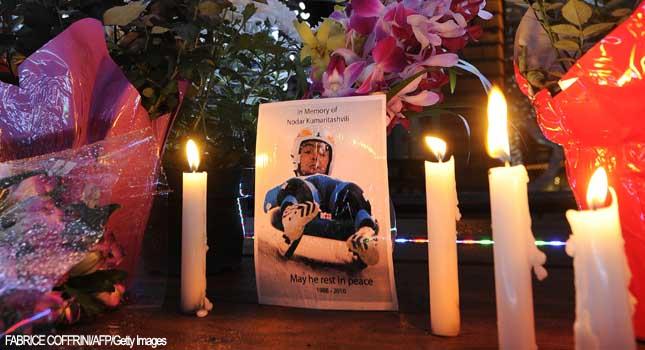
The accident that will forever mar the memories of the 2010 Winter Olympics was set in motion by a mistake that the 21-year-old from Georgia made coming out of a curve on the Whistler luge track, the International Luge Federation (FIL) said in a report released Monday.
But after that crucial moment, Kumaritashvili lost control and ended up at the mercy of gravitational forces that turned his sled into a catapult.
"No athlete would have control in dealing with this type of ‘catapult’ effect," the report said.
Canadian luger Jeff Christie, who finished 14th at the Winter Games, said there was simply no predicting the accident.
"The accident was such a freak accident, it ended up happening to Nodar, but it could have happened to anybody, in my opinion," he said in an interview.
"The events that led up to it were a perfect storm."
But Christie, who is an athlete’s representative on the luge federation, suggested there need to be stronger rules about training runs.
While the FIL report reaffirms that Kumaritashvili had fairly qualified for the Games, he had only 26 runs down the track prior to his accident.
This was despite the fact that FIL had mandated extra training runs for competitors in an acknowledgment of the track’s high speeds.
But Kumaritashvili didn’t attend the 2008-2009 international training week at the track, nor did he compete in the 2009-2010 World Championship there, according to the report.
"If you don’t show up for them, you don’t get that extra experience," said Christie.
"If we added something extra into the Olympic qualifications saying you have to qualify like normal but at the same time you have to have had a certain percentage of the offered runs, I think that would be a good way to learn from what happened and be able to move on in a productive way," he added.
The chilling accident, on the first day of the Olympics, was streamed live online, the final moments showing Kumaritashvili’s goggles skittering down the track as he lay motionless besides it.
As the first bars of music were being played at the opening ceremonies later that night, officials were huddled in meetings trying to figure out how to continue with competition.
The FIL report said there was "a divided opinion" about lowering the start ramp for the men’s competition, which was the first medal event on the track following Kumaritashvili’s death.
There was no unanimous consensus about lowering the start for the women’s and doubles races either, FIL said.
Shortening the courses was done to reduce speed and provide "an emotional and psychological benefit to the athletes."
Officials also raised the height of the walls on sections of the course and squared off the curve of the ice between the base of the track and the side walls.
Though competition went ahead, organizers faced daily questions over the overall safety of the track and whether the changes were an acknowledgment that it was too fast.
The $119-million sliding centre had been built to specifications that should have kept racers at speeds below 136 km/h.
The top speed achieved on the track was 153.98 km/h by German racer Felix Loch.
"The FIL has determined, as is verified within this report, that it was aware of the high speed reached on the Whistler track," the report said. "Based on this, it implemented changes it believed would mitigate the challenges posed by the higher than anticipated speed.
"Thousands of runs were conducted on this track prior to the Olympic Winter Games by which FIL became convinced that it had managed to establish a safe environment for athlete competition."
The report said Kumaritashvili exited the 15th curve in the 16-turn course too late, causing him to take a less-than-favourable line into the final curve. FIL decided that Kumaritashvili tried to keep the sled low on the track, which raised the amount of G-force he would experience in the final seconds.
With that, he lost control.
Kumaritashvili’s right hand reached for the ice, which distributed more weight onto his right shoulder. Combined with the G-force, that meant the sled runners basically steered him straight to the right — in this case, into the inside corner of the wall.
"Both actions literally served to pivot it in a similar way a sharp turn is made when a handbrake is applied to a car at a high rate of speed," the report said.
Typically, when a sled hits the wall like Kumaritashvili’s did, the runners will break or the slider will be thrown off the wall. Neither happened, and the energy threw Kumaritashvili over the opposite side of the track, milliseconds after he was clocked at 143.88 km/h.
Kumaritashvili’s hips cleared that wall by centimetres. Had that wall been a bit higher, he would have likely remained in the track. Instead, he sailed over the barrier, the back of his head striking a steel beam — the fatal blow.
FIL said that, in normal situations, that wall would have been high enough to keep a slider from exiting the track.
"Neither the computer simulations nor the technical experts who (certified) the track … foresaw the possibility," the report said.
Athlete safety should continue to be the primary concern going forward, said John Furlong, chief executive officer for the 2010 Olympic organizing committee, known as VANOC.
He said the FIL report brought no closure for him and suggested he was uncomfortable by the idea that Kumaritashvili seemed to be at fault.
"I think the most important thing is to think about how you don’t have that happen again," he said.
"A young man died here, our priority needs to be to try and do everything we possibly can for that young man’s family."
The International Olympic Committee said in a statement that Kumaritashvili will never be forgotten and called the report a thorough effort.
It will now form part of a larger review being conducted by the IOC on the safety of all sports at both the Winter and Summer Games.
As for the track itself in Whistler, the changes made after the accident will remain in place unless FIL says otherwise, said Keith Bennett, president of the Whistler 2010 Sports Legacies Society which assumes ownership of the facility on May 31.
"I don’t think the report is going to change our plan, which is to proceed with a recreational program and welcoming the national sport organizations and their athletes to come back and train and race here," Bennett said in an interview.
Athletes plan to do so.
"That track is very important for our program and for our future," said Tim Farstad, executive director of the Canadian luge federation.
"We plan on recruiting, and sliding and having our national teams go there and train on it before Europe. We plan on using it as much as possible."
FIL is not scheduled to race in Whistler next season. Bobsled and skeleton are to race there this fall.
The luge federation said it anticipates resuming "competition from the original start heights" for both a World Cup luge race in 2011-12 and the 2013 world championships in Whistler.
The report also makes clear that keeping speed in check will be a top priority at tracks going forward. More than a year ago, the FIL told Sochi officials they would not homologize, or certify, that track if it was built to allow speed exceeding 135 km/h.
"The question is, why did he go out of the track? Part of that is the speed," USA Luge CEO Ron Rossi told the Associated Press. "Lesser speed, he wouldn’t have gotten such potential energy and he wouldn’t have gone above the line of the wall."
David Kumaritashvili, the slider’s father, agreed.
"No matter what mistake he had committed, he should not have flown off it," the slider’s father said.
While FIL said it was their final report, there are still more to come.
The coroner’s office in B.C. will release its own report next month, that will include a more detailed accident reconstruction provided by the RCMP.
FIL meetings in May and June will further discuss track safety, particularly at the facility to be built for the 2014 Sochi Olympics.
—
With files from The Associated Press