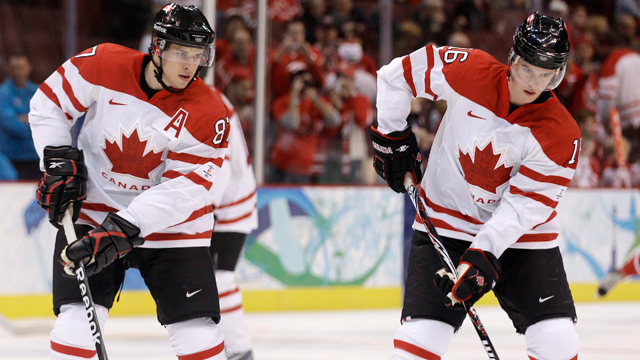

As Jonathan Toews led his line onto the ice more than a dozen minutes into a scoreless affair, the anxious buzz that preceded the opening faceoff of the 2010 gold medal game in Vancouver still reverberated around the arena. Though he’d been a key player for Canada in the tournament, anchoring what might have been the most offensively capable checking line in hockey history, Toews had yet to find the back of the net. After a faceoff to the right of American goalie Ryan Miller resulted in the puck moving behind the goal, Canadian left-winger Mike Richards went on the attack. Richards picked the pocket of defenceman Brian Rafalski, pivoted toward Miller and fired a quick shot. The rebound kicked out to the side of the net, where Toews had been surveying the situation. Before Miller had a chance to reset, Toews snapped the puck home. The then-21-year-old’s first Olympic goal not only gave Canada a 1–0 lead, it meant Toews was now officially contributing in every aspect of the game.
The final goal of that epic clash, of course, produced the image that will endure for decades. But while Sidney Crosby’s overtime winner instantly afforded him a spot in hockey lore, when it came time to anoint the best forward of the Olympics, Toews got the nod. That was acknowledgement not only of his team-leading eight points, but also his yeoman’s work blanketing opponents alongside Richards and right-winger Rick Nash. Four years, two Stanley Cups, one Conn Smythe and one Selke Trophy later, Toews’s status has gone from two-way force to all-world superstar, a generational player who could walk into the Hall of Fame at age 25. But for all the accolades in Toews’s confetti-rich career, Canadian coach Mike Babcock will once again be counting on the less-glamorous weapons in Toews’s arsenal to make an impact. It’s Toews’s diversity that best defines the type of players Team Canada gravitated toward in its quest to defend gold, and nobody on the club is more capable of performing a wide variety of tasks at an elite level than the Chicago Blackhawks’ captain.
If Crosby remains the country’s golden boy, then Toews is the dutiful son who handles all the details that keep things running smoothly. “Captain Serious” isn’t the type to leave anything to chance. And even if he has front-man moxie, he’s happy to play the role of bass player, keeping the background beat. If shutting down Ilya Kovalchuk, Phil Kessel and Nicklas Backstrom comes at the expense of offensive chances, so be it. Regardless of whether Canada is leading or trailing in a tight game, the two constants will be collars that feel tight and Toews being on the ice.
While the same can’t be definitively said of any other Canadian forward, executive director Steve Yzerman and his staff clearly value decorated athletes who can move around the chessboard. That’s how guys like Patrick Marleau, Jeff Carter—both of whom have spent extensive time at both wing and centre—and Toews’s Blackhawks teammate Patrick Sharp landed on the squad. Marleau was on the 2010 Canadian team, creating a familiarity that could prove crucial in a short tournament. Because Marleau has never been the visibly teeth-gnashing type, his efficient game is sometimes knocked for a lack of passion. But it’s easy to overvalue exuberance and undervalue consistency, and Team Canada knows exactly what to expect from Marleau. The same can be said for Carter, a big body who had three game-winning goals for the Los Angeles Kings in their march to the 2012 Cup. Carter’s game might not jump off the page, but he’s an opportunistic shooter who can be slotted into different spots and still do damage. Sharp is capable of playing both wings, and his skating separates him from the pack. His defensive awareness makes him a viable candidate for duty on a shutdown line like the one Toews centred in Vancouver, but his high hockey IQ could also mesh with the wizardry of a playmaker like John Tavares.
Of course, none of Marleau, Carter or Sharp are Toews. The few guys in the world who are like Toews tend to get mentioned in those hypothetical conversations about having one player, regardless of age, to build a franchise around. While other countries would surely promote some of their homegrown heroes, the puddle-sized pool of players like Toews is still largely stocked by Canada. Think Crosby and Tavares. For all the hand-wringing that gets done any time Canada enters an international competition and doesn’t return with gold, the country still produces players who are the top one percent of the top one percent, athletes who got an extra dollop of ability along with the maniacal focus that allows them to separate from merely spectacular players. Those are the people who seem to somehow always be at the epicentre of extraordinary moments, like Gretzky to Lemieux in 1987, Joe Sakic burying the dagger past Mike Richter in 2002 at Salt Lake City and Crosby taking a pass from Jarome Iginla before stuffing the puck by Miller to send Canada into hysterics four years ago.
Toews’s extra sprinkle of pixie dust first glistened at the 2007 World Junior Championship, when he went three-for-three in a shootout versus the United States with a berth in the gold medal game on the line. Along with his tremendous showing at the Olympics three years later and the incredible work he’s done transforming the Blackhawks into a perennial NHL power, Toews’s junior exploits now seem like an obvious harbinger of what was to come.
What does Toews have in store for this prime-time showing? His varied attributes make for endless possibilities. All we know for sure is that whatever the situation, Toews will get the tap. And given the other multi-dimensional options on the Canadian bench, that’s saying something.