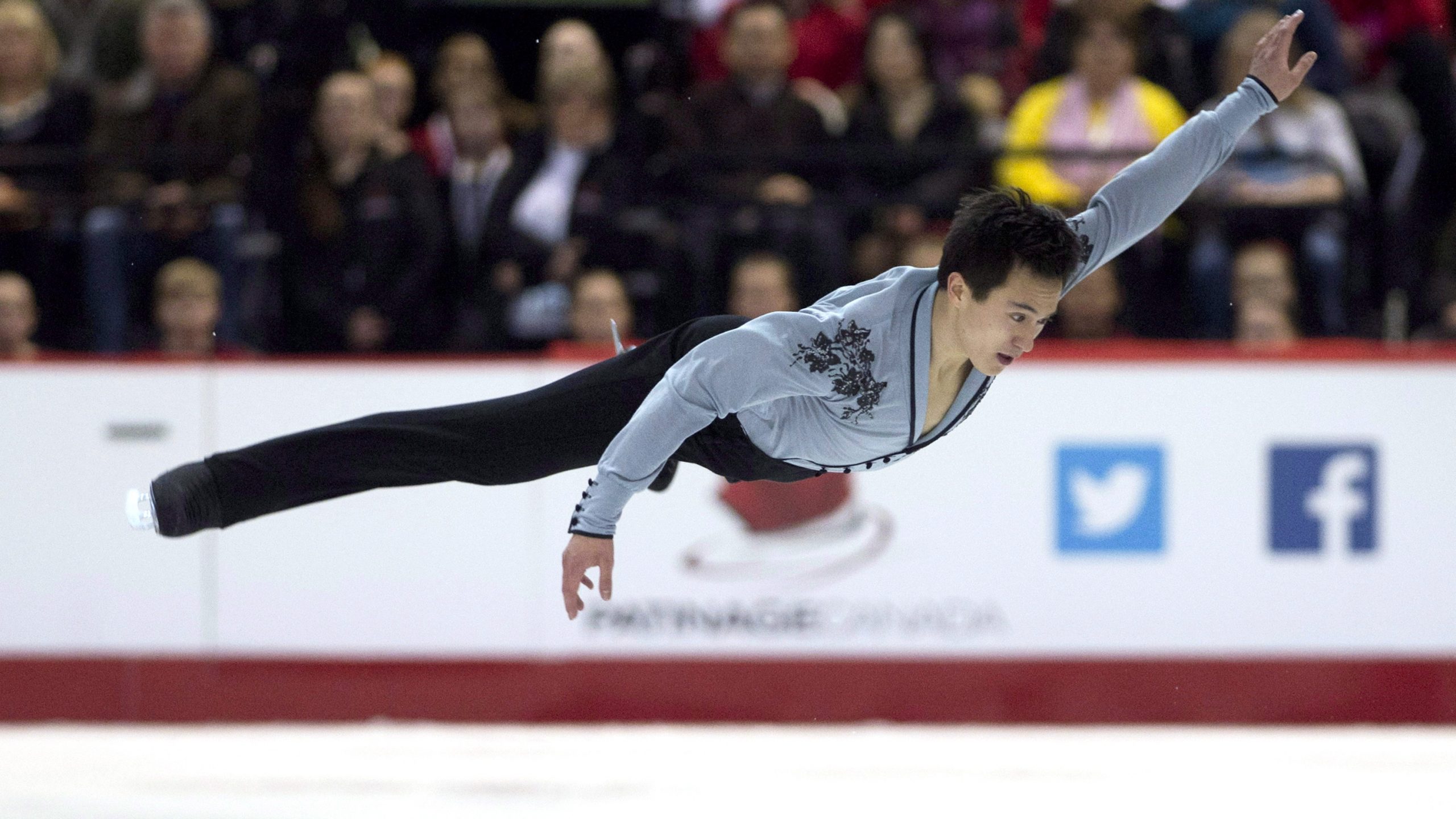

Patrick Chan, 23, is Canada’s best bet for a first-ever Olympic singles figure-skating gold. The three-time world champ took the time to detail the opening of his short program for Sportsnet, including the quadruple-toe, triple-toe combination.
It’s always really nerve-racking at the start. My short program is unique because it has about seven seconds of music where I don’t move. It gives me a chance to calm my breathing and let the music take over and guide me through the program. That’s the one element of skating that never changes, whether you’re in Japan or China or Europe or back home—the music is always consistent. I start to match my breathing with it. When I initialize my first movement, it feels like there’s goosebumps travelling up my body.
I bring my arms up. I try to tell myself to stay really calm and to move my arms from my shoulders and back, because when I’m jumping, spinning and moving on the ice, I always try to move from my back as opposed to my extremities. It’s really important to set the stage properly.
The music keeps going. I drop down and I come back up, so there’s a balance component of the program where I’m on both my toe picks. It’s funny, when I first learned to do it, it was very hard and I lost my balance a couple of times. I just listen to the music and I hit the toe picks on the right cue. What you notice is the music really is the dictator in the program.
Then I come around to the other end of the ice. As I skate, there are turns, very subtle movements that I think only certain experienced skaters can do because the music is so slow—there aren’t a lot of busy notes, it’s just the piano. It’s very simple, so you have to be quite confident in your movements because you can’t just cover up things you’re not good at with more arms—there’s no music to do it to.
I extend my arms and legs, and look at the judges, peering over to initiate the connection so they don’t feel like I’m leaving them out. The problem I had with this program at the beginning of the season is that I was too disconnected from the judges—too much in my own world instead of drawing them in so they start feeling the same thing I am. You do that with little subtle gazes matching the extensions.
Then I lunge down and look up, and that’s when I initiate the fall and the rise of the whole program. It’s like stretching pasta—you’re stretching and contracting and you want to keep it flowing.
I start setting up for the quad—I try to get as much speed as I can. The one disadvantage of a piece of music that’s slow is that you tend to skate slow and become relaxed. But you can still be aggressive, and that usually gives it a very cool effect. I always try and think of pushing with my whole blade against the ice on the crosscuts when I’m backwards, and when I turn forwards and step into the quad, I try to push with my back leg to the front leg, making sure that I rise. It’s a step forward but it’s more of a jump to the front leg, because I’m so light on my feet and I’m transferring a lot of power and momentum. That’s very important going into the quad, you want to keep the momentum moving.
I’m not sitting on my heels; I’m always on an edge. You can’t generate speed on a flat blade—you need to be on an edge in order to push against the ice. That push usually gives me enough speed, and then I always do an arm flourish to the judges at that point. Once again, it’s to acknowledge their presence. A lot of skaters don’t do that—especially going into a quad—they don’t take the time to be like, “OK, I know you’re still there,” to the audience and the judges.
Then I pivot backwards. I’m done getting my speed and I initiate my three-turn—a change in direction and a change in edge—into the quad. At that point in competition I’m always telling myself, “Check, I feel good, good speed.” Then I think of holding my right side. Going into the quad, you never want to get your upper body ahead of your legs; that’s usually when you don’t get the right axis in the air.
As I do my three-turn, my arms are static. It’s what my coach Kathy [Johnson] and I call a body hold. Your arms and your chest and your shoulders are in one spot, so you could be moving side to side or backwards and forwards, but your body’s staying in one spot.
On the quad toe, I rotate counter-clockwise, so I pick my left foot in. A lot of people think you’re vaulting yourself up off your toe pick, but the toe pick is really a transferring of weight. You’re actually jumping off your right leg more than the left. You won’t be able to get enough height to do a quad if you put all your weight on the picking leg and try to jump off that leg. Your right leg is angled so you can generate the most power from your quads and glutes.
Once I step forward, I try to snap my hips. I’m coiling my hips back, and when I pick, I snap my hips. After that, it’s kind of a blur. I set myself up as much as I can and the rest of the jump is muscle memory. I don’t know if Kathy’s going to like this, because I’m telling all my secrets! Then I just think of bringing my right elbow in and squeezing as hard as I can. My big quads last around .72 seconds. Technically you can squeak out a quad in .69 seconds in the air.
As I land, my right foot has to come down first. Sometimes you’re a bit off in the air so you could be landing on an inside edge. That’s usually quite dangerous. Flat or an outside edge are the best landings. If you land on the outside edge, if your toe pick hits and then you hook, it’s kind of like a pinball machine—when the ball hits a curve in the track, it generates a lot of speed. I try to land on the toe pick a bit on an outside edge, and that usually whips me out with a good flow, enough to do a combo.
The quad in the air might be the fastest I’ll go in the program, but I don’t go much slower after landing it.
To get the triple toe up, it’s basically the same thing [as] the quad toe, only three rotations. Without putting the free leg down, you have to ride the momentum and pick with the left foot again. You always want to initiate every jump in figure skating with your legs, as opposed to your upper body. Your upper body’s just along for the ride.
At this point, my heart rate is pretty high, probably 170 or 180, and I’m just getting started.