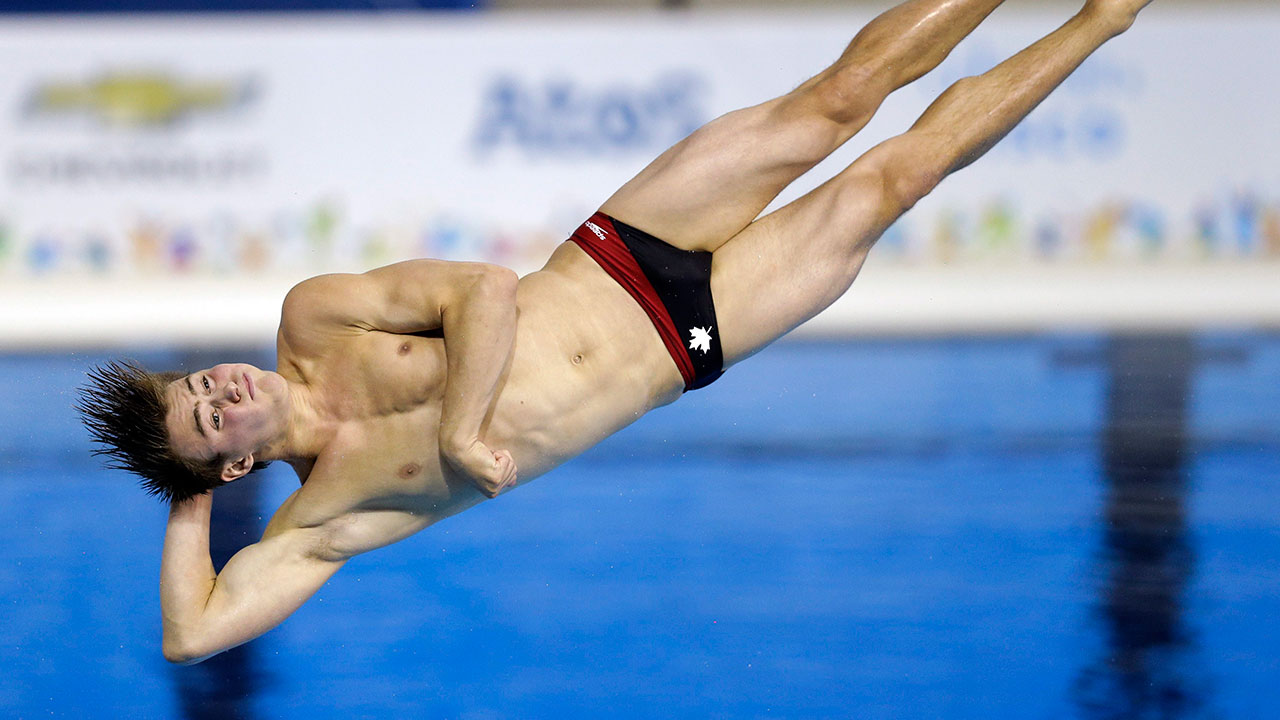
To execute 307C (diving parlance for the reverse three-and-a-half, tuck position) off the three-metre springboard, Philippe Gagné takes four carefully measured steps toward the tip, launches off his right foot, again off his left, and a third time off both (these jumps are known as the “hurdle”). He vaults into the air, as high as possible and away from the board, then hurls himself back toward it, pulling his knees up to his chest, gripping his shins, and spinning repeatedly before entering the water.
Reverse dives are difficult, and dangerous: Miss your mark and pray your head doesn’t collide with the board in that first blind backward rotation (as Greg Louganis’s famously did at the 1988 Games in Seoul). But 307C happens to be Gagné’s favourite dive. “When you know you’re getting it right, it’s one of the best sensations,” he says. Gagné got it more right than ever at Canada’s Olympic diving trials last month, netting a score of 99.75 (out of 100), a personal best.
At 18, Gagné is the youngest member of Canada’s Olympic diving team, and the latest in a steady stream of world-class athletes this country has fielded in the sport over the past 30 years. He began diving at age five at his local pool and a year later was referred to CAMO, the prolific Montreal diving club that produced Jen Abel, Émilie Heymans and Alexandre Despatie (and before them Annie Pelletier and Sylvie Bernier). He is relatively new to the international circuit—the Pan Am Games last summer were his biggest competition to date, and he was so nervous he almost didn’t make the finals. But then he recovered to collect the bronze medal and went on to his first world championships in Kazan, Russia, where he and François Imbeau-Dulac came fifth in the men’s synchronized three-metre.
Gagné only made it as far as the semis in the individual event at worlds, and he knows he has some work to do before he catches up to the Chinese and Mexican divers who tend to dominate the podium. “I still have a lot of technique to be perfected and I need to [build] a little muscle,” he says. But he’s also confident in what he brings to the table. A taller diver at five-foot-11, Gagné manages to get a lot of height off the board, which gives him room to better control his dives. He also has a strong entry, that all-important element of diving that living-room judges around the world train their eyes on when the Olympics roll around every four years. “I have, we call it a rip,” says Gagné. “I’m good at making almost no splash.”
Gagné may be a long shot to medal this time around, but Canadians will likely be hearing his name for years to come. And don’t be surprised if he gets to the finals in Rio. He’s good under pressure, often nailing his hardest dive, 407C (the inward three-and-a-half, in which the diver starts with his back to the water and, after takeoff, rotates forward, toward the board), in competition, despite struggling with it in practice. “I’ve always been a diver who doesn’t really think that much when I’m doing a dive,” he says. Before climbing up to the board, Gagné will receive a “correction” from his coach, some specific aspect of the dive to focus on to try to maximize performance. “I can’t stand staying on the board for more than five seconds,” he says. “I’m going to think about the correction and just try to do it. And it always helps.”
The men’s three-metre springboard preliminaries will be held on Aug. 15