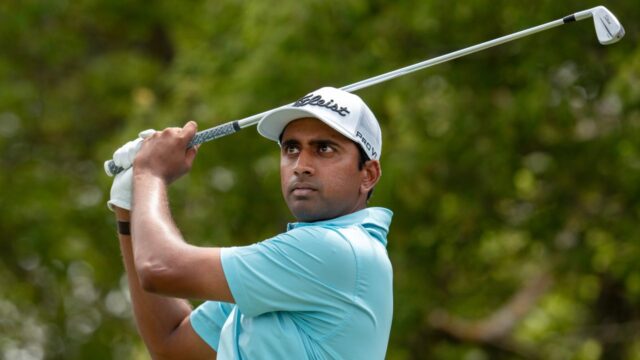
CALEDON, Ont. — The path toward the highest reaches of professional golf is rarely a straight one, and it tends to get increasingly narrow the closer you get to the prize. There are plenty of prodigies among the game’s biggest names, athletes whose success seemed assured from the time they picked up a club: Tiger Woods, Rory McIlroy and Phil Mickelson among them.
But for so many others, it’s a road less travelled, with plenty of potholes and blind turns.
And yet one way or another, the ones with the right combination of talent, temperament and perseverance find a way.
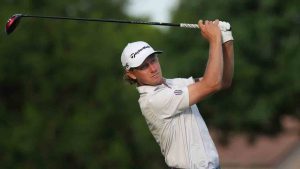
Sudarshan Yellamaraju, the 24-year-old from Mississauga, Ont., who is teeing it up at his second RBC Canadian Open at TPC Toronto at Osprey Valley this week, is just such an example.
He didn’t come from a golfing family or grow up with access to the best equipment or the finest courses. His family immigrated from India to Winnipeg as a child. And golf was something that his father — who didn’t play golf himself — would put on TV to keep his son occupied.
Something must have crept in through osmosis because Yellamaraju couldn’t get enough of this strange new game. He took up golf as a six-year-old, playing almost exclusively indoors during the long Winnipeg winters, using rental clubs. At age 9, he entered his first tournament and shot 101. It was the last time he wouldn't break 100. By the time he was 11, his family had moved to Mississauga to give him more opportunities to explore the game.
But it was very much an exploration. Rather than hire coaches, he watched YouTube, absorbing clips of the greats he was trying to chase, taking advantage of the opportunity to watch their swings frame by frame and compare them to his own. If he saw something they were doing that he wasn’t, he’d try it. If it didn’t work, he’d try something else. In between, he’d keep practicing.
Does he have a superpower for discernment?
Most people who resort to YouTube or go swimming solo in the deep waters of the golfing internet end up drifting far from shore, their golf swing a never-ending collection of tips and drills and feels that can cause more confusion than certainty.
But Yellamaraju found his way.
“I mean, the only thing I can say is you just got to just feel it out, right?” he said after carding a one-under-par round of 69 while playing alongside 2022 U.S. Open champion Matthew Fitzpatrick of England and Norway’s Victor Hovland, a seven-time winner on Tour. “Feel what works for you. Eventually kids are going to start playing the game because they want to just have fun and they want to enjoy it. And if you're wanting to just kind of keep getting better, if you're going to do it by yourself, it's just trial and error, and you just figure it out, and practice. I spend hours and hours practicing, so maybe that's probably helped a lot.”
Seems to have paid off.
Yellamaraju has made a steady climb up the professional ranks since forgoing college golf after high school: He played qualifying events for what is now the PGA Tour Americas and eventually gained status there and used good results on that tour to earn status on the Korn Ferry Tour, the feeder tour for the PGA Tour. His breakthrough came last year, when he won on the Korn Ferry Tour and earned enough ranking points to graduate as a full member of the PGA Tour.
Instead of watching golf’s greats to absorb their swing mechanics, Yellamaraju was suddenly competing against them, and often beating them. His fifth-place finish at the Players Championship in March earned him more in one week — $925,000 — than he’d won in his entire career to that point.
After 16 events, he’s made 13 cuts and earned $2,267,877 and arrived in Caledon as the leading money winner among Canadians on Tour.
And he’s still doing things his own way. When you look out at the practice range at a PGA Tour event, there’s never just a player hitting balls, trying to find their groove, alone in their own thoughts. At the professional level, the most solo of endeavours is a group activity. There’s almost always a small army of experts and assistants trying to help squeeze out a margin, ease some doubt of just crack jokes. There are swing coaches and mental-performance coaches and short-game coaches and putting consultants, strength-and-conditioning coaches and nutritionists.
Not for Yellamaraju. There’s him and his caddie. Even now, he doesn’t have a coach. The closest he has is his father, who grew up playing cricket in India and might play golf once a year. But it’s still his eye that Yellamaraju trusts — that, and the work he puts in to find his game in the dirt, as Ben Hogan used to say.
But not on Thursday. Rather than fight traffic and walk among the crowds in the heat, the Yellamaraju family stayed home, trusting their son would navigate the course well enough on his own, because he always has.
“They said they didn't really want to be in the whole hustle and bustle, so they're probably able to watch on TV,” said Yellamaraju. “(Ours) was a featured group, so … “
Experiencing golf through a screen has been essential to his development, anyway. Father and son would pore over highlights and slow-motion clips and distill their own answers to the mysteries of a game that few can ever solve.
“It's like we both learned the game together, because he doesn't play golf,” said Yellamaraju, who was tied for 73rd, five shots behind a pack of six golfers at minus-1. “He had really no interest in golf, to be honest. It was my own interest. So, it was just kind of he was just learning through ... he played cricket growing up, so some characteristics from that. But, obviously, there's still a lot of things that you can't do the same way when you're playing cricket to golf. So he tried that, and then he also would watch as well and try to see what people would do and … like I said, a lot of trial and error where we were just kind of learning together.”
The external validation wasn’t all that long in coming. It became pretty clear he was on the right track when he began racking up junior wins and then even did well when he stepped up against older competition.
“When I won the 2017 Ontario men's amateur, when I was 16, that was a pretty big,” he said. “I would say that was just like a really big assurance that I'm doing the kind of the right things, but I had still a long way to go in what I was doing, but like I said, a big one like that really helped.”
He’s quickly earned the respect of the other Canadians on Tour.
“I’ve played a few practice holes and been paired with Sudarshan, and he's really impressive,” said Corey Conners, a two-time Tour winner from Listowel, Ont. “I love how he goes about his business. … He’s really focused in on each shot. He hits the ball far, hits it straight, a great putter. There's really no holes in his game, and I think you've seen that. He's made some great climbs up the leaderboard on the weekend and I'm really proud of him for that. He's an impressive player.”
Yellamaraju followed up his breakthrough at the Players with a sixth-place finish at the Houston Open the following week. He went from being a player few Canadian golf fans were even aware of to someone whose back story was being shared on network broadcasts. It was a little bit jarring.
“I mean, I was looking at it more like the fact I played well in a big tournament, and then all that stuff that kind of came, I mean, I kind of knew it would happen, but I didn't realize the magnitude of it,” said Yellamaraju, who said there was a noticeable uptick in fan interest this year compared to last. (There were a few cries of "Go Mississauga!" out there on Thursday).
“But I just kind of took it as a pretty good positive, and I'm just going to kind of build on that, and just trying to play, keep playing the best I can.”
The only difference now is that if he goes on YouTube, he can find his own highlights to study, with more potentially coming this week.