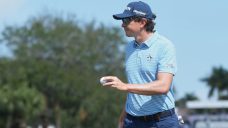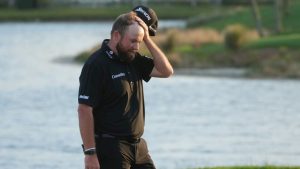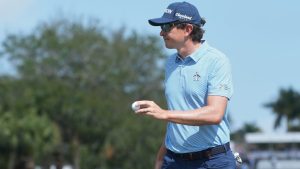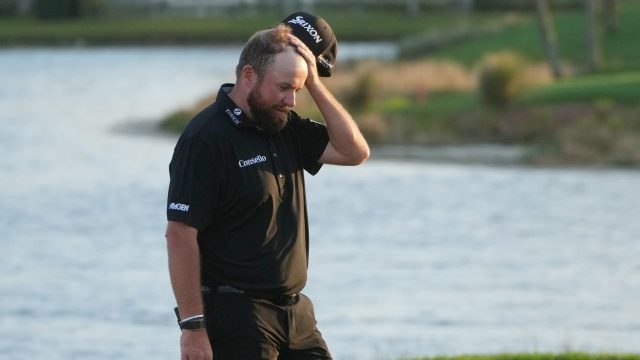
ORLANDO, Fla. — It's OK to feel sad for Shane Lowry.
He had one hand on the trophy and the other hand outstretched to hug his 4-year-old daughter when she ran onto the 18th green at PGA National to celebrate the first time seeing her father win. That was the plan, anyway. Lowry could practically picture the whole scene.
“Just to see her little ginger hair running down the 18th green would have been the most special thing in the world,” he said. “I thought I had it. I thought I was going to win.”
That was before he hit 3-iron off the 16th tee and into the water and had to scramble for a double bogey just to stay one shot ahead. Before he could hit another shot, Lowry watched Nico Echavarria make birdie on the par-3 17th to tie him. And then Lowry hit a chip 7-iron — perfect number, perfect club, imperfect swing — into the water for another double bogey.
A five-shot swing in two holes. It was cruel to watch, and especially painful to hear him talk about how badly he wanted to win for 4-year-old Ivy, no one else.
But there's no need to feel sorry for Lowry.
There will be other opportunities, perhaps more painful outcomes, no promises. Such is sport. This is what golf does to players at the highest level. The game can turn on the best of them without notice, as it did Sunday in the Cognizant Classic.
“Golf does strange things to you at times,” Lowry said, “and it certainly did it to me today.”
Lowry, of course, has plenty of company on far bigger stages.
Scott Hoch missing a 30-inch putt to win the Masters in 1989 comes to mind. Later that year was an even greater gut-wrenching moment when Mike Reid lost a three-shot lead with three holes to play in the PGA Championship. He was in tears meeting with the press, stopping six times to compose himself.
Bob Verdi wrote in his column for the Chicago Tribune that Jack Nicklaus sought out Reid in the locker room at Kemper Lakes and his voice cracked when he told Reid, “I just wanted to say I've never felt so bad for anyone in my life.”
It happens.
But it was something Lowry said late Sunday afternoon when trying to decipher how one bad swing on the 16th tee could leave him unable to feel the club face. Lowry said he told caddie Darren Reynolds, “How do I feel like this now when I went through what I did last September in Bethpage and got through that fine?”
It was a reminder not just how fickle golf is, but the extraordinary gap between the highs and lows.
Yes, it was only five months ago when Lowry birdied three of his last four holes, the last one from six feet to secure the half-point Europe needed to retain the Ryder Cup. What a moment! He pumped his fists and spun around the green while squeezing every teammate he could find.
“Coolest thing I've done in my life,” Lowry said that day, strong words coming from an Irishman who won the claret jug at Royal Portrush.
Jim Furyk is the only Ryder Cup player who was on both sides of the decisive match against Europe. He watched Paul McGinley celebrate a European win at The Belfry in 2002, and it was Furyk's win against Miguel Angel Jimenez that clinched it for the Americans at Valhalla in 2008.
His conclusion of those moments?
“Losing always hurts worse than winning feels good,” Furyk once said.
Lowry has suffered twice now at PGA National. It was four years ago when he came to the 18th hole tied for the lead. Sepp Straka blasted a 334-yard drive over the bunkers that left him a 6-iron to the green. And then the sky opened with rain so hard Lowry couldn't take the same aggressive line off the tee. "As bad a break as I’ve got in a while,” Lowry said after finishing one back.
There would be others. It's golf. And it doesn't have to be on a major stage, where fans have witnessed the sudden calamity of Jean Van de Velde at Carnoustie in the 1999 British Open, the slow bleed of Greg Norman at the 1996 Masters and the perplexing decisions by Phil Mickelson when he made double bogey on the final hole to lose the 2006 U.S. Open at Winged Foot.
One hand on the trophy?
That was Kyle Stanley at Torrey Pines in 2012 when he had a three-shot lead and was 77 yards from the 18th green. His wedge spun back into the water, he three-putted for a triple bogey and lost in a playoff to Brandt Snedeker. Stanley's lip quivered as he tried to explain what happened on No. 18.
“I could probably play it a thousand times and never make an 8,” he said. The next week, Stanley came from eight shots back to win the Phoenix Open.
Justice served? No. Just a strange sport.
Tommy Fleetwood lost the Travelers Championship on a two-shot swing at the final hole, and a month later gave up a two-shot lead with three holes to play in the FedEx Cup playoff opener. Two weeks later, he was the FedEx Cup champion.
There's always the next tournament. There's always another opportunity, no guarantees. And there was only one option for Lowry.
“I have a tee time next Thursday in Bay Hill,” he said, “and I have no choice but to move on.”