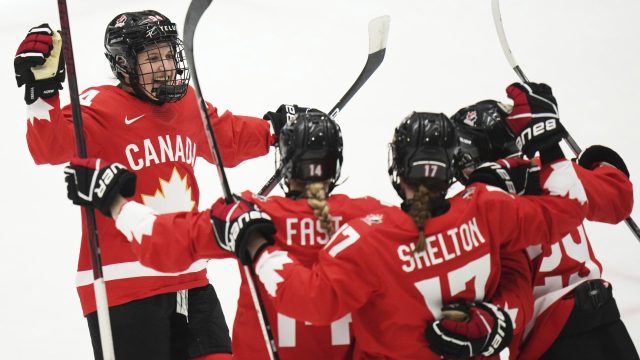
The wait is over. The women’s Olympic hockey tournament begins Thursday, with the world’s best players embarking on what’s expected to be the strongest, fastest tournament yet.
While all eyes will be on Canada and the United States as the cross-border hockey powerhouses are once again on a collision course for the gold-medal game, there are plenty of other storylines at play — both within each roster, and looking at the tournament as a whole.
Here’s what you need know about the 2026 Olympic women’s hockey tournament in Milano Cortina.
Tournament format & schedule
The women’s hockey tournament includes 10 nations, divided into two groups based on IIHF rankings and Olympic qualifications. All teams will play four round-robin games, matching up against each team in their respective group once, before learning their quarter-final fate.
Group A is the heavyweight class, consisting of the top five teams in the world (listed in order of IIHF seeding): United States, Canada, Finland, Czechia, and Switzerland. Teams in Group B (Sweden, Japan, Germany, France, Italy) took a longer route to the Games, clinching their berths via Olympic qualifiers, with the exception of Italy — as host nation, they get an automatic berth. All five teams in Group A will advance to the quarter-finals, taking the top five seeds of the knockout round based on preliminary-round standings. The top three teams in Group B will advance, and will be seeded Nos. six through eight.
From there, the quarter-final round will follow a 1-8 playoff format beginning Feb. 13.
Team Canada’s round-robin schedule:
Thursday, Feb. 5: @ Finland, 3:10 p.m. ET
Saturday, Feb. 7: @ Switzerland, 3:10 p.m. ET
Monday, Feb. 9: vs. Czechia, 3:10 p.m. ET
Tuesday, Feb. 10: vs. United States, 2:10 p.m. ET
Thursday, Feb. 12: @ Finland, 2:30 p.m. ET*
*Finland game was postponed from Feb. 5 because of norovirus cases affecting the Finnish team.
Knockout round schedule:
Quarterfinals: Friday, Feb. 13 & Saturday, Feb. 14 (games at 10:40 a.m. & 3:10 p.m. ET both days)
Semi-finals: Monday, Feb. 16 (10:40 a.m. & 3:30 p.m. ET)
Bronze medal game: Thursday, Feb. 19 @ 8:40 a.m. ET
Gold medal game: Thursday, Feb. 19 @ 1:10 p.m. ET
Storylines
All eyes on the ice (literally)
As we turn our attention to the rink in Milano Cortina, there will be particular attention paid not just to the players on the ice but the ice surface itself — especially in the early days of the hockey tournament, which starts up Thursday.
There’s been much chatter and consternation about the state of the arena since officials announced just how behind-schedule it is. A tour of the facility last month revealed widespread reporting on the state of dressing rooms and fan concessions, with photos showing the rink as still very much a construction zone. All that can be (mostly) ignored as long as the ice is up to professional standards. January test runs revealed a few concerns about its quality, though more time and plenty of flooding since then have eased those. As the women’s tournament opens before the men hit the ice, they’ll be the first to chime in on the conditions, and everyone will be listening.
The defending champs are now No. 2
No nation has won more gold medals in women’s hockey than Canada — in seven tournaments, the Canucks have claimed gold five times; USA has topped the podium twice — and yet there’s some momentum siding with the Team USA. Team Canada arrives in Milan as the defending gold medal champs, but also as the underdog to the top-seeded Americans, who are ranked No. 1 by the IIHF heading into this year’s tournament. Canada sits at No. 2. The difference is slim, but it’s interesting.
Since Canada was crowned Olympic champ in 2022, the cross-border rivals have taken turns topping one another on the world championship stage, with the most recent tournament ending with the U.S. edging Canada in overtime at the 2025 tournament last April.
Almost exactly one year has passed since Canada last defeated the U.S. in an international best-on-best game at the senior level — that was the final instalment of the 2024-25 Rivalry Series last February. Since then, the U.S. has claimed six straight victories, including at the 2025 women’s world championship and a clean sweep of the 2025 Rivalry Series.
That Rivalry Series served as both nations’ final chance to see players in action ahead of the Games, and while the rosters weren’t entirely the same as the ones we’ll see in Milano Cortina, the results raised some eyebrows for how lopsided a showcase it was. The U.S. outscored Canada by a combined score of 24-7 across four games, including a 10-4 drubbing in December.
Canada relying on experience, but newcomers bring intrigue
Of the 23 players named to Team Canada’s Milano Cortina entry, 16 were part of the gold medal-winning squad four years ago in Beijing, including veteran Sarah Nurse, who led the team to the top of the podium. No one has as much Olympic experience — or golden goal-scoring success — as captain Marie-Philip Poulin, who debuted at Vancouver 2010 and now hits the ice for her fifth Olympic tournament. This is the fourth such tournament for veteran forward Natalie Spooner, and 10 players named to the 2026 team also suited up in 2018.
Team Canada brass is counting on that experience to once again carry Canada to the top of the podium, but there’s no doubt the seven players making their Olympic debut with Canada bring plenty of intrigue, too.
Toronto Sceptres forward and leading scorer Daryl Watts tops that list. She brings a jolt of offence — she’s third all-time in PWHL scoring — and had a really strong world championship performance in last spring’s national team debut. She’s joined by fellow forwards Julia Gosling, Kristin O’Neill, and Jenn Gardiner as first-time Olympians at forward.
Debuting on defence, Sophie Jaques has been a force in the PWHL, winning a pair of Walter Cup rings with Minnesota and making her way onto Team Canada’s 2025 world championship roster before being named to the Olympic team. Perhaps no newcomer was as much of a surprise as the addition of fellow defender and 28-year-old Olympic rookie Kati Tabin, whose physical presence on the blue line shows a desire by Canada’s management to insert a little more sandpaper to a blue line that also includes forces like Renata Fast and Ella Shelton. (The message being sent: Enter Canada’s zone at your own risk.)
And in net, while the crease is set with Ann-Renee Desbiens — in two Olympic tournaments, including being the starter in 2022, she’s never lost an Olympic matchup — second-year New York Sirens goaltender Kayle Osborne played her way onto the roster as a backup who could bring some insurance if needed.
Team USA packs a punch on offence with plenty of fresh faces
Like Captain Canada, Marie-Philip Poulin, Team USA captain Hilary Knight also embarks on her fifth Olympics. (Unlike Poulin, Knight has already announced these Games will be her last.) While she’s joined by some respected veterans — the usual suspects, like Kendall Coyne Schofield up front and Lee Stecklein on defence among them — there’s been a lot more turnover on this roster, with a lot of youth and new faces. Just six players on this roster were part of the 2018 squad that won gold at Pyeongchang 2018. There are 11 players with Olympic experience dating back four years, the squad relying heavily on its youth movement with 12 players making their Olympic debut.
Unlike Canada, whose roster is comprised entirely of pro players, Team USA’s side features seven players still in college. This group is headlined by Laila Edwards, who becomes the first black women’s hockey player to compete for Team USA at the Olympic level, and also includes second-time Olympian Caroline Harvey. Division-I forwards Joy Dunne and Abbey Murphy currently lead the NCAA in goal-scoring, and bring that elite offence to a roster that also features the PWHL’s top four points leaders (all of whom play for the back-to-back champions in Minnesota).
PWHL talent on full display
The women’s hockey landscape looked a lot difference during that last Olympic cycle four years ago. Since those 2022 Games, an entire professional hockey league has launched to massive success, and we see the presence of the PWHL on almost every roster. We’ll see the impact on the ice, with the 2026 Games promising play that’s faster, stronger, and more powerful than ever.
No longer do the world’s best women’s hockey players have to wait for marquee international events to test themselves against the best. These national team players are honing their crafts daily, year-round, with the resources that let them thrive. In the two and a half seasons of PWHL play, we’ve seen the quality rise exponentially.
All 23 of Team Canada’s players are PWHLers. Sixteen members of the U.S. squad are in the league. And while the biggest PWHL presence is focused on Canada and the USA, it’s not just about those North American powerhouses. There are 22 European PWHL players representing six different nations at the Games, with Czechia leading the way (8), followed by Finland and Sweden (4), Germany (3), Switzerland (2), and Italy (1).
The hockey world is still focused on Canada vs. USA, and it would be a massive shock if that’s not the gold-medal matchup. But it’s a global game, and we’re seeing that now more than ever on the Olympic stage.
Can Czechia build on world championship momentum?
Team Czechia has been on the rise in the women’s hockey world for several years now. They’ve competed in the bronze-medal game in four straight women’s world championships, winning two (2022, 2023) and losing in OT to Finland in both defeats (2024, 2025). The nation hosted the 2025 tournament — yet more proof of the growth of the women’s game there. The country has produced some incredible young talent, headlined by forward Kristýna Kaltounková, the New York Sirens’ first overall draft pick last spring who leads the PWHL in goal-scoring as a rookie and is set to lead Czechia into the Olympic tournament.
Last Olympics, Czechia competed in Group B. They had to fight their way into an Olympic berth, not yet ranked high enough by the IIHF to get an invitation that way. Four years later, they enter the tournament as the fourth seed in Group A, where they’ll be tested right from the start among hockey’s powerhouse nations. While they’re not expected to upset Canada or the USA, their round-robin matchup against Finland will be particularly fun to watch as it will most likely offer up a preview of the bronze medal game. A medal at these Games would mean the first such award for Czechia’s women’s hockey team at the Olympics, and a significant victory for the international growth of the sport, too.