Olympic stories usually come from Olympians, the athletes who travelled across the world to wear the maple leaf and compete for Canada.
But, of course, there’s another side to the Olympic experience: those who don’t get a ticket, who answer the phone after the selection process and hear the words “I’m sorry.”
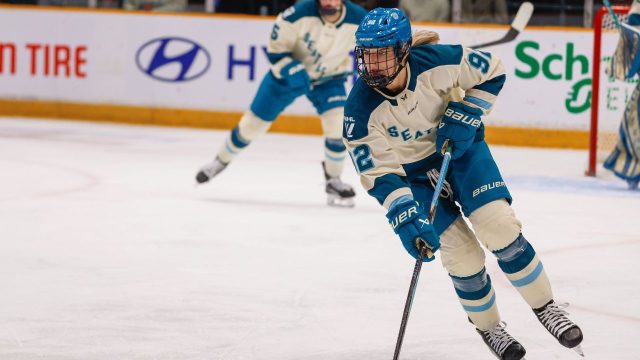
Danielle Serdachny was one of seven women’s national-team players cut from Team Canada ahead of Milano Cortina 2026. As the Seattle Torrent forward processed her heartbreak, she decided it was time someone shared how it feels when everything it takes to pursue an Olympic dream doesn’t quite get you there.
Whatever she’s doing, it’s working: the Edmonton native has returned to the ice in top form.
With a game-winning goal against the league-leading Boston Fleet that snapped a four-game losing streak on Friday, the 24-year-old has surpassed her career-high in goals and isn’t slowing down.
Ahead of Thursday’s game between the Torrent and Montreal Victoire (7 p.m. ET / 4 p.m. PT on Sportsnet and Sportsnet+), Serdachny shared her experiences with the expansion franchise, celebrating the Super Bowl with the Seahawks and what she learned after being cut.

This Is Our Game
Rogers is a proud partner and fan of the PWHL, and supports the growth of women’s hockey in Canada by creating unique fan experiences and inspirational opportunities for girls to connect with their hockey heroes.
This Is Our Game
This conversation has been edited for length and clarity.
Sportsnet: What has your experience been like on the Seattle Torrent, an expansion team?
Danielle Serdachny: It's been a great experience for me. I really enjoy being around my teammates, my coaches have shown a lot of belief in me, and then the city of Seattle has also been outstanding. We have some of the best coaches in the PWHL, as well as the best fans. Coming in, I wasn't too sure how the hockey fans specifically look to you in Seattle, but I see they rally around the team, so definitely a really exciting time for our group.
What has it been like to build chemistry on a team with players that have been thrown together from across the league?
I mean, I think it's a work in progress, as you've probably seen. We've lost people to injuries, trades, that sort of thing. We've gotten along off the ice very well. I think that definitely helps translate to that on-ice chemistry. We have a few games here on the road trip and I'm looking forward to building the chemistry then, too. (Seattle’s four-game run stretches March 13-21).
Watch the PWHL on Sportsnet
Watch the Victoire, Charge, Sceptres and Goldeneyes in marquee matchups throughout the season as the PWHL returns to Sportsnet and Sportsnet+.
Broadcast schedule
What are some things you do off the ice to build chemistry?
I think just hanging out as a team. I think that it isn't just about hockey. So, separating hockey from the group and having fun just as people, I think that's been really helpful for us. And then obviously with the Seahawks winning the Super Bowl, it was a great time for the city.
Were you involved with the celebrations?
They actually allowed us to go on the field there, which was lots of fun. I think there was not too many people on the field, they gave us a special exemption. We were pretty close to the celebration, and it was definitely cool to see.
What else makes your experience now different from your first year with the Ottawa Charge?
I think just I’m having a more enjoyable experience on the ice. Obviously, things weren't going in the net at the start of the year, but it started to come together. But my coaches never stopped believing in me and were always having conversations with me and I think that helped me more on the ice.
Last week’s win over the Boston Fleet was one of the biggest standouts from the Torrent’s season so far, and you had the game-winning goal. Can you take me through that?
Honestly, it was a really special game for our group. That was the game, I believe, we had around 17,000 fans. (13,350 fans were in attendance.) Super loud and proud, and we wanted to get a win for them. I remember Buckey (Mikyla Grant-Mentis) there scoring that big jump. Then on my goal, Natalie Snodgrass made a great play to me backdoor. I was able just to tap it in, thank god.
You wrote a story in The Athletic about your experience being cut from Team Canada’s Olympic team. What prompted you to tell your story?
I think it's just important for people all over — fans, media, family, friends — to hear both sides of what could be a potentially tremendous experience for so many people. You hear about all those life-changing experiences, but rarely hear about the other side of it, of the people who maybe didn't make it because they got cut, or injuries, or that sort of thing. I think it was important to shed some light on that experience, because I know whether it's life or sport, there's a lot of failure and setbacks. I think that part of the story is also important to hear, almost the human aspect of it, so people have that understanding. Obviously, it's not easy to talk about it all the time. Like I mentioned, there are still many emotions attached to everything that happened, but it's honestly just been incredible the amount of people that have reached out to me regarding the article.
After you were cut, you started meeting with a mental performance coach. Can you share anything about that experience?
It's something I've wanted to have for a long time, but it's almost like the fear of taking that first step was in the back of my head. But obviously, with a time like that, when you get cut from the Olympics, you're just looking for different solutions.
I found it very helpful for me to have someone not related specifically to our team, but someone that has worked in hockey for a long time, just having those different conversations with a professional and them giving you different exercises or things you can work through, I think helps shift your mindset, which I think is very important for me.
You also shared about processing failure.
I've juggled with it a bit. Like with me not making the Olympic team, I don't want to look at it as a complete failure. Obviously, in my head, that's the words I use, but just thinking about it more as the process of what did I do to get to that point and what you can learn from it, I think it's important. Rather than just saying, ‘Oh, I failed.’ I don't know if failure is necessarily the right word, but maybe coming short of your goals is a better way to word it.
It's been five games since the break and you've had three points. You're kind of on a tear right now. How has this whole situation fueled you on the ice?
I want the team to do well. As far as the standings, we're not doing great right now, but I think we've seen so quickly how things change in the PWHL and the standings. Getting cut from the Olympics is obviously very heartbreaking, but at the same time, it was almost like a weight off my shoulders and now I can focus on just being able to play my game and playing a bit more free rather than worrying about all the other factors that could go into making an Olympic team. Being more forward-focused has really helped me and trying to play to my strengths to do what I can to help the team.