“SHE MAKES THE GAME FUN”
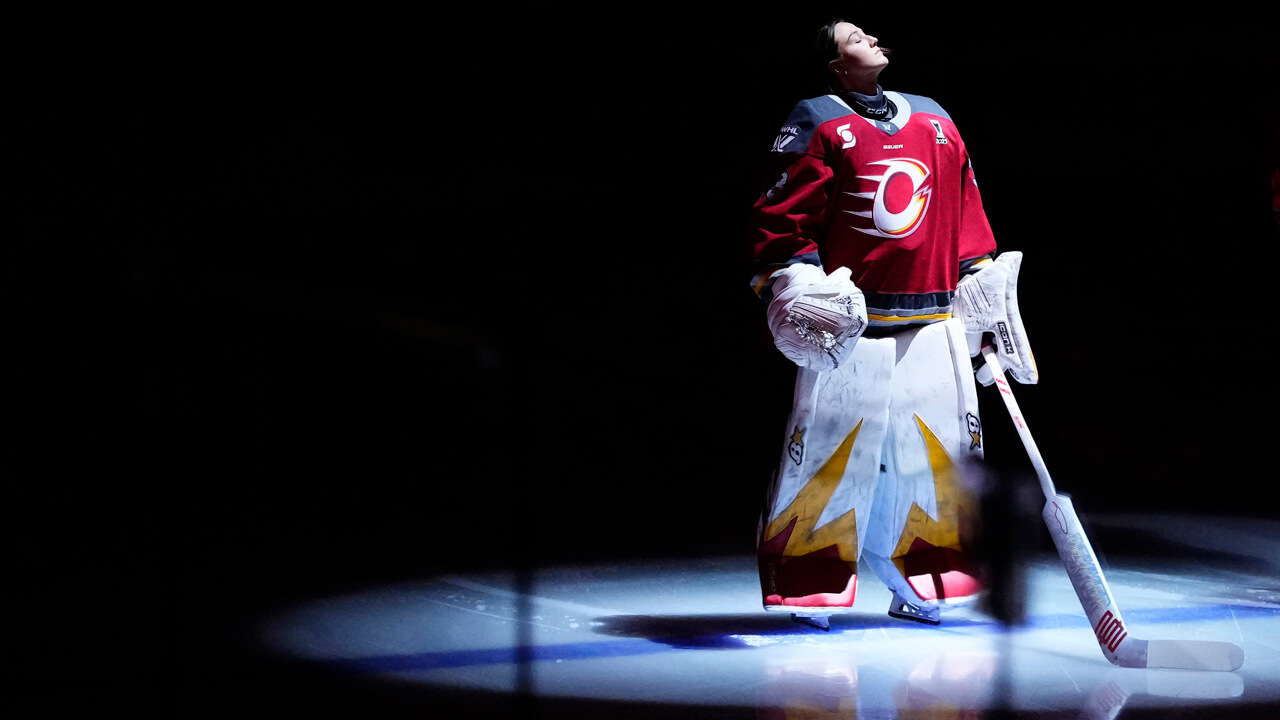
J ust like she does before every start, Gwyneth Philips will eat a lot of pasta the night before she next hits the ice for the Ottawa Charge. But another key part of the goaltender’s pre-game routine will soon have to change because, as she explains, “I’m really running low on dinosaur documentaries.”
All season long, the 25-year-old Philips has been watching T. rexes and pterodactyls before she suits up in games. She even roped in her roommate on the road, Taylor House, who now joins Philips at her place the night before home games, so they can watch together. The pair recently finished the Netflix series The Dinosaurs. “I didn’t learn anything, but it was pretty cool,” Philips says, before pointing out: “It’s really for the layman.”
Philips, who’s clearly no slouch when it comes to dinosaurs, has lately been reading a lot about World War II, which could be a precursor to her next interest-turned-pre-game-habit, given that reading The Rise and Fall of the Dinosaurs by Steve L. Brusatte spurred this one. “Maybe I’ll get into the history of wars — that might be my new fascination,” she says.

Philips is hardly the first goalie to march to the beat of her own drum. As teammate Peyton Hemp puts it: “She is unlike anyone I have ever met, in the best possible way.” Some dare call goalies “weird,” which could come off rude. Charge captain Brianne Jenner instead offers this with a laugh: “She is definitely a goalie. We love her.”
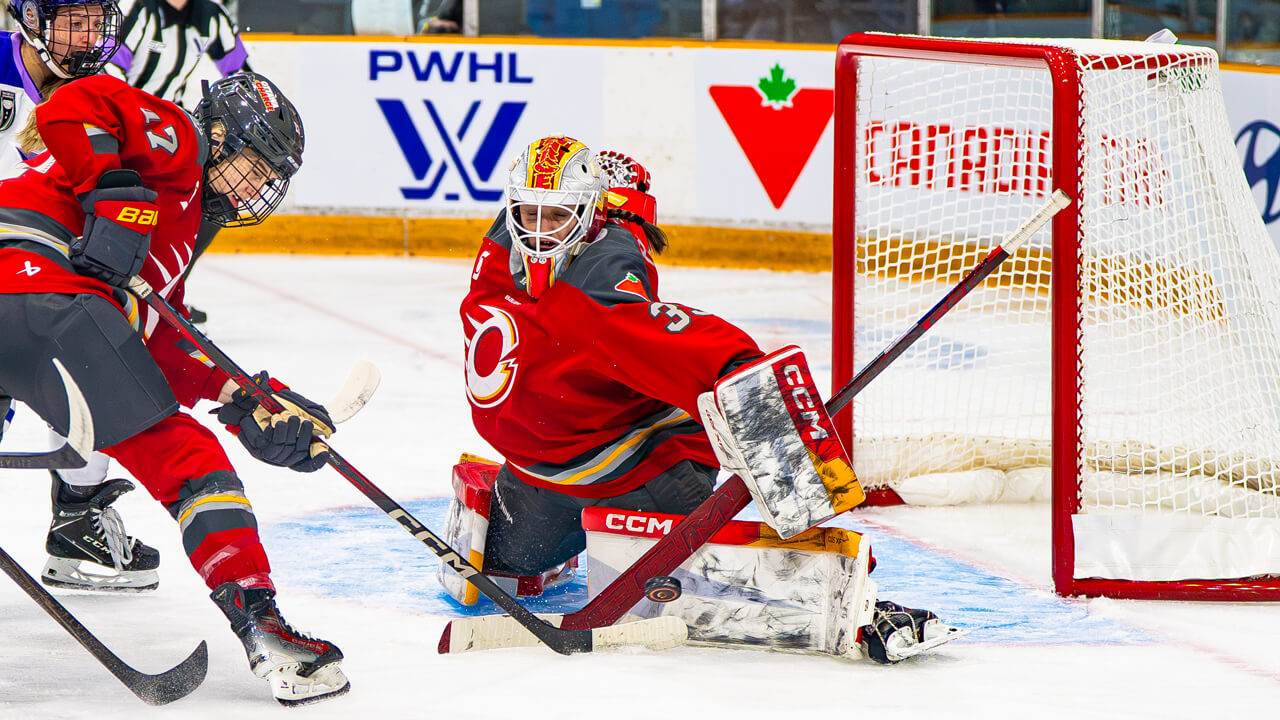
As unique as Philips’ many interests may be, her path to becoming one of the best goalies in the game is even more distinct. She’s the only professional hockey player to ever come from her hometown of Athens, Ohio; the entire state has produced just a handful of pros. When Philips took over Ottawa’s net halfway through last season after an injury to star goaltender Emerance Maschmeyer, she helped turn what could’ve been a season-ending disaster into a first-ever playoff berth and a run to the Walter Cup Final. Not only that, but the rookie goaltender took home the playoff MVP award despite Ottawa losing to Minnesota. Now, with eight games to go in Philips’ first full pro season as a starter and her team one point out of the final playoff spot, the Charge’s bid to claw their way back into the post-season will again be led by the netminder unlike any other. “She truly is the backbone of the Ottawa Charge,” Hemp says. “I don’t know what we would do without her.”
T he Ohio Philipses were not a hockey family until this most recent generation. As Gwyneth’s dad, Guy, explains it, when his kids were little, a friend’s son played and that young man seemed like a good human being and player, so Guy figured his son and daughter should try it, too. There was only house league hockey in Athens, though, so once Gwyneth and her older brother, Guy Jr., got into the game more seriously, it meant driving more than an hour to Columbus or three hours to Pittsburgh to play on competitive teams.
“At one point, I was playing on three hockey teams, not to mention whatever school sport I was playing at the time,” says Philips, who was on both girls’ and boys’ teams as a kid and also starred as a volleyball player, won school sprinting titles and regularly made boys’ all-star baseball teams.
On the ice, Philips played both goalie and defence. She was nine or so and playing goal at a district camp when she caught the eye of Kathy Pippy, who founded what’s now the Pittsburgh Penguins Elite Girls’ program. “Your daughter has no idea what she’s doing out there,” Pippy told Guy Sr. “But there’s potential, so you should try and develop this.”
That wasn’t exactly music to Guy’s ears, because he didn’t want his daughter to be a goalie. “As a player, she could just skate right around the other kids — nobody could catch her,” he says. So, despite Philips’ clear leanings towards the net, he was hopeful she’d change her mind and be a speedy defender. Guy even joked to one of her coaches, a firefighter: “If you make my daughter a goalie, I’ll burn down your house!”
There’s a running disagreement over exactly who bought Philips her first set of goalie pads. Guy swears he did, but his daughter makes a fair point to support her memory that it was her mom, Linda: “I mean, he was threatening to burn people’s houses down if they let me play goalie, so I have a hard time believing he bought me the pads.”
By 11 or 12, she considered herself primarily a goalie. Others agreed: Philips recalls wearing the mishmash of goalie gear she’d acquired over the years to a pond hockey game with her primary team, who she usually played out for. “I was pretty good and the coaches said to my dad, ‘Maybe you should let her play goalie because the kid can’t skate backwards and she’s a defenceman, so…’” Philips says, laughing.
Getting ice time meant constant travel. Guy says that while some refer to the parental “sacrifice” required to help kids get to the top level, “that doesn’t resonate with me. It was always a blast.”
It did require logging thousands of miles in the family vehicle, though. “I remember my dad driving me from a game in Pittsburgh for my girls’ team, back to Detroit for a game with my boys’ team, back to Pittsburgh for a game with my girls’ team and back to Detroit, all in one weekend,” Philips says. “I think we did the trip three times.” It’s a four-hour drive between those two cities, plus the more than three-hour drive from Athens to Pittsburgh. “I was a kid with endless energy,” she says, repeating her dad’s sentiment: “It was so much fun.”
Just after she graduated Grade 7, Philips remembers her family receiving what she calls an “auto form email” to gauge her interest in playing college hockey someday. “I remember my parents, like, shitting themselves being like, ‘Oh my god, our daughter’s getting recruited to college!’” she says. “Everyone was getting these emails if you signed up for hockey, but at the time we didn’t know that, and college was never really on our radar for hockey. That was kind of like a light switch moment.” In other words, her whole family was suddenly aware NCAA hockey was an option.
Like her older brother, Philips attended a prep school in suburban Pittsburgh called Shady Side Academy, which she credits for much of her development thanks to regular work with goalie coaches. Pippy was instrumental, too, helping Philips and her family when it came to navigating rep hockey and finding the best programs in the state.
Philips earned invites to USA Hockey’s national development camp from 2014 to ’16, and that’s when the wheels started turning that she could perhaps represent her country at the highest level. Though she didn’t make the U-18 American roster, she was invited to the national goaltender camp in 2018. “It kind of relit the fire for that national team prospect,” she says.
In 2019, Philips accepted a scholarship to Boston’s Northeastern University, where she majored in industrial engineering. On the ice, Philips spent her first three seasons backing up current Team USA and Boston Fleet starter, Aerin Frankel, and though Philips had to learn to be a backup, she made the most of her limited starts, which included shutouts in her first three appearances.
Philips took over the Huskies net for her last two seasons, and her career .958 save percentage remains the best ever in women’s Div. 1 history. Her GAA of .960 is bettered across the NCAA only by Ann-Renée Desbiens, who now stars for the Montreal Victoire.
In June of 2024, not long after she’d graduated college, the Charge made Philips the first goalie selected in the PWHL draft, at 14th overall.
“I think for Gwyn, we knew we had an incredible goaltender,” says Ottawa’s head coach, Carla MacLeod. “But you just never know how that’s going to translate when the moment presents itself.”
I n the space of 40 days last year, Philips was twice thrown into the fire on a moment’s notice.
The first time came last March. Not long after Maschmeyer got a standing ovation from a sold-out TD Place crowd for making her 1,000th career PWHL save in a game against the Minnesota Frost, she had to be helped off the ice by team trainers after suffering a lower-body injury while trying to make a subsequent save.
And so, in came the rookie Philips with 8:55 to go in the third period and the Charge leading Minnesota 2-1. The first shot Philips faced went in, and just like that, the game was tied. Though the Charge went on to win — Philips saw just one more shot and made the save — it wasn’t the most encouraging performance. Three days later, the team learned Maschmeyer, their best player, was going on the long-term injured reserve list.
“Those first few games with the Charge were a little shaky,” Philips says. “I think everyone was a little bit nervous. We were kind of in that playoff push and your starting goaltender goes down. Everyone was like, ‘Okay, now who’s this kid?’”
Philips allowed 10 goals in her next three games. Then over the two games after that she allowed just one and recorded her second career shutout (she had one previously as a backup). The Charge went on to win five of their last six games to earn a first-ever franchise playoff berth.
“She not only performed well, she elevated,” MacLeod says. “I think one of the great things about Gwyn is she doesn’t morph with the moment. She actually just brings herself to the moment, and she performs exceptionally well.”
Just 40 days after she took over Ottawa’s net, Philips was sitting on Team USA’s bench at Budvar Arena in Czechia during the gold medal game of the 2025 women’s world championships. The game was tied in the third period when Team USA’s starter, Frankel, was injured during a collision and had to leave the game. Philips was up again.
Her career starts for Team USA numbered two at that point: Philips had shut out Czechia and Switzerland in round-robin play but hadn’t yet taken the ice in the knockout stage.
As she skated out for the biggest game of her career with that gold medal on the line, Philips reminded herself of a few things: “Control what you can control” and “I’ve just got to get through the next 15 minutes.”
Less than a minute after she took over the American net, Taylor Heise gave Team USA a 3-2 lead on the power play. But with a little more than five minutes to go, Canada tied things up when Sarah Fillier beat Philips from the slot through net-front traffic.
That tie held and the game headed to overtime. “I just had to keep going,” Philips says now, with a laugh.
She made 10 more saves in the overtime frame, which ended at the 17-minute mark when Heise threaded a pass to Tessa Janecke, who deposited the back-door winner. Philips threw her arms up in her crease and celebrated with her teammates before singing “The Star-Spangled Banner” with a gold medal around her neck. She’d made 18 saves to secure the victory.
“That was a really special moment,” she says now, of her first gold medal for Team USA. Her second came just last month, when Philips again backed-up Frankel, this time at the Olympics in Milan. Philips was perfect in both starts in her Olympic debut, against Switzerland in pool play and Italy in the quarterfinal, serving up a pair of shutouts.
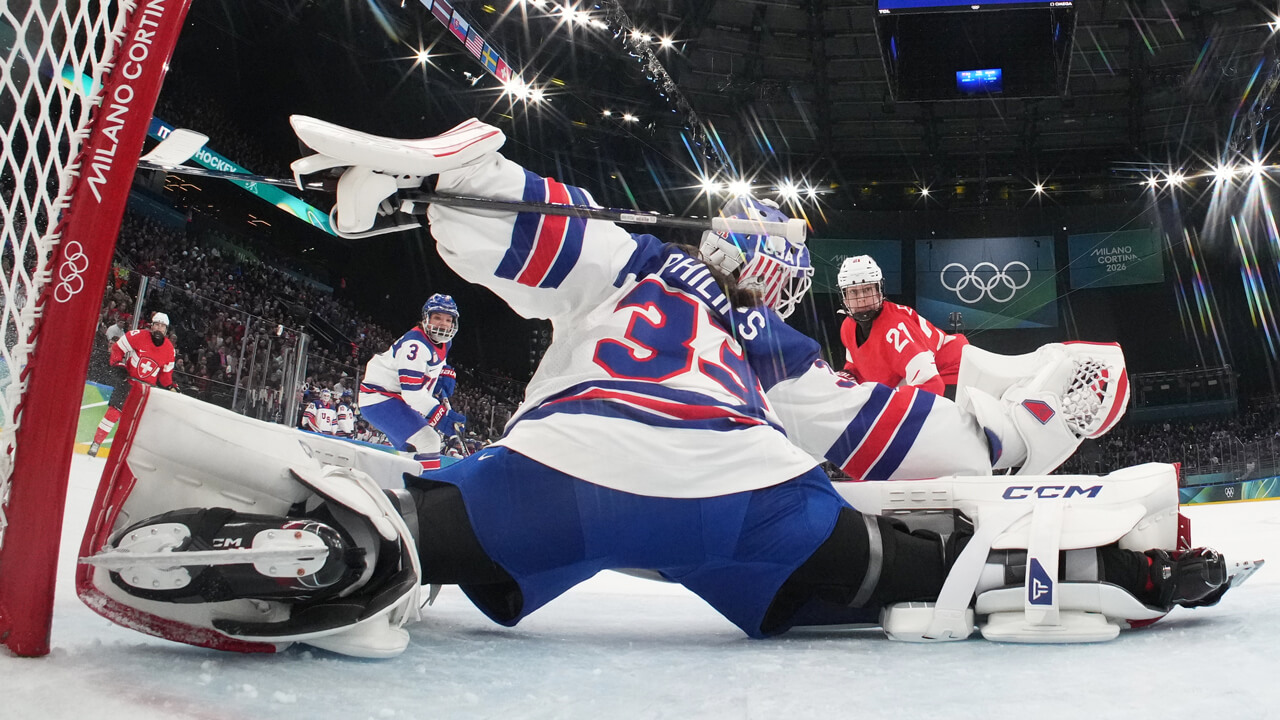
“Hockey aside, it was really cool to experience something like that, to see all the different countries and cultures together, living side-by-side, and get to watch the best of the best do what they love,” she says. “And then with the hockey, it was so much fun to play with that national team and at that level. It was great to be there, and to win a gold medal is like every little kid’s dream. So, that was amazing and to do it in such dramatic fashion was pretty exciting. USA-Canada, you wouldn’t expect anything else.”
After allowing three goals on eight shots in a game earlier this month against Minnesota and being pulled with five minutes to go in the first period, Philips bounced back in her last start, against Montreal, allowing one goal on 21 shots as Ottawa earned its league-leading seventh overtime win. That out-paces their five victories in regulation. “I think that’s what’s hurting us the most,” Philips says, since the league awards two points for a win in overtime and three for one in regulation. “But at least we’re finding ways to win.”
Her focus now is making sure she’s ready for each game, with eight still to go. “Because a lot can happen. Every game is really important,” Philips says. “So, just making sure that they all matter.”
Last season, Philips started all eight playoff games and put up a sparkling 0.952 save percentage, with a 1.23 GAA. But the team that leads the PWHL in OT wins this season lost four playoff games in overtime during their run in 2025 — including their last three against Minnesota in the Walter Cup final.
“That is a lot of motivation to move into this third-year playoff push,” Philips says of coming so close. “We saw what we could do last year, and I think we’re a better team this year and we know that. We know we need to battle hard to get into the playoffs and prove to everyone that we are a good team and we belong, just like we belonged last year.”
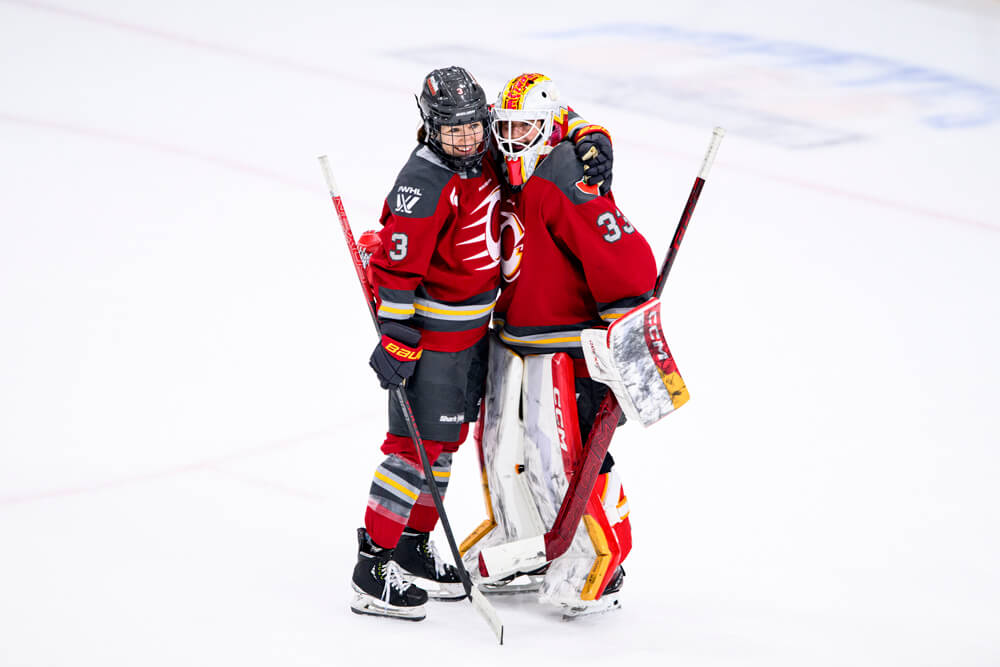
There’s a lot of belief in the Charge dressing room, and a significant amount of it is thanks to No. 33.
“We have so much confidence in front of Gwyn,” Jenner says, a fact punctuated this off-season when Ottawa chose to make Philips one of their three protected players, so expansion teams couldn’t sign her away.
“She allows us, sometimes, to find our own feet as a team when things aren’t going quite our way,” MacLeod says, pointing to a win against Vancouver earlier this month. “We weren’t playing our best, but she was able to help us hold onto that scoreboard and we earned the two points in overtime.”
MacLeod, a former defender for Canada’s national team and a two-time Olympic gold medallist, says that when Philips is at her best “there’s almost a lightness to her game.” Her feet are stable, her positioning is solid, she’s calm and she relies on her athleticism when there’s a lot of net-front action in tight.
“When’s she’s comfortable and she’s enjoying things, there’s not many on the planet that can match her abilities,” MacLeod says. “To me, she’s struck a really nice balance of what it takes to be elite at this level [while] not losing sight of who she is as a person and what she brings to a group and why she loves the game. I just think the world of her. She makes the game fun. She remembers that it is a game. She’s just a treat.”
“She’s such a free spirit,” Jenner adds. “She has a lot of different interests. I don’t get the sense that, you know, her world would fall apart if hockey wasn’t there. And I think that’s really good. She just seems like a well-balanced, happy human, so it’s great to get to be around her and get to work with her every day.”
Once hockey is done this season, whether it ends with the Walter Cup in hand or not, Philips has a plan for the summer. She’ll no doubt be posting more “Gorge with Gwyn” segments on her TikTok account as she crushes various meals. And just like last year, she’ll go on a camping trip with the trailer she bought at the end of last season, and she’ll hike and enjoy nature.
“Something similar, just maybe a bit longer,” Philips says, comparing the camping trip she’ll take this off-season to last year’s. The added length is in part because she’s budgeting for a two-day stop on the way home in the town of Drumheller, Alta. Philips plans to take her time in Drumheller. There’ll be a lot to enjoy in The Dinosaur Capital of the World.