“A DIFFERENT LEVEL”
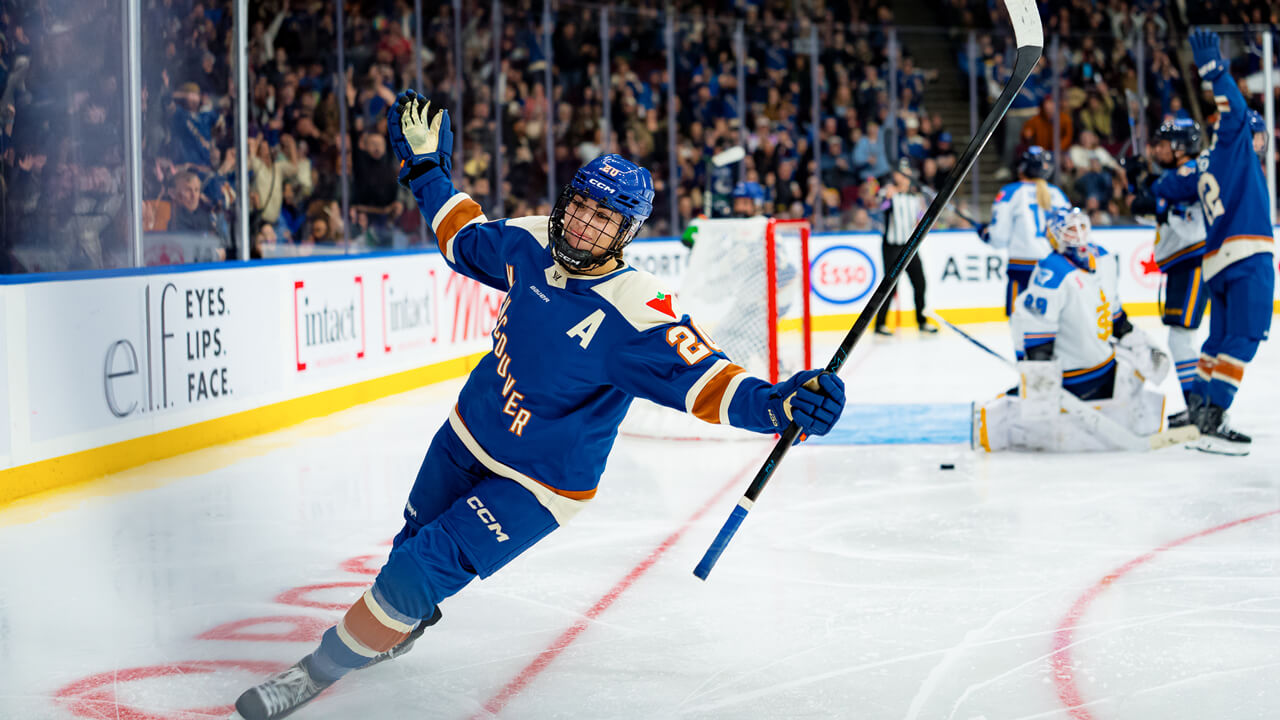
S arah Nurse can feel it building; the weight of the moment pulling her forward, the momentum swinging in her direction. It’s late November 2025 and the two-time Olympian is floating across the ice under the lights of Vancouver’s Pacific Coliseum, draped in the colours of her new club, the name of her new city emblazoned in vintage diagonal across her chest.
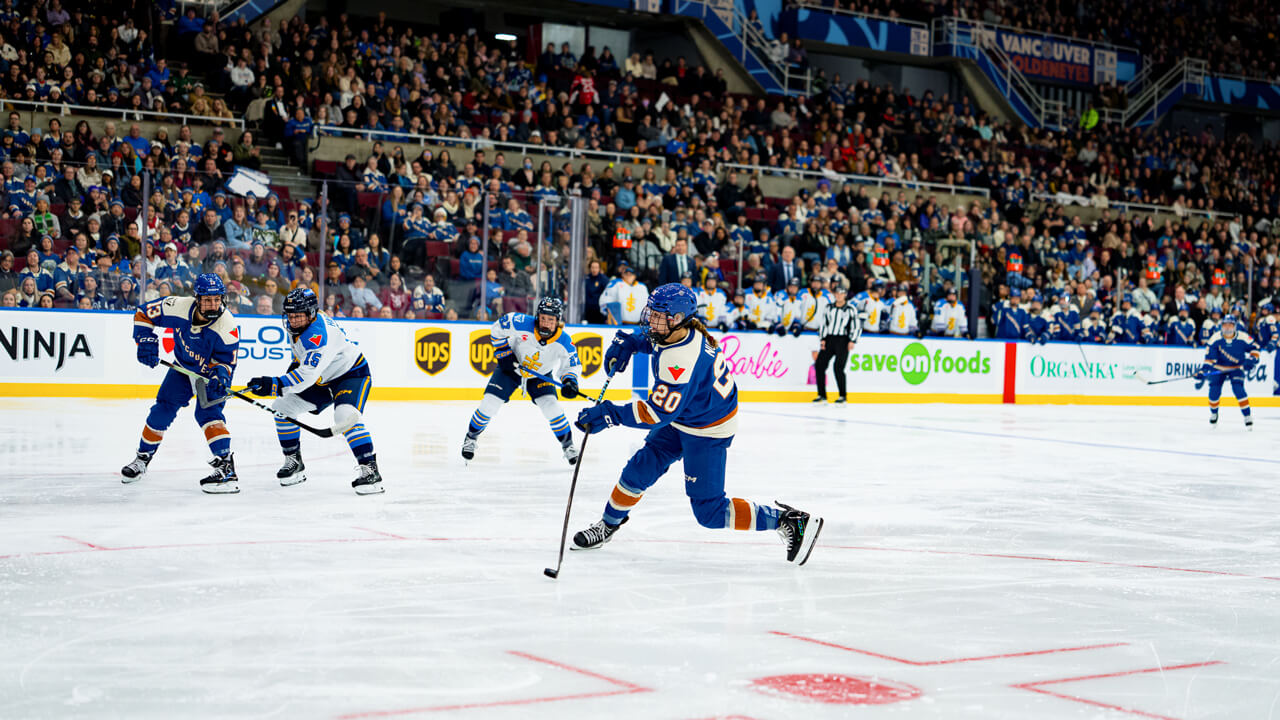
She swings in a short loop through the top of the Seattle Torrent’s zone, hounding defenders, before she drifts back towards centre ice. A reminder of the occasion and its undeniable stakes arrives beneath her feet as she reaches the middle of the sheet, her skates carving into the great eye painted at the heart of the surface. Twenty minutes earlier, the puck dropped on this first game in Vancouver Goldeneyes history and the starters gathered around this monumental image — the first Professional Women’s Hockey League club logo embedded into the ice in the first building in which a PWHL team serves as the primary tenant. She’s arrived at a pivotal moment in the game’s history, in this city’s history, and Nurse — a Canadian hockey icon already, arguably the face of this fledgling franchise — carries much of the Goldeneyes’ hopes on her shoulders.
But she senses something coming her way.
“I felt really good from puck drop,” she says now. “I felt like my feet were moving, my hands were moving. I just felt good. The puck was attracted to me that day.”

She’d already flirted with history earlier in the night, mounting a promising rush towards Seattle’s cage, pulling a highlight-reel move at the netfront, only to be stonewalled by goaltender Corinne Schroeder. Now, in the final minutes of the first period, Nurse circles as Torrent blue-liner Megan Carter carries the puck out of her team’s zone, looking to push the play up ice, intent on doubling Seattle’s one-goal advantage. But as Carter approaches, the puck seems to take on a life of its own — it drifts off her stick and wobbles towards Nurse, just as the Goldeneyes veteran wheels over that great eye.
Nurse wastes no time. She picks up the puck, peels towards the offensive zone, and sprints down the right wing. Teammate Michela Cava overlaps, beelines to the slot. Michelle Karvinen joins them on their left. The Torrent defence is in shambles, a lone defender left to try to quell the attack. Nurse reaches the right circle, pulls the puck back, and waits.
The crowd tenses, ready to explode. No. 20 drifts, the puck held out behind her, eyes fixed on Karvinen.
And then it whirrs into gear, that indescribable part of Nurse’s game, that innate ability to reach out and touch history. Here, with everyone in the building holding their breath, with her team desperate for a moment — this is where it all comes together for Nurse. A final puzzle piece clicking into place, allowing us to see her, fully. She waits one more beat, and then takes matters into her own hands, chancing a quick glance at Schroeder and wiring the puck along the ice. It skitters towards the cage, slips between the netminder’s pads, and comes to rest in the back of the net.
Pacific Coliseum erupts, the 15,000 in attendance seeming to rise to their feet as one, towels swinging wildly, hoarse cheers echoing through the building and spilling onto the ice.
“The crowd just roared — I’ll never forget it,” Nurse says. “And then when they announced, ‘The first goal in Vancouver Goldeneyes history,’ I just got chills. Because the building was so loud. And it felt like all of the tension, everything in the air, getting that first goal in franchise history — like, the bubble burst.
“And then we were off to the races.”
For Nurse, potting the first Goldeneyes goal in what ultimately wound up being the first Goldeneyes win was the latest in a collection of marquee moments. The Hamilton, Ont., standout has made a career of rising to the occasion. Whether it was in college, when her Wisconsin Badgers lifted three straight conference championship trophies; or at the Olympics, when she led Canada to 2022 gold, breaking the women’s tournament scoring record in the process; or in the PWHL, where she finished among the league’s most prolific scorers in its all-important inaugural season, one thing has always been undeniable about Nurse: when the lights are brightest and the stakes are highest, No. 20 comes to play.
But the 31-year-old now finds herself navigating a new chapter in her career. In the PWHL’s 2025 expansion process, Nurse was tabbed to help lead a new era of women’s hockey in Vancouver, to uproot from Toronto, move across the country, and use her highlight-reel magnetism to spread the good word of the game out west. All this just before the 2026 Olympic Games arrive in February, calling her to Milan for another starring role. It’s plenty to balance, especially during an injury-ravaged season that’s sidelined her for all but a few games. But Nurse isn’t sweating the pressure. She’s focused only on what she can control, on getting her game right.
And she can feel her feet moving, feel her hands moving. She can feel the puck coming her way.
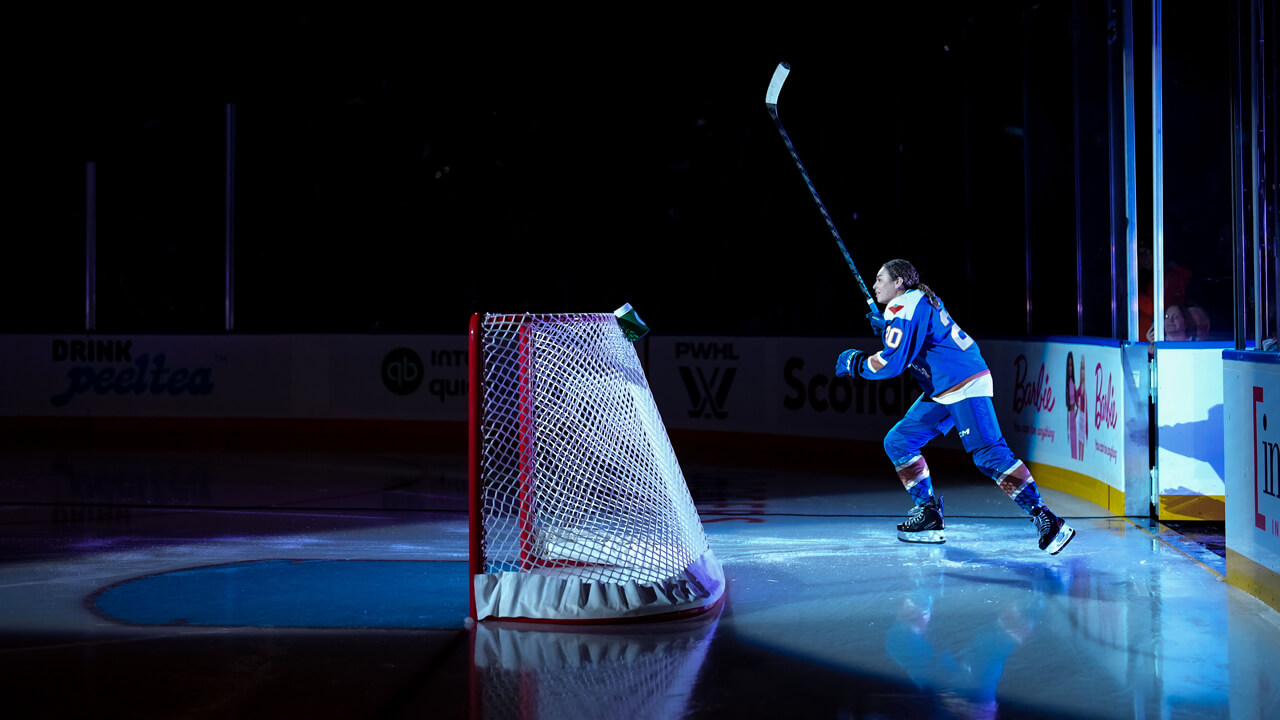
I t was the thrill of flying across the ice, more than anything else, that first pulled Nurse to the rink. “I was really mesmerized by figure skaters,” she says. “I absolutely thought it was so, so cool. But my parents thought that hockey may be the better direction for me, so they ended up putting me in that. I loved to skate from the first time I stepped on the ice, so I think that was what kept me coming back to hockey.”
Her father, Roger, was the first in the family to fall in love with the game. “He never played hockey growing up, but coming from the Caribbean when he was young, he wanted to assimilate to Canadian culture, so that immediately meant hockey,” she explains. “When I came around, he wanted me to learn how to skate. We were able to go on the little pond together and he taught me — that led to hockey.”
Starting out playing on boys’ teams, Nurse got the chance to transition fully into girls’ hockey at 11 years old. Even back then, she felt something about her game pulling things towards her. “I remember people wanting me on their teams,” she says. “But not necessarily knowing what that meant when you were a kid.” As a teenager, she was recruited to suit up for a local Hamilton squad, the Stoney Creek Sabres. It was there that Nurse truly started to establish herself, earning calls from NCAA programs. Putting up 36 goals and 56 points in 35 appearances during her final season with the club, she could feel the roots of something special taking hold.
“I had goals to make Team Ontario and Team Canada, and as I continued to progress, playing against older players, I kind of thought, ‘Maybe I could actually do something with this sport,’” she says. “Because I’d been playing against older players for a pretty long time, so when I’d get with my own age group, I felt really confident in my abilities.”
At the tail end of that run with Stoney Creek, though, came the first real blow to that confidence. In 2012, Nurse was invited to her first national team camp, ahead of the under-18 women’s world championship. The dream was there, close enough to touch — but she was cut from the squad. “That was one of the first times that I hadn’t made a team. In that moment, you kind of feel like your life is completely over,” she remembers. “But I learned at 16 years old that you have to figure out how to take rejection and redirect it into something positive.”
The next year, she got another shot. This time, Nurse wouldn’t be denied — she clinched her spot, donning the maple leaf for the first time. She scored her first goal for her country — a short-handed tally in a dominant win over Germany — rang in her 18th birthday by helping Canada take down Sweden in the semifinals, and ultimately snagged her first gold medal. It was claimed in vintage fashion: an overtime nail-biter against the Americans. “I remember seeing the women win in 2002 at the Olympics. I just wanted to be part of that team for as long as I can remember,” she says. “To have that opportunity at 18, that was the pinnacle. I was so appreciative, because it’s such an incredible honour. And I think my parents, the people around me, they maybe thought that was the only time that I was ever going to be able to represent Team Canada, because obviously the senior national team is very hard to crack. So, I definitely took everything in stride.”
On the heels of that first foray into international hockey, Nurse set off on another new journey, leaving Hamilton and heading west to join the University of Wisconsin’s hallowed hockey program. Settling on the Badgers had been an easy decision. “My aunt Raquel played basketball at Syracuse University, so I was super familiar with what a big school looked like. … And that’s exactly what I wanted — I wanted to sit in a classroom of 400 people and have the professor not know my name,” she says with a laugh.
“I wanted to play at a hockey school. We had our own designated women’s hockey rink there. When they showed me around, I remember they had a calendar up in the office — it was the football team, the basketball team, and women’s hockey. That was the trifecta at Wisconsin.”
Still, excitement aside, it was a lot of change. “You’re still a child, really. I know you turn 18, but you’re a child when you go off to university,” she says. “And I’m in a completely different country; I’m so far away from my family. But I just remember getting there and feeling so comfortable. … Feeling so at home. And knowing that it was going to be such a big step and a big transition, going from minor hockey to one of the best schools in the country.
“I definitely had to figure out how to elevate my game, how to continue to own my strengths, but also find ways to differentiate myself.”
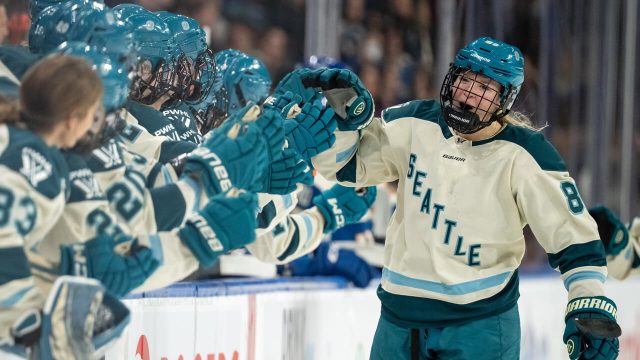

By the end of her four-year run in Badgers colours, Nurse had amassed 76 goals and 137 points through 150 games — punctuated by a final season that saw her collect 25 goals and 53 points over 39 appearances — and led Wisconsin to three straight conference championships. All that winning, all those battles, brought progress off the ice, too. “I think I was just able to mature when I got there,” Nurse says. “Just being able to learn and continue to better myself and strive to be the best — I mean, we had so much success at Wisconsin. I played with so many incredible players.
“I’m so proud to say that I was a Badger. Like, I always hype up Wisconsin. Anybody tells me they’re going to Minnesota or Ohio State, I always give them the gears, because I’m like, ‘Why wasn’t it Wisconsin?’ I truly believe that, from academics and athletics, it’s one of the best places that you could possibly go for women’s hockey.”
In the wake of that college hockey trek, Nurse’s journey to the game’s true mountaintop — the Olympic Games — began. So synonymous is her name with Olympic hockey now, it’s easy to forget how her run with the national team started: as an underdog, an extra, before she worked her way into the spotlight.
“All throughout university, I wanted to crack that roster, or at least be given an opportunity,” Nurse says. “I played at a little 4 Nations [Cup] tournament with the senior team in my second year of university, and that was the only sniff with the national team I got throughout my four years there. And I remember my senior year, I was like, ‘You know, I’m just going to give it my all — I want to win a national championship. I’m just going to play for the people in my locker room at Wisconsin, because I want to go on a run here and win this title.’
“And I played some of the best hockey that I’ve ever played in the last few months of my senior season. I think that’s what really got Team Canada to take notice, and maybe take a chance on a player that they had never really brought to anything before.”
The result of that attention was another move, this time even further west, for a 2017-18 Team Canada centralization season in the lead-up to the 2018 Olympics.
“I had to move to Calgary, and all of a sudden I’m on a team with Meghan Agosta and Marie-Philip Poulin and Shannon Szabados. I’m with players who have been to two, three, four Olympics, and I’m like 21 years old, never sniffed this team before,” Nurse remembers. “I just went in with eyes wide open and absolutely nothing to lose. There were 28 players that year who were selected to centralize and invited to try out for the team — I think going in I was probably No. 28 out of 28.
“I just tried to do everything I could, to be whatever player the team needed me to be. And that was a fourth-line energy player that went and forechecked, hounded pucks and just didn’t give anything up defensively. I really took pride in that role that I played. … That’s ultimately what got me on the team, just being willing to do whatever it was for the team. And it was really special to be able to realize that dream of going to the Olympics for the first time.”
Nurse had earned her shot, but she remained on the squad’s fringes. The 2018 tournament wound up a heartbreaker for the red-and-white, the Americans outlasting Canada in an agonizingly long gold-medal battle, eventually winning in a six-round shootout. When it came down to that shot-for-shot decisive frame, Nurse wasn’t sent over the boards. Still, she left South Korea with a silver medal and her first Olympic goal — a game-winner potted against the Americans during the preliminary round. It was a step forward.
“It gave me the confidence that I really did belong,” she says of that first Olympic run. “That I was one of the best players in this country, and one of the best players in the world. … To go to an Olympic Games, and score a goal against Team USA, my first Olympic goal, I’ll never forget that. … It was like, ‘No, you actually belong here. You don’t look out of place. And you should really own that.’
“I think that really carried me through the next four years.”
Those next years were a rollercoaster for Nurse, and for the women’s game as a whole. Drafted second-overall by the CWHL’s Toronto Furies, she played a season for the club in 2018-19 before the league folded. Then came the journey with the PWHPA, Nurse suiting up for the organization in Toronto while serving on its board. There were World Championships, too — a 2019 bronze won in Finland; a 2021 gold won in Calgary. And there was a global pandemic, and a racial reckoning that swept through the sports world, pushing Nurse — as one of the most prominent Black players in hockey — to the forefront.
Amid all of it, Nurse tried to remain focused on building herself into a go-to player for the national team. And in 2022, a chance to return to the Olympic stage arrived.
Team Canada’s head coach for the tournament, Troy Ryan, had worked with Nurse since her early years in the national program. He understood as well as anyone how to put the talented winger in a position to succeed. “When I think of Sarah as a player, and her offensive production, I generally think it comes from the transitional side of the game,” he says. “She gets herself in a good position, forces a turnover and then transitions quickly to offence — her defensive plays are actually her first offensive play.”
It’s for this reason that Ryan started Nurse as a depth piece, primarily a defensive presence, early on in the 2022 Games. But fate intervened.
“I’ll share something that, honestly, I know internally we know how things went down, but I don’t think it’s ever really been written or talked about,” Ryan says. “We were at the Olympics, Sarah Nurse started on the second or third line — she was down the lineup, she wasn’t playing with Poulin at this point. The night before the game we played against the Olympic athletes from Russia, I remember we had a conversation in the Olympic Village. The conversation honestly was just coaches sitting around, debriefing about the day, having a beer, unwinding. We were thinking of different scenarios, little adjustments we’ll make if something doesn’t work.
“Emily Clark was playing with Poulin at the time, and we thought Sarah Nurse was playing really well where she was. But [Nurse] was kind of feeling it — everything she touched turned into some offensive stuff. So, we just had a conversation — leading into the playoffs in the Olympics, if things didn’t get better, we were going to potentially make that change.”
The next day, Canada took the ice for their tilt against the Russian athletes. But first came an hour-long pandemic-related delay, Canada refusing to play because the results of the Russian athletes’ COVID-19 tests had not yet been processed. The teams eventually decided to go ahead with the game as long as they could do so wearing N95 masks. But before they took the ice, Canada got some results of their own.
“During that delay, we actually got some test results back for the next game — in those results, there was an inconclusive test for Emily Clark,” Ryan says. “We thought, ‘You know, we can’t on one side fight to wear the masks but then have an inconclusive test and not do something about it.’ So, we made the decision to pull Emily Clark from the game.
“We had legitimately three seconds to make the decision. It was in the warmup. … But because we had that conversation the night before, we already had it in our back pocket that we would slide Sarah Nurse into that situation.
“And then she just caught lightning in a bottle.”
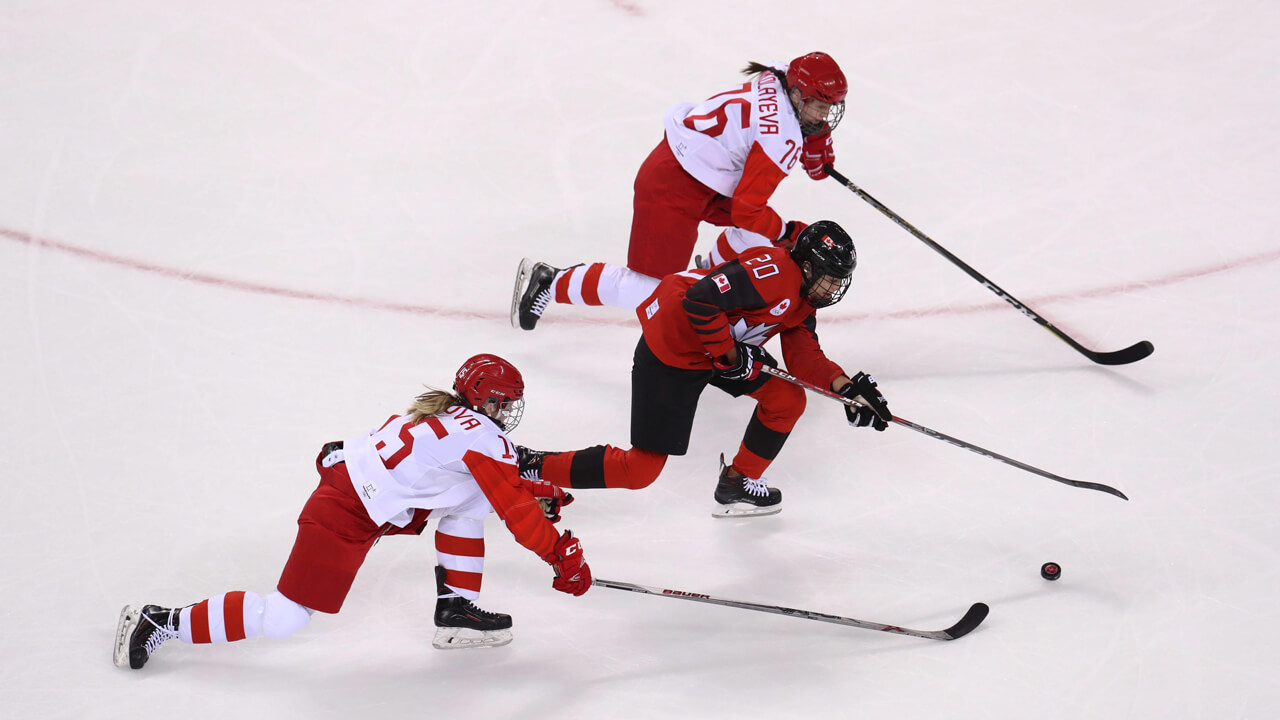
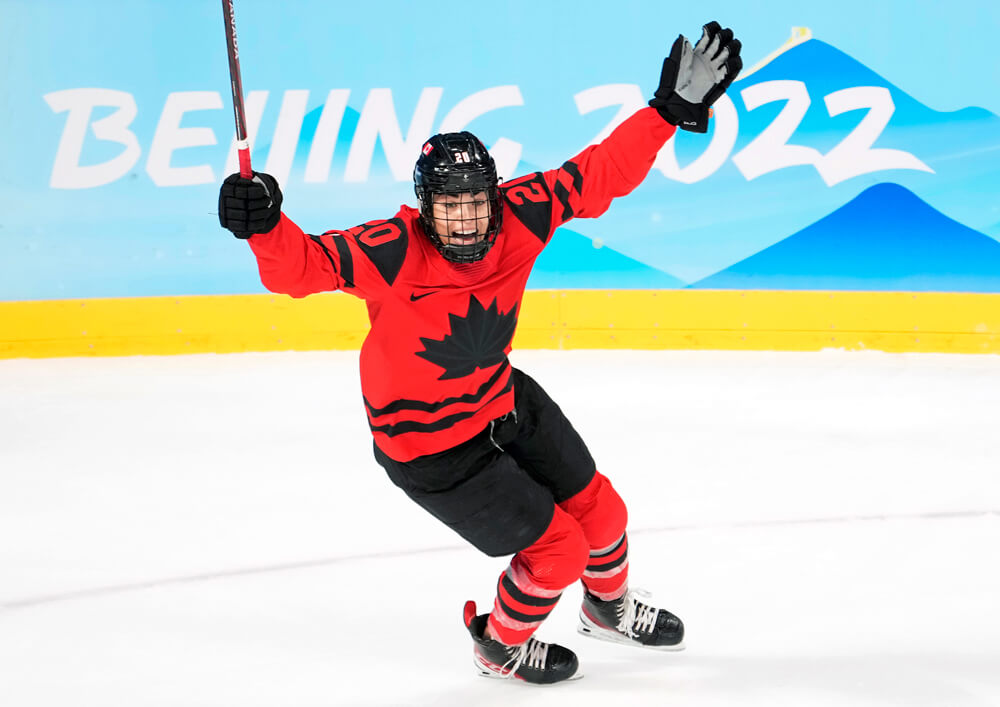
Moved up to the top line, Nurse opened the scoring two minutes into the game, then set up a power-play tally a period later. The next game, she set up the tying goal in an eventual win over Team USA. Then came the playoff round — Nurse pulled out a four-point performance in a dominant quarterfinal win over Sweden, and another four-point night in Canada’s semifinal win over Switzerland. When the gold-medal game arrived — Canada vs. USA, everything on the line — Nurse played a central role in the tournament-clinching victory, opening the scoring yet again, before setting up Poulin for the eventual game-winner.
Nurse’s two points in that Olympic finale gave her 18 total over the tournament’s seven games, breaking the women’s tournament’s scoring record set by Hayley Wickenheiser back in 2006. Nurse’s 13 assists set a new record too, besting Wickenheiser’s 12 from that same ’06 tournament.
It was the pinnacle of her on-ice career. But in the moment, it was all a blur.
“Honestly, no,” she says when asked if she was able to appreciate the magnitude of what she’d accomplished at the time. “When you’re at the Olympics, it’s such a huge, huge entity. There’s so much media and so much distraction around it. And it’s supposed to be the peak of your performance, you’re supposed to be at the top of your game at that point, so you really need to shut out the external distractions. So, that’s what we tried to do. We were in Beijing, we were by ourselves, it was during COVID. We had these burner phones. It was pretty crazy. I literally [just] had my family’s phone numbers, I didn’t have any friends, acquaintances who were blowing up my phone, or anything like that.
“I remember Blayre Turnbull came up to me one day and was like, ‘You know you’re close to Wick’s record?’ I was like, ‘What? What record?’”
It was Ryan who eventually told Nurse she’d made Olympic history.
“It was kind of a whirlwind experience,” she says. “You know, to have your name in talks of Hayley Wickenheiser, Marie-Philip Poulin — I mean, you dream about playing in gold-medal games, it’s kind of crazy, but I don’t know if I dreamed about the impact of me being in a gold-medal game. … But you know, when your name’s on the lineup sheet beside Poulin and Jenner, you’re expected to perform. I think that the three of us, we had such an incredible time and an incredible Olympics together.
“You know, Brianne Jenner broke a record, Claire Thompson broke a record, Marie-Philip Poulin obviously is in the history books. It was an Olympics to remember.”
In the afterglow of that golden performance, Nurse’s name was catapulted into a higher stratosphere. “It was pretty crazy. Because prior to that, leading up to 2022, I think I would have been a pretty well-known face in the women’s hockey community. … But I think coming back, obviously the Olympics is the global stage, and people that you don’t expect to be watching women’s hockey are watching women’s hockey,” she says. “It was cool to see how many people were impacted by our team and our gold-medal run. To have players in the NHL, for example, know who you are and want to talk to you about hockey and your experiences. I think that was interesting too, because we don’t have much crossover with the NHL.”
For Ryan, having seen her journey firsthand since its early days, Nurse’s growth off the ice — into one of the most prominent names across the sport at large, as typified by her becoming the first women’s player featured on the cover of EA Sports’ NHL video game — has impressed him as much as all she’s accomplished on it.
“I think the biggest thing is there’s just been so much change from the time when she was just graduating college to who she is today — as a player, but even the personality that she is now,” he says. “There’s been so much growth from her. I mean, not a lot of people knew who Sarah Nurse was in 2017, 2018. Now, the majority of the hockey world knows who she is — plus even more people.
“It’s been fun to just have a front-row seat to it, you know? The impact that she’s been able to have with her brand, inspiring young girls to play.”
R yan and Nurse reunited in 2024, when the launch of the PWHL brought both of them to Toronto. For Nurse — a key member of the PWHPA leadership group that helped bring the PWHL dream to fruition, and one of the five players who formed the executive committee of the league’s players union when it eventually launched — seeing that vision become reality was especially meaningful.
“It was a long time coming,” Nurse says. “We had spoken for so many hours at length about what a professional women’s hockey league could look like. And we had so many people come to the table who wanted to see this thing through. So, to finally get to the finish line with the Walter Group and create the PWHL, it felt so gratifying. Because it was like, ‘Wow, we have people who are very respected in the sports world, with Mark Walter and Billie Jean King and Ilana Kloss, who really see us. See value in us and our sport and the product and what we do.’
“And thinking about how quickly they wanted to turn it around — like, we were not a league seven months before we dropped the puck on January 1st in 2024. It was so incredibly special.”
Ryan was tabbed to be the first head coach of Toronto’s PWHL franchise alongside GM Gina Kingsbury, who’d worked with him as general manager of the national team. Kingsbury and Co. selected Nurse as one of three players, along with Turnbull and Renata Fast, signed by Toronto before the inaugural draft. It was an easy decision, Ryan says.
“When you think of a new professional women’s league, in a place like Toronto, and based on how the last number of years had went, I can’t even imagine not having someone like Sarah Nurse,” he says. “She’s from just down the road. … It just seemed like such a no-brainer to get a quality player, that has influence in the community. It seemed like the obvious and right fit, to make sure that she was in Toronto.”
The decision paid off. In the PWHL’s inaugural season, with all eyes on the league, with pressure mounting to deliver thrilling performances, to kick things off right, Nurse did her part — the star winger put up 11 goals and 23 points in 24 games, finishing with the second-highest sums in the league on both counts, just behind teammate Natalie Spooner. For Nurse, it was another lifelong goal made real.
“I loved that I was able to sign in Toronto. Being able to play close to home was such a dream of mine,” she says. “[I was] so spoiled that my family got to see me play so much over those last two years. I mean, Toronto is such a hockey Mecca in Canada, so to be able to play professional hockey there, it was such an honour. I loved every second. … I was so familiar with the players, the staff, the city. It was so ingrained in who I was growing up.”
Year 2, though, was more difficult. Nurse started the season in vintage form, putting up 12 points through her first 15 games, ranking as one of the league’s top scorers once again. But midway through the campaign, she suffered a lower-body injury in a Rivalry Series game that ultimately sidelined her for nearly two months. Nurse returned for the final six games of the year, finishing the season with six goals and 14 points in 21 appearances, fifth on the team on both fronts.
In late April 2025, as the season wound to a close, the PWHL announced the league would expand to Vancouver and Seattle, that an expansion draft was coming. The league’s six teams were allowed to protect three players — Toronto chose Fast, Turnbull, and Daryl Watts. Nurse was left exposed.
During the signing period that preceded the expansion draft, the winger inked a one-year deal with the new Canadian franchise and headed west.
“From a player’s perspective, it’s very nerve-racking, because it’s so disruptive to us in our daily lives,” Nurse says of the expansion process. “All of a sudden, you could be across the country, like I ended up being. But from a fan perspective, from an investment perspective, it’s amazing, because obviously there’s a demand for the product and you want to grow the product as large as possible, within reason. So, it’s great that we had so much demand for expansion within the first three seasons.
“Obviously, the expansion rules were extremely aggressive. When the opportunity came up and I was able to have a conversation with Cara [Gardner Morey, Vancouver’s GM], my intuition just said, ‘This is a great possible scenario for you.’ I think that it was the right time, probably, for me to make the move. I think everything worked out the way that it was supposed to.”
After all the battles they’d waded through together for the national team, Ryan lamented the loss from the Sceptres’ side of the equation. But the coach understood, too, the bigger picture. The importance of No. 20’s magnetism.
“You know, I think all things being equal, we obviously would have liked to be able to keep her in Toronto, and we definitely feel her loss not being in Toronto. But we also understand that she’s great for Vancouver and great for the league’s expansion into the Western part of Canada,” he says. “You know, for her to now be part of an expansion [franchise] in such a great market like Vancouver, it’s a very similar situation to why it made so much sense for us to want to have her in Toronto.”
As expected, her impact in Vancouver has been immense, says teammate Hannah Miller. The North Vancouver-born forward signed with her hometown club 10 days after Nurse, following a two-year run alongside her in Toronto. In Miller’s eyes, while No. 20’s on-ice accomplishments speak for themselves, they’re a small part of what makes Nurse such an important leader in the Goldeneyes room.
“Sarah’s one-of-one,” Miller says. “One of my favourite teammates of all time. I think a lot of people just think about her as a hockey player, everything she brings on the ice, which is incredible: a great two-way player, can play in any situation, somebody that you always want to have on your team. But what stands out to me is the person off the ice. She brings so much to a locker room, so much energy. Her laugh is contagious. She’s always keeping things light and really takes the time to get to know everyone, get to know her teammates, and make an effort.
“She’s just a light in any room that she walks into.”
The work Nurse has put in to get to this point isn’t lost on those who share a bench with her, either. “Everything she’s done for our game … it’s honestly incredible,” Miller says. “I think about myself — playing and travelling and the schedule, everything that it takes. But you look at someone like her, and all the things she’s doing — all the requests, all the media. She just does it all. And she does it all with so much grace and class.”
For Nurse herself, adjusting to life out west has been a journey — acclimatizing to a new city, a new team around her, a new fanbase to play for. But there’s a sense of familiarity, too, in the way Vancouver has embraced women’s hockey, the way the women’s game has been lifted up, like it was back in Wisconsin. “I hadn’t spent a ton of time in Vancouver, but I was so excited,” Nurse says. “Getting here, the city’s been so supportive, and shown us so much love. I mean, we have our own rink over there at the Pacific Coliseum, that is decked out and branded ‘Vancouver Goldeneyes.’
“They don’t have that anywhere else in this league just yet.”
I t’s mid-January, and Nurse has arrived at yet another pivotal point in this inaugural British Columbian season, another date circled on the calendar.
It’s been a difficult road to this one from the last one, that historic season-opener in November. After potting the first goal in Goldeneyes history, ushering in this new era, an upper-body injury knocked Nurse out of the lineup. She missed the club’s second game, then its third, its fourth. Weeks turned to months. All told, Nurse was forced to sit out 11 games, missing the rest of November, all of December, and the start of the new year.
But here, an hour up the road from her hometown, she’s returned. The Goldeneyes have arrived in Toronto for their first meeting with Nurse’s former club, the reunion set to play out under the lights of Scotiabank Arena. And after weeks on the sidelines, No. 20 is back in the lineup.
The veteran’s status has been shrouded in mystery since that inaugural appearance in Goldeneyes colours. And yet, while sidelined, Nurse was named to the national team squad that will soon make its way to Milan for the 2026 Olympic Games. “Obviously there’s a bit of an unknown,” Ryan, who will coach that team once again, says of Nurse’s availability for the tournament. “One, is the injury going to be enough that she’s not putting herself at risk from a physical standpoint? The other part is, fitness-wise, is she where she needs to be? You know, speed, tempo, pace, timing of not playing for a while. Is that something where she’s going to be able to make the adjustment and be at that level come early February?
“We anticipate that she will or, to be honest, we wouldn’t have selected her. But we also thought it was very important to have that conversation with her, to let her know that at this point we’re selecting her, but there’s still work to be done.”
Of course, this vein of uncertainty is hardly new territory for No. 20. “One thing we know for sure is Sarah has been through this before,” he says. “Heading into the last Olympics, she barely played the whole second half of the season because of a lower-body injury. There were many, many times we were like, ‘Is she going to be ready?’ And I think that injury was a much more difficult one to come back from and then perform, than the situation she’s in now.”
Now, as Ryan’s Sceptres and Nurse’s Goldeneyes take the ice, as they fly over the Maple Leafs logo embedded in the middle of the sheet, the coach awaits his first chance to see the winger’s progress himself, to find out whether she still seems like a player who can make an impact when they reunite in red and white next month.
Two minutes into the tilt, there’s a glimpse. On Nurse’s first shift, she flashes a bit of her signature skill, picking up a pass in the right circle and, in one motion, corralling the puck and whipping it into the slot, nearly finding Karvinen for a quality look. Later in the period, another, Nurse getting the puck along the wall, spying an oncoming defender, and pulling out one more spinning dish while taking contact to spring Karvinen for a breakaway. Soon after, No. 20 breaks towards Toronto’s net on a 2-on-1. A period later, she dashes through the neutral zone, bypassing a pair of Sceptres, throwing a chance on net.
It’s building. Feet moving, hands moving, the puck finding her once again.
The game gets chippier, the contact increasing on both sides. Toronto opens the scoring midway through the second period, Savannah Harmon burying one from the right circle, getting the home crowd on its feet. It’s going sideways on Nurse’s squad, just like the start of that opening-night tilt back in Vancouver.
But then those gears whirr into motion once more. And Ryan gets his answer.
Twenty seconds after Harmon’s goal, Nurse makes her way to the netfront, dispensing with the spinning dishes, opting for a blue-collar approach instead. As her teammates work the puck to the point, she battles for position. Timing it just right, she dips behind the Toronto defender, then slips back around her, emerging wide open, as if out of thin air, a pocket of dangerous space spread out in front of her.
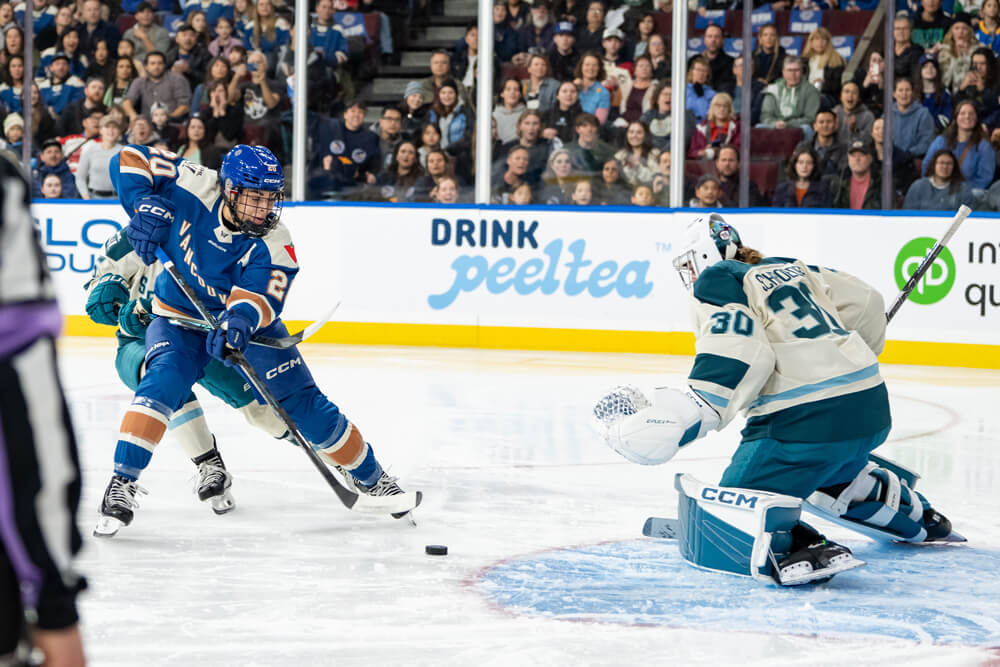
Nina Jobst-Smith spies the fleeting opportunity and sends in a hard wrister. Nurse takes a step. She angles her body, so the puck drifts between her and the cage. And with one deft touch, she redirects the puck, sends it spinning through netminder Raygan Kirk’s pads and into the back of the net.
The winger throws both arms high. Her teammates mob her. “Being injured, it’s not easy,” Miller says. “For her to come back, in Toronto, against her former team, hometown, Scotiabank [Arena] game, and score — it’s incredible. … It’s pretty electric, what she’s been able to do.”
When the two teams meet again a few days from this moment, back at Pacific Coliseum, Nurse will do it again, scoring two more times against her former club. Three circled dates on the calendar, three marquee performances for Vancouver’s No. 20.
On the opposing bench, Ryan couldn’t have been too surprised. For those who’ve spent any time with Nurse, it was never really in doubt. The stakes were simply too high, the lights too bright.
“A lot of people see her as a high-end skill player, and although she does have high-end skills, I think the best part of her game is when she’s playing a bit on the edge,” Ryan says when we speak the day before the two reunion tilts. “As a game gets competitive, she does a really good job of just not getting caught up in the emotion of it. Of playing sound positionally, forcing turnovers from people that maybe are playing a little bit with the emotion of the game. When the game gets a little greasier, a little more physical, a little more emotional, when the stakes get high, she doesn’t get caught up in it. In those difficult moments, she’s able to stay calm.
“When there’s just a different level — a different level of physicality, a different level of compete — I think that brings out the best version of Sarah Nurse.”