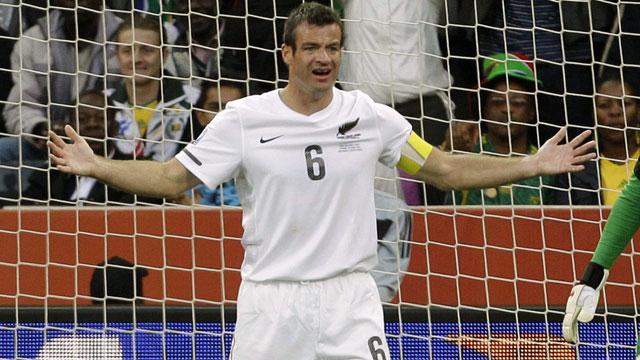

Rugby is the most popular sport in New Zealand, but the excellent exploits of the All Whites over the past few years means soccer is growing in stature in the country.
The Kiwis won the 2008 OFC Nations Cup, earning a trip to the FIFA Confederations Cup the following year where they bowed out in the first round on the back of three shutout losses.
 More team profiles:
Canada |
England |
Italy |
Germany |
Portugal |
Russia |
Croatia |
The Netherlands |
Argentina |
South Korea |
Senegal |
New Zealand |
Spain |
Denmark |
Sweden |
Ukraine
They had a much better go of it at the 2010 World Cup. The Kiwis marked their first tournament appearance in 28 years by drawing all three of their matches and finishing third in their group ahead of powerhouse Italy.
New Zealand’s path to the 2014 World Cup is clear and manageable: win Oceania, and then beat a CONCACAF team (possibly Canada?) in the inter-continental playoff to book a trip to Brazil.
THE QUALIFIERS
New Zealand is considered the favourite to win the Oceania qualifiers as the most experienced team in the final group that includes New Caledonia, Tahiti and Solomon Islands.
Still, success shouldn’t be taken for granted after New Caledonia upset New Zealand in the semifinals of the 2012 OFC Nations Cup, a tournament that was eventually won by Tahiti.
The Oceania champion will advance to the inter-continental playoffs where it will meet the fourth-place team from CONCACAF in a two-match series with a World Cup berth at stake.
THE MARQUEE MATCH
The Kiwis kick off the final round of the Oceania qualifiers on Sept. 7, 2012 with a visit to New Caledonia, but it is the return match on March 22, 2013 back in New Zealand that could very well decide the group. That fixture is the second-last one for both teams, and with New Zealand scheduled to play Solomon Islands and New Caledonia versus Tahiti, the March date is one that both countries can’t afford to lose.
THE COACH
A key member of the New Zealand side that made its World Cup debut in 1982 in Spain, Ricki Herbert has revitalized the Kiwis since taking over the coaching reins in 2005. Under his tutelage, New Zealand won the 2008 OFC Nations Cup, competed at the 2009 FIFA Confederations Cup, and qualified for the World Cup in 2010.
A former standout player in his native New Zealand, Herbert also had a brief spell with English club Wolves in the mid-1980s. He began his coaching career in 1990, and took charge of New Zealand’s U-17 and Olympic side before graduating to the senior team.
BIGGEST STRENGTH
Once considered international doormats, New Zealand have gained a great deal of respect after recent positive results, most notably their performance at the 2010 World Cup. As the top team in Oceania, this will serve them well as they plough their way through the qualifiers, especially if they advance to the inter-continental playoff.
BIGGEST WEAKNESS
New Zealand isn’t exactly spoilt for choice, as the team lacks depth and general quality at several key positions. The majority of players ply their trade in the Australian A-League (not exactly a circuit known for its skill level), while only a few of the players who play in England are regular starters with their teams.
PLAYER TO WATCH
Ryan Nelsen has valuable Premiership experience, although the current Queens Park Rangers defender saw limited action in 2012 with Tottenham. You’d think he would have called it quits after captaining his country at the 2010 World Cup. But at 34, he still has a deep desire to represent New Zealand, and the team could use his experience and expertise on the defensive end.
BREAKTHROUGH PLAYER
He only has a handful of caps, but centre back Winston Reid shows great promise. Reid, 24, began his pro career in Denmark with FC Midtjylland before moving to England in 2010 when he signed with West Ham United. Although he struggled for playing time at first, Reid is expected to regularly feature during the 2012-13 Premiership season as the newly-promoted Hammers try to maintain their topflight status.