
Football has a strange, possibly ill-judged relationship with notions of “progress.”
Everyone involved, supposedly, likes a bit of progress. And why wouldn’t they? It sounds great. But sadly, alongside this island of pleasure that progress provides, progress in football is also marred by confusion. Because, unfortunately, no one actually knows what progress means.
Progress in football basically manages to be both completely ubiquitous and massively elusive—there’s a lot of talk about it, but none of it is very exact at all.
“It’s about getting results,” you might be told by an ex-player who has tricked his way into your house. But what results? Where? When? How? Why? And didn’t Bayern Munich move their Champions League-winning manager aside to get progress via performances? Ultimately it’s not clear what progress represents and it’s also absolutely not agreed upon.
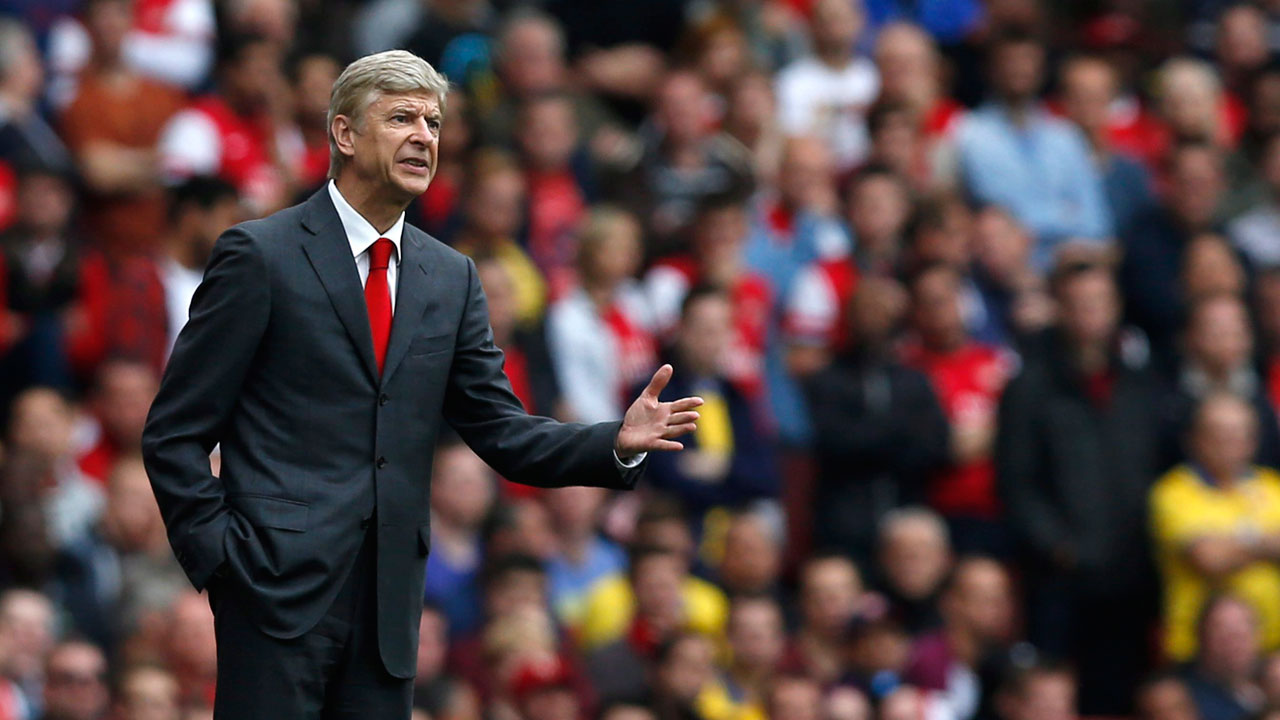
And, now, to the losers in all of this. No one has lost out more to the confusion around what progress means than Arsene Wenger and his Arsenal team. No one will ever be worse represented by wonky “progress culture” than the team that won 1-0 away at West Bromwich Albion this weekend and still had its manager touted for the sack. And I’ll tell you why.
Arising precisely from the confusion around progress is the idea that Arsenal under Wenger has spent the last three, five or ten years moving in circles. “The seasons pass by but Wenger and his players play out the same combination of defensive problems and obvious managerial mistakes every time,” reckon the hoards of ex-players and fans who bring out banners like “Arsene, thanks for the memories but it’s time to say goodbye.” But they have it wrong, or have at least drawn the wrong conclusions from the bits they have right. What they’re watching isn’t stasis or circles or a lack of progress.
Soccer Central podcast: SPORTSNET.CA’s Soccer Central podcast, hosted by John Molinaro and James Sharman, takes an in-depth look at the beautiful game and offers timely and thoughtful analysis on the sport’s biggest issues. To listen and subscribe to the podcast, CLICK HERE.
If we judge progress moderately fairly or accurately, there’s plenty of it at Arsenal.
Just over three years ago Wenger’s side lost 8-2 to Manchester United. It was a bad moment. An easy one I know, but if you compare the present to that past, just for a start, the positive differences are so easy to pick out it is ridiculous.
Then: No world-class players, even theoretically. Now: At least two, in Alexis Sanchez and Mesut Ozil. Then: A central defence featuring Johan Djourou and crying out for “a big man.” Now: Per Mertesacker, a big man. Then: A central midfield involving 20 year-old Francis Coquelin as a holding midfielder. Now: A squad containing two working-age holding midfielders, whatever you think of them, neither one of them being Francis Coquelin.
You can keep going. Then: A flimsy Aaron Ramsey. Now: A substantial (if out of form) Aaron Ramsey. Then: No squad depth. Now: A bench this weekend featuring Kieran Gibbs, Hector Bellerin, Tomas Rosicky, Alex Oxlade-Chamberlain, Joel Campbell and Lukas Podolski. Then: The always sketchy but defiantly prevalent complaint that there were “no leaders” in the team. Now: Mertesacker, Mikel Arteta and Sanchez.
So many of the complaints aimed at Wenger back then have since been objectively addressed, and yet there are worries about circles and stasis and even regression. It’s a way off.
Even if you compare less obviously bad moments than that to this current one, there are still relatively easy points to score on how Arsenal has improved.
Have a look. Last year Arsenal regularly ended up playing with Santi Cazorla, Olivier Giroud and Tomas Rosicky in the same attack, and part of the reason its title challenge faded was that those players were too slow a combination to inspire proper fear in proper defenders. This year, Wenger added the aforementioned Sanchez and the yet-to-be-mentioned Danny Welbeck—and, simultaneously, Theo Walcott and Joel Campbell have both become available for selection. There’s suddenly an abundance of guys who can run really quickly—not to mention newly adequate back-up for Giroud up front.
That’s progress!
Freed from big stadium debt and signed up to newer, bigger sponsorship deals, I have it that Wenger has been removing weakness from his squad really effectively ever since he signed Mesut Ozil last summer. With hindsight, which we all have now, Arsenal’s past ten years actually goes neatly into: the downwards trajectory (cushioned by Wenger) when there was no money and all the best players left at the end of the 2000s, to the (albeit jagged) upwards trajectory since just before the stadium debt got paid off.
My argument is that all of this can only really be made to feel circular when there’s confusion around exactly what progress is and, as a result, it’s over-simplified—which is exactly what keeps happening.
You can see why it happens—the means for that process of over-simplification are all in place, because certain (highly-related) aspects of Arsenal’s last few seasons have absolutely played out again and again. For one, Wenger’s team has finished third or fourth nine times in a row—and looks to be on course for that to continue again this season. Second, defensive midfield remains a weakness. Third, Wenger’s record against big teams is still naff. But, importantly, none of these negatives negates all of the positive shifts I’ve described and it is confusion around what progress means that would make anyone assume that they did.
European Football Weekly: Sportsnet 590 The FAN’s Dan Riccio, Derrick Brandao and Thomas Michalakos take an in-depth look at the beautiful game on the European Football Weekly podcast. For more details and to listen to past shows, CLICK HERE
It’s about nuance. We’re allowed to say that there is progress in some areas at Arsenal, despite some major negatives remaining in place in others. Right?
I want to say that there’s value in this way of thinking. After the slow start Wenger’s team has made this season, we can see that we’re talking about “soft” progress—progress that isn’t yet “results” based. But that should still count, because, even if you don’t value it on its own terms—quite usefully—soft progress is a precursor and even prerequisite for the hard progress of results.
It goes like this: If you haven’t got a spare billion dollars, you tend to have to improve bit by bit underneath the surface before your team gets actually good at winning football games. Soft progress—you see?
So, Wenger’s “post-stadium-debt” improvements to his team might have so far missed out a defensive midfielder (and a backup centre-back), but, look, they have created a brilliant platform should one of those arrive sometime soon—a far superior one than would have existed three years ago. That’s important. And, what’s more, the more savvy (if not ultimately successful) performances shown against the likes of Chelsea and Manchester City this season suggest that, yes, this is a team getting closer to being a couple of places higher in the league—even if it isn’t going to get that yet and even if not everyone is prepared to note its soft successes along the way.
My point is that even if there are mistakes left unattended to that give the illusion of circularity around Arsenal, there can still be and is important progress of a kind. And in a football world that had a healthier, less confused attitude towards progress, no one would be saying that Arsenal under Wenger was moving in circles. We’d be saying, somewhat pretentiously, it was moving in upward spirals—a position that accurately reflected the nuances of the situation rather than one that just simplified it and became a “WENGER OUT” banner.
As it is, I’ll make a prediction. Arsenal will finish fourth this season, somewhat disappointingly. But next season, having yet more cornerstones of a decent team in place, Arsenal, a team with no financial right to compete with Chelsea and Manchester City, will do just that. Properly. And to some people it will feel like a surprise and to some people it will feel like miraculous redemption for Wenger.
But the reason that will be the case is that the bits of progress he has made with this team for the last three or so years haven’t been counted up—they’ve instead been disregarded, along with all the other things that involve taking in a little bit of nuance to understand fully.
There’s a difference between soft progress and no progress. And that’s the end of today’s lecture.
Ethan Dean-Richards is a London-based writer. Follow him on Twitter