European soccer fans weren’t the only ones who felt betrayed and blindsided by plans to build a Super League.
Here in Canada, diehard fans felt the kick to the gut as well.
The reaction to the explosive April 18 announcement that 12 "elite" European soccer teams were joining forces to form a Super League was swift and dramatic.
Across the United Kingdom, dyed-in-the-wool fans of local teams swarmed the streets, protesting a move that would have forever changed the European soccer system they had grown up with.
While that volcanic fan reaction eventually convinced owners to walk back the plan, fan disenchantment remains.
Even though there were few, if any, public demonstrations across Canada, many fans across the country were hurting.
[relatedlinks]
Shocked and betrayed
When Jon Bisby heard the news, it nearly sent him into an existential crisis.
"The first emotion was pretty disgusted, angry," said Bisby. “The second emotion was, what am I going to do now?"
As a boy growing up in Lancaster, England, a town north of Manchester, Bisby proudly sported the sky blue and white of Manchester City – one of the six English clubs involved in the ESL.
Today, he’s the president of the Man City supporters’ group in Vancouver, boasting roughly 40 paying members who, pandemic-permitting, regularly gather at the 3 Brits Pub to rally behind the team.
Bisby says the announcement of a new, exclusive Super League was a betrayal to long-time fans, and left him questioning whether he could continue following his boyhood heroes.
"I supported them since I was a kid, so it’s like 40-odd years," said Bisby.
"Could I come to terms with the greed of this kind of move and the lack of tradition, history and just taking away the whole spirit of sport?"
The announcement’s timing was another insult to Manchester City fans, says Bisby, as the team was gearing up for a League Cup final the following weekend, and a much-anticipated Champions League semifinal tilt against Paris St. Germain coming this Wednesday.
All of a sudden, did any of this matter?
"We’d only made one semi before in the Champions League, and so it was kind of a little piece of history again, we’re really looking forward to it," he said. "Then they come along and say, well, it doesn’t really matter anymore because next year there’s this Super League going on."
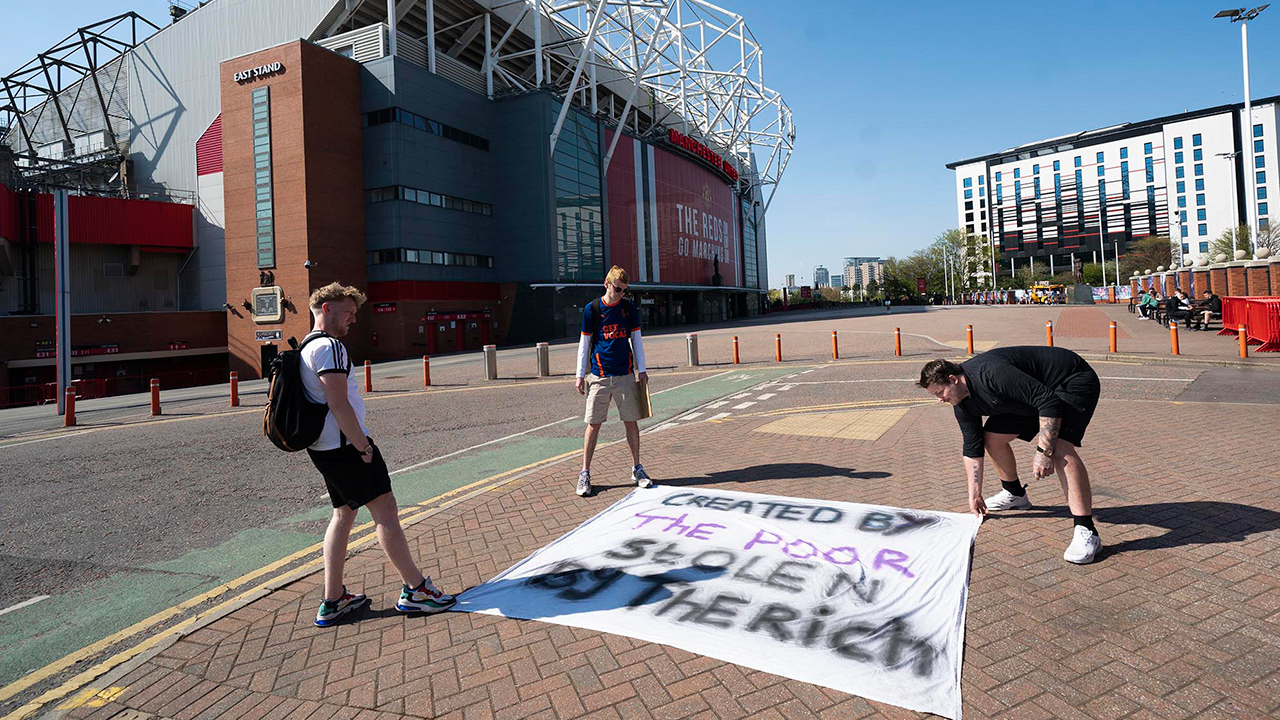
Football supporters place a protest banner outside Manchester United’s Old Trafford Stadium, Manchester, England, Monday, April 19, 2021. (Jon Super/AP)
Graham Page grew up in Toronto, and while he follows many sports, he feels nothing quite compares to the culture of European soccer.
In a typical year, Page attends a game or two overseas – he was in the stands when Manchester United clinched the Premier League trophy against Arsenal in 2009.
"It’s not just a two-hour game, and it’s not all dependent on who wins, who loses," said Page. "You’re going over for the atmosphere before the match, afterwards you’re in the pub. It’s the camaraderie."
Page is currently chair of the Manchester United Supporters Club of Canada, with 200 paying members across the country, and locations in Toronto, Vancouver, Montreal, Winnipeg and St. John’s.
Much like Bisby, the Super League announcement – which United was a part of – left him questioning how it would affect his fandom.
"I’m sure I would have kept watching it to some degree, but a significant part of me would have been disgusted to continue to watch," said Page.
What draws Page and so many others to the sport is the culture. It’s the grassroots, community-based support for clubs that inhabit nearly every town or neighbourhood in the U.K.
The promotion-relegation system works to keep the fans’ passion alive throughout the season, no matter the level of play, unlike the championship-or-bust style in North America, where losing can actually be beneficial.
That’s why fans were so outraged by the announcement. The ESL posed a giant threat to everything club soccer in Europe stands for.
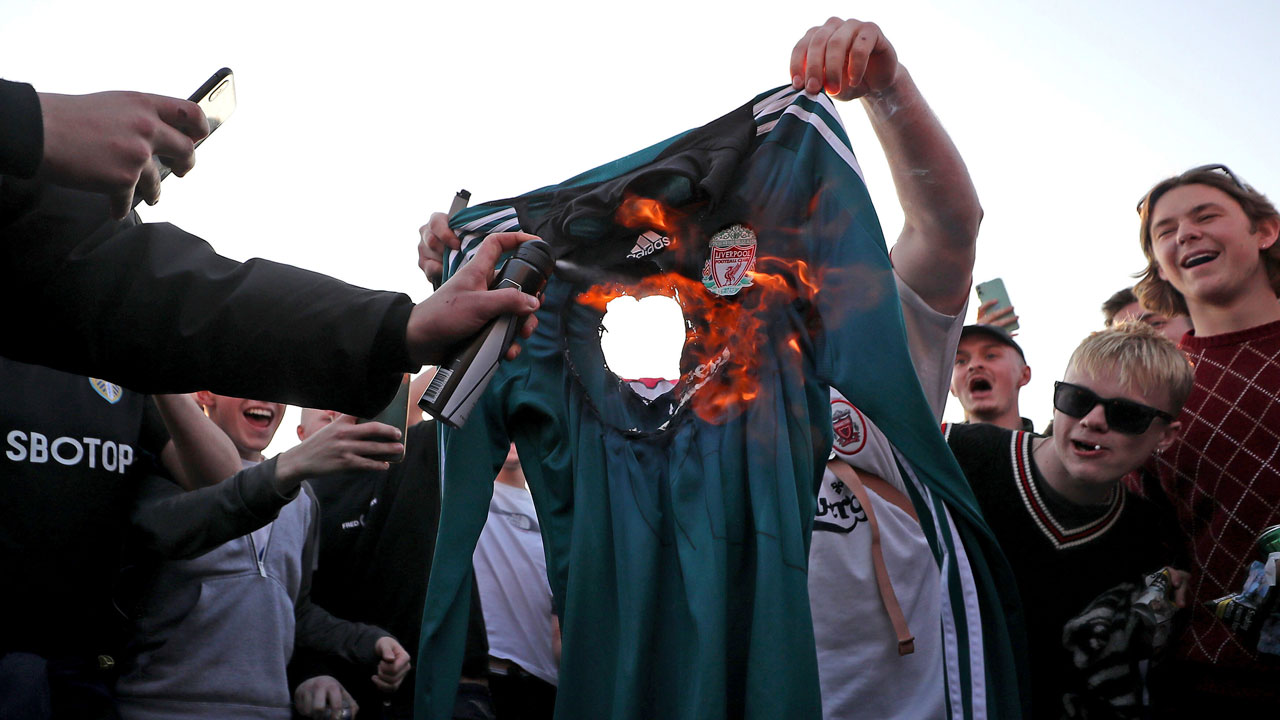
Fans burn a Liverpool replica shirt outside Elland Road, as a protest against Liverpool’s decision to be included amongst the clubs attempting to form a new European Super League. (Zac Goodwin/AP)
Rob Lancaster, a native of the West Ham area of London living in Toronto, believes that’s what the Super League founders, many of whom are foreign and own professional sports franchises in the United States, wholly misjudged.
"It’s all been driven by money," said Lancaster. "And these owners don’t understand the actual demographic, the culture of the game in the U.K. The history, the passion, the soul, you know, the rivalries that we have."
Lancaster is a lifelong supporter of West Ham United and current member of the Toronto Hammers supporters’ group, which met weekly at the Dog and Bear on Queen Street West before the pandemic.
Despite living in Canada since 2013, he hasn’t been captivated by North American sport. The lack of promotion and relegation is at the heart of why; it’s an important distinction that makes European football so different.
Since West Ham is rarely contending for the title, he says the battle to remain in the Premier League and avoid demotion to a lower division is crucial in keeping his interest peaked.
"If you’re not competing for a trophy, you’re competing for survival," said Lancaster.
“As much as I don’t want to be involved in a relegation battle, it’s more exciting to be involved," he said.
This season, the Hammers are in contention for a place in the Champions League.
As holders of fifth place in the Premier League, West Ham boasts a better record than Super League founders Arsenal, Tottenham and Liverpool.
But with the creation of a Super League, earning a Champions League spot had lost its significance.
"You’re just undoing all the hard work that this club has done and worked on this year to get where we are," said Lancaster.
"What you’re saying to us is well, the prize that awaits us… it might not be there for us."
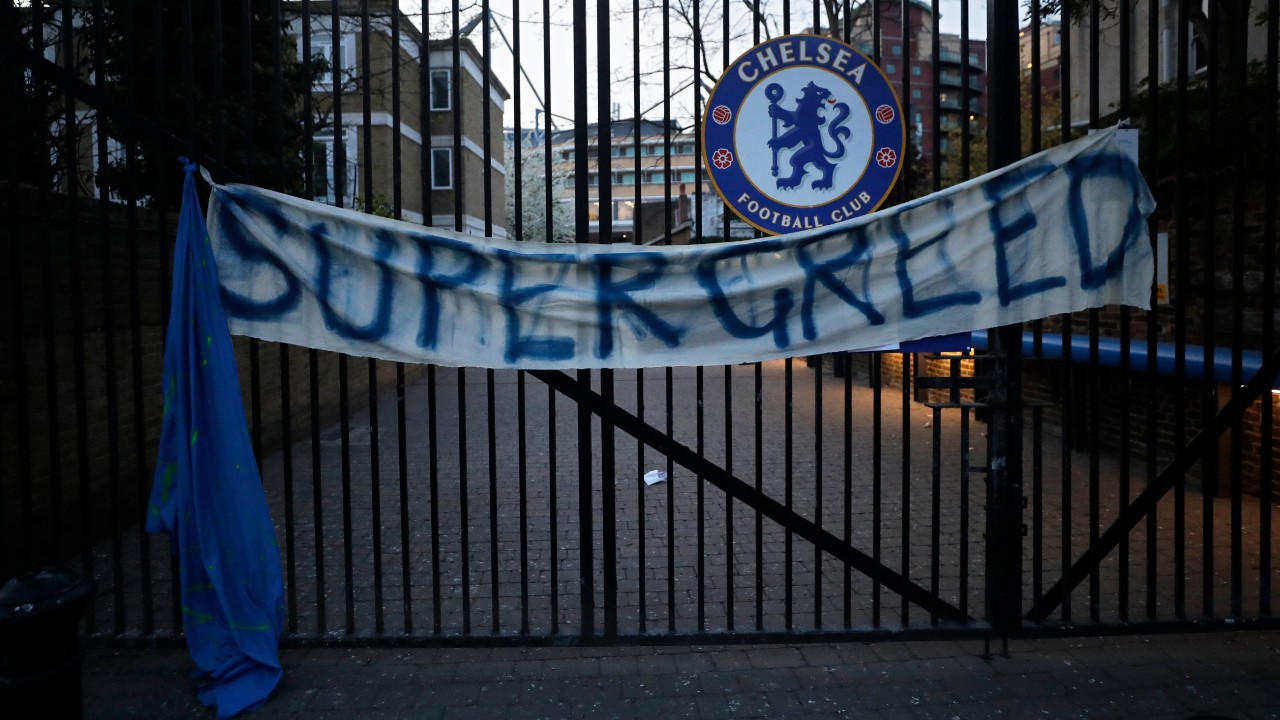
A banner hangs from one of the gates of Stamford Bridge stadium in London where Chelsea fans were protesting the club’s decision to be included in a new European Super League. (Matt Dunham/AP)
Revolution not complete
Following two days of fan revolts and widespread backlash, the Super League collapsed. At this point, Barcelona and Real Madrid are the only clubs that haven’t officially backed out.
Despite the short-lived league’s dramatic fall from grace, the fight to return Europe’s game to its traditional roots is far from over.
Fans continued demonstrating throughout the week, with Man United supporters at the forefront demanding their current owners leave the club.
The Glazer family, owners of United since 2004, have long been under scrutiny for making decisions in favour of their bottom line instead of considering the club and fans’ best interests.
Although the Super League is dead (for now) and executives at several clubs involved have stepped down, the root of the problem hasn’t dissipated, Page says.
"We still now have owners who very clearly thought this was a good idea," he said. "The problem is still there."
Lancaster was glad he could once again dream of seeing the Hammers play Barcelona or Real Madrid perhaps as soon as next season, but also felt the Super League debacle had given the soccer world a wake-up call.
Under the current system, a handful of clubs hold vastly more money and power than the rest, and they’re seeking even more. Lancaster says he wouldn’t be shocked to see the "elite" clubs try a Super League stunt in another format down the road.
The truth is, they already are.
While the Super League announcement was causing widespread outrage, UEFA approved a re-formation of the Champions League.
The new format, set to begin in 2024-25, includes an additional four spots in the tournament, two of which would be reserved for clubs that didn’t earn qualification but are historically highly ranked by UEFA.
Thus, those spots essentially serve as a cushion to ensure these "elite" clubs compete in the Champions League and continue to reap the financial benefits, even if they have a substandard season.
"Those changes are, quite frankly, a step towards a European Super League-type structure," said Page. "I have a feeling that was not a coincidence, and it was meant to try and detract from the statement by the Champions League whereby they’re expanding the number of teams."