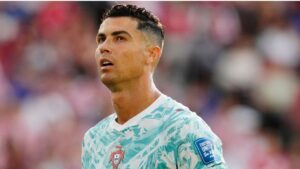
The ongoing saga between sporting icon Cristiano Ronaldo and the Portuguese Football Federation has hit another checkpoint.
Ronaldo has been levied a 30-day suspension by the federation and a fine of €255 ($286 USD) after exiting Portugal's national team camp early.
“The disciplinary council — non-professional section — of the Portuguese Football Federation hereby decides, in the present proceedings, to find the charges fully substantiated and, consequently, to convict the defendant, Cristiano Ronaldo dos Santos Aveiro, for committing, on a single occasion and with intent, the disciplinary offence provided for and punishable under Article 160(1) of the RDFPF, and to impose upon him, as a result, a 30-day suspension and, additionally, a fine set at €255.00," said the official statement.
Ronaldo left the team ahead of Portugal's Nations League clash with Denmark after a dispute with head coach Jorge Jesus. Ronaldo accused Jesus of breaking promises over his playing time, having been left on the bench against Norway.
The federation previously announced a provisional suspension after an investigation was opened on Oct. 9, before Monday's final verdict.
Ronaldo addressed his departure from the national team in a lengthy public statement on Tuesday, expressing frustration over what he described as a breach of trust involving the federation’s president and Portugal's coach. The 41-year-old said he had been assured that his place remained with the national team, despite feeling that his presence was no longer wanted.
“I decided to leave the camp without waiting for any further breach of word. For me the truth is still the most important thing in the relationship between people,” Ronaldo said.
He claimed he had spoken with the federation president and coach earlier that day and offered them the opportunity to tell him directly if they no longer wanted him involved.
“In fact, in a conversation I had with the President of the FPF and with the coach on the morning of the day of that press conference — they can certainly confirm this — I reaffirmed that if they did not want me there they should tell me,” he said.
Ronaldo maintained that he had never interfered in the technical or tactical decisions of a national-team coach throughout his nearly 25-year career. He said he respected the decisions made by coaches but felt he could no longer remain with the group after what he characterized as a broken promise.
Despite his criticism, the Portugal captain accepted responsibility for leaving the camp and apologized to his teammates and the Portuguese public.
“I also owe an apology to my national team teammates for having left the camp,” Ronaldo said. “Despite the absolute breach of trust in the coach’s word, as those who witnessed these conversations can attest, I should not have done it. The responsibility is exclusively mine.”
Ronaldo also called on the federation to hold him accountable, arguing that his status as captain should make the incident more serious rather than provide him with special treatment.
“The consequence of this act of mine must be assessed and punished by the Portuguese Football Federation. I understand that the punishment should have no mitigating factors,” he said. “I am not just any player; I am team captain, and that constitutes an aggravating factor.”
He added that he understood the need for consequences and believed the same rules should apply to every player, regardless of their standing in the game.
Ronaldo also addressed speculation about a potential farewell to international soccer, insisting that his priority remained competing for Portugal rather than planning an exit from the national team.
“If I am physically well, playing for my club, with goals, I hope, after serving the suspension that may be applied to me, I will be available, as I have always been until today, to compete and win for our national team,” he said.