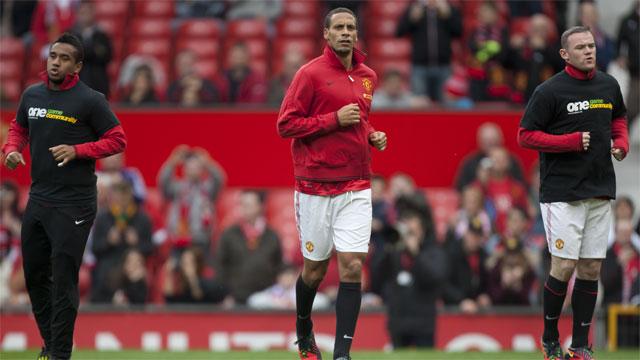

Rio Ferdinand will never wear an England shirt again.
"Never" shouldn’t be thrown around lightly, but when a situation has become as untenable as Ferdinand’s relationship with the FA and England manager Roy Hodgson, for the sake of all parties a permanent break is the most sensible solution.
Ferdinand was supposed to be in Podgorica on Tuesday with his Three Lions teammates for a key World Cup qualifier against Montenegro. Instead, Ferdinand was in Qatar, acting as a pundit and providing commentary on a match in which he was likely to feature.
Why? He deserved to be there and he genuinely wanted to be there… well, he told us he wanted to be there.
Last week, Ferdinand pulled out of the England squad for both the Montenegro match (which ended 1-1) and last Friday’s 8-0 drubbing of lowly San Marino. The veteran Manchester United defender isn’t hurt, but he didn’t go because he’s 34-years-old and for the sake of prolonging his career and avoiding any spell on the sidelines as United seeks its 20th top flight title. Considering his age, fitness history and the physical demands of his position, his concerns are justifiable ones, But with Ferdinand, the circumstances are different.
Capped 81 times by his country, but none since June 2011, Ferdinand has been vocal about perceiving to be frozen out of the international set-up due to political reasons. Ferdinand found himself at the centre of the race row between his long time England defensive partner John Terry and his younger brother Anton. Though Terry was found guilty of racially abusing the younger Ferdinand by an FA tribunal, the elder brother felt that his exclusion from the Three Lions was due to the FA and Hodgson siding with Terry over the affair.
While an exclusion from the England 2012 Euro squad in favour of the likes of Joleon Lescott and United teammate Phil Jones could be viewed as support for Ferdinand’s position, it wasn’t difficult to view things from Hodgson’s angle. Missing large spells of the previous two seasons due to injury and rarely playing consecutive games while fit, carrying the aging Ferdinand on a 23-man roster would be a measured risk, regardless of the political climate surrounding the defender.
Public sentiment changed, though, on June 3 when Chelsea’s Gary Cahill suffered a double jaw fracture and was ruled out of the tournament. With a first-choice central defender out with injury, Hodgson turned to once capped, 22-year-old Liverpool defender Martin Kelly as his replacement.
Now, the chances of Hodgson having to use Kelly in a match were slim, but the fact that he chose an inexperienced player, normally employed on the right, and not the battle-tested Ferdinand, lent credence to Ferdinand’s standpoint that his omission was based on more than simply fitness. Ferdinand’s position as winning the PR war was strengthened later in the summer when Hodgson apologized after being recorded on London’s Tube telling fellow riders that Ferdinand would never play for England again.
With public perception on his side, Ferdinand entered this season with redemption on his mind and has, thus far, produced a fine campaign for league-leading United and reasserted himself as one of the best central defenders in the Premiership. So when Hodgson handed Ferdinand a national team call-up last week, though it was fully merited, it was also a mea culpa from the England manager. A prouder man might not have been able to do what Hodgson did, so it was an admirable gesture on his part to attempt to bring the prodigal son back into the fold.
From both a political and an optical perspective, Ferdinand’s response could not have been worse. Even if Ferdinand was carrying a knock, he should have accepted the call-up and sat on Hodgson’s bench, finally burying the hatchet. Instead, he chose to act in a manner completely against how he purported to feel. Anybody who truly felt that an international call-up was an honour and a privilege should have accepted the assignment with open arms and made the last two years water under the bridge.
But Ferdinand wanted the last word and chose to make Hodgson and the FA look foolish after breaking the olive branch in half.
With his international career in its death throes, nobody is blameless, but it was the veteran defender who turned down the opportunity to rectify matters in the end. For Rio Ferdinand, the prospects of making a statement outweighed the prospects of being the bigger man and so concludes a regrettable episode for English football.