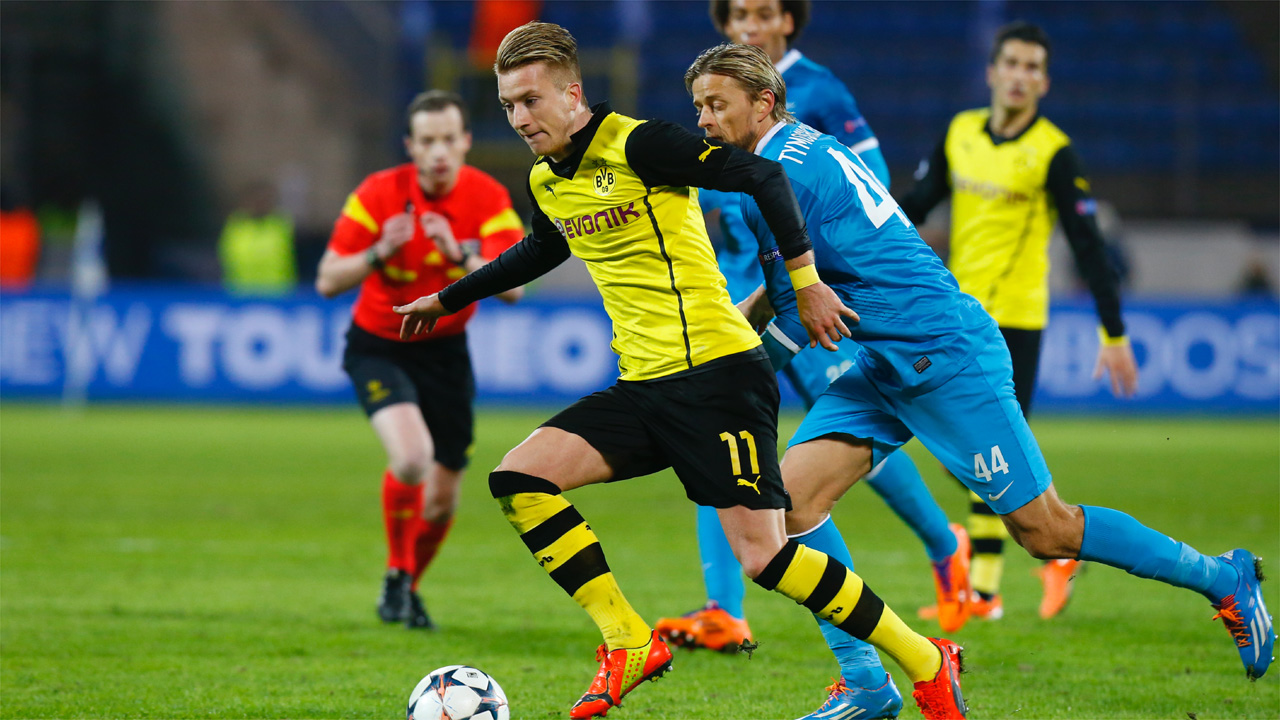

Choreographed chaotic displays of affection are the best way to describe the scenes produced by Borussia Dortmund supporters each matchday at the famous Westfalenstadion.
Win or lose, a capacity crowd of over 80,000 inside Germany’s largest stadium create a spectacle that arguably goes unmatched in European football. The iconic Sidtribune—Yellow Wall—houses almost 25,000 standing spectators that orchestrate the larger than life atmosphere.
For the past few seasons, the product on the pitch was worthy of the festivities taking place in the stands. Since taking the helm in 2008, Jurgen Klopp has built a yellow demon that has terrorized the Bundesliga—winning back-to-back titles in 2011 and 2012—and came close to lifting the club’s second Champions League crown in 2013. Unable to match domestic rivals Bayern Munich’s resources, Dortmund was able to achieve sustainable success through great scouting and development, even though their continued success became a double-edged sword.
Soccer Central podcast: SPORTSNET.CA’s Soccer Central podcast, hosted by John Molinaro and James Sharman, takes an in-depth look at the beautiful game and offers timely and thoughtful analysis on the sport’s biggest issues. To listen and subscribe to the podcast, CLICK HERE.
Decline has set in.
With two wins, seven points and 10 goals from nine domestic matches this season, Dortmund sits one point off the bottom three, unable to stop the tailspin. Their 1-0 home defeat last weekend to Hannover was a crippling blow. It quickly extinguished the recent momentum gained through an emphatic 4-0 performance away to Galatasaray in the Champions League, where Dortmund is a perfect three for three with nine goals scored and none conceded. Their form is night and day between the two competitions, but Dortmund aren’t necessarily playing that bad in the Bundesliga—they are just lacking that little bit of verve that makes them so deadly. The quality is there, which is why their current position in the table (15th) is so baffling.
Despite the loss of Robert Lewandowski on a free to Bayern Munich, money was invested over the summer to steady the ship—Ciro Immobile and Adrian Ramos—and recoup some of the 28 goals scored by the Polish striker last season. Almost £50 million was spent and the results have fallen way below expectations. Bayern Munich spent less than Dortmund this off-season and sit 14 points superior at the top of the table. It needs to be said that the Bavarian giants had key pieces in place leading up to the new season, but more important they never have to worry about their best players being poached.
Has the time finally come for a change in scenery for Mr. Klopp? What else is left to accomplish in the North Rhine-Westphalia?
Year after year, Klopp helplessly watches his top talent sold to the highest bidder and yet somehow manages to keep his team competitive. It began with Nurin Sahin in 2011, followed by Shinji Kagawa, Mario Gotze and now Lewandowski. You can almost guarantee one of or both Marco Reus and Mats Hummels will be next to leave the Westfalenstadion. Astute scouting and youth development has allowed Dortmund to stay relevant and be considered among Europe’s elite clubs. At one point, Klopp’s model of success was looked upon with envious eyes, and to a certain degree still receives much admiration. But let’s face facts: Dortmund is a selling club and that won’t change in the current football landscape.
Regardless of the trust and loyalty between manager and club, the very real possibility of missing out on Champions League football next season would be a significant hammer blow in financial terms for Dortmund.
I don’t expect to see Dortmund hovering above the relegation zone for too long. This team has way too much talent for that. However, the time has come for Klopp to venture off into foreign territory for a new challenge. Having started his managerial career at Mainz in 2001, Klopp guided the club into the Bundesliga for the first time in their history (2005), spending consecutive years in the German top-flight before being relegated in 2007. He even stayed on despite Mainz’s demotion in an attempt to bounce straight back up, which never materialized, and was the catalyst in his move to Dortmund in 2008.
At 47, it’s impossible to question his loyalty given his track record. Thus, the idea of Dortmund sacking their manager is highly unlikely, as is Klopp walking away from the project he built from the ground up. However, an amicable split seems to be the best step forward for both parties this summer, regardless of Dortmund’s final league position.
Rumours linking Klopp with a move to Arsenal haven’t faded away, despite Arsene Wenger signing a three-year extension. Arsenal would be the perfect destination for the Stuttgart-born manager should he desire a fresh start—the Gunners have the resources to stay competitive, even though they have a similar track record as Dortmund when in comes to selling their best players. Klopp’s presence and winning credentials could help fend off outside interest.
Another interesting option would be Tottenham. Spurs owner Daniel Levy has proven to be trigger happy and not shy to hit the reset button at White Hart Lane—three different managers in two years and six since Martin Jol was sacked seven years ago. Mauricio Pochettino is now under the microscope following a below-par beginning to his Tottenham career.
The next logical step is for Klopp to move to England. Unless there is a vacancy at the Estadio Santiago Bernabeu or Camp Nou, the Premier League is most likely the German’s next venture.
Regardless, the cord needs to be cut. Both Dortmund and Klopp need to move on.