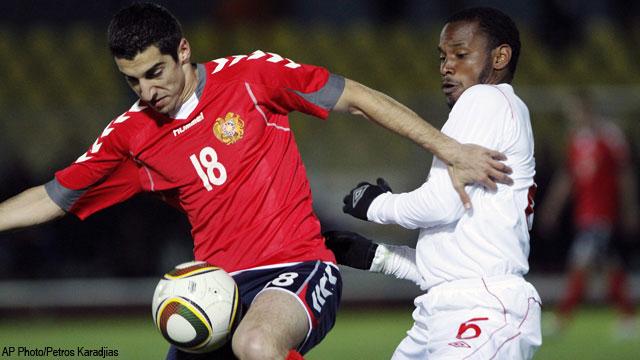

When you think of budding football nations, Armenia would not make the cut.
Since gaining independence after the split-up of the Soviet Union in 1992, the Highlanders have never qualified for a major tournament and are normally considered a stepping stone for the more established national teams in UEFA. Most consider them as an easy three points, lumped in with similar minnows such as San Marino, Andorra, Moldova and Liechtenstein.
But the Euro 2012 qualifying campaign resulted in a major change of fortune, with Armenia becoming the predator instead of the prey and coming within 90 minutes of making history.
With Canada set to play Armenia in Cyprus Wednesday in a friendly, most people are unaware of the Canucks’ latest opponents. Here is a rough guide on what you need to know about Armenian football and who to watch out for when the two countries meet.
 Programming alert: Watch Canada vs Armenia live on Sportsnet, starting with our pre-game show at 11:30 am ET on February 29.
History
In just under 20 years, Armenia has made significant strides to gain respectability in the world of football. Their lowest FIFA ranking was 159 (June 1994), but now the tiny nation of just over three million inhabitants are 41st in the world and 25th in Europe, their best ever seeding in their short history.
Development has not been easy, especially prior to 1991 when the domestic league fell under the Soviet football pyramid and was nothing more than a regional tournament. Some of the country’s best even suited up for the USSR. After the collapse of communism, the Armenian Football Federation was formed and they immediately created their own identity by setting up a Premier League, First Division and domestic cup competition (Independence Cup) in 1992.
Currently the top tier consists of eight teams and the second tier has nine, although all the clubs in the lower division are reserve sides from the Premiership. FC Pyunik is the most decorated club in Armenian football with 13 league titles, five Independence Cups and eight Armenian Supercups. They are also the most popular club in the country and boast an incredible list of graduates — most of the top players in Armenia have come through their youth set-up.
However last year saw a new team lift the title for the first time in ten seasons, with Ulisses FC being crowned champions. No club has ever made it to the group stages of a European competition, a statistic that might soon change.
Qualification Results
First International Match: Armenia vs. Moldova (0-0) in Yerevan
1996 European Cup Qualifying: last place in their group, beat Macedonia in Skopje for their only victory. Conceded seventeen times and only scored five goals in 10 matches. Almost earned a result in Seville against Spain, but lost on a second-half penalty.
1998 World Cup Qualifying: finished in fourth place ahead of Northern Ireland and Albania, but 12 points back of a birth to the finals. Started the group stage with a morale-boosting goalless draw at home to Portugal, and recorded a 3-0 victory over the last-place Albanians towards the end of qualifying.
2000 European Cup Qualifying: finished second from bottom, with both wins coming against last-place Andorra. Best result in defeat came against France, losing 3-2 at the Hrazdan Stadium after taking the early lead.
2002 World Cup Qualifying: another last place finish, ending without a win and five draws in 10 matches. Best result came in 1-1 draw at home to eventual group winners Poland, and lost a heartbreaker to Ukraine 3-2 after being taking a two-goal lead at home.
2004 European Cup Qualifying: beat Northern Ireland twice to finish ahead of them in the group, fourth from five teams and ten points off a playoff spot that included eventual cup winners Greece
2006 World Cup Qualifying: both wins came against lowly Andorra, which kept them from finishing at the foot of the group. Terrible defensively, conceding 25 goals in twelve matches, most in their history at a major tournament. Almost produced a shocking result in Yerevan against group winners Netherlands, but a second-half goal by Ruud van Nistelrooy ruined a good overall performance.
2008 European Cup Qualifying: UEFA decided to cancel both legs versus Azerbaijan, leaving both teams with only 12 matches played instead of 14. Finished second-last in group, but recorded back-to-back victories against Kazakhstan and Poland, before tying Portugal at home. Despite positive results, four goals scored came in those three matches.
2010 World Cup Qualifying: Another disappointing finish, dead last in group with a single victory against Belgium at home. The result was followed by an impressive performance versus Spain, coming from behind before losing 2-1 from a second-half penalty by Juan Mata. Only six goals scored in 10 matches.
2012 European Cup Qualifying: best result yet, finishing third and missing a playoff spot by four points. Won five matches from 10, leading group with 22 goals scored. Beat Slovakia in both legs, recording their best ever result with a 4-0 victory in Zilina. Loss on final day ended Cinderella run. Armenia scored two goals in the match, however one was an own goal by Valeri Aleksanyan which gave Ireland the 2-1 win.
Players to Watch
Gevorg Ghazaryan (Metalurh Donetsk): plays as an attacking midfielder or a striker and earned first international cap in 2007. He has scored six goals in 23 matches for the national team, five of them coming in 2012 qualifying, and is one of Armenia’s main goal threats.
Marcos Pizzelli (FC Kuban Krasnodar): Brazilian by birth, the attacking midfielder made his debut for the national side in 2008 after gaining citizenship, scoring five goals in 18 matches — four of them coming from the recent qualifying campaign. He spent five seasons in the Armenian top flight, winning three scoring titles with 75 goals in total. Possesses the skill to also create chances for teammates and is one of the team’s main threats in the offensive zone.
Yura Movsisyan (FC Krasnodar): played in the MLS for Real Salt Lake between 2007 and 2009. The forward led the team with five assists in qualifying, and is not afraid to pull the trigger if given a chance on goal, adding four goals in the process.
Henrikh Mkhitaryan (Shakhtar Donetsk): by far the best player on the pitch for Armenia. The midfielder was purchased for 7.5 million Euros from his former employers Metalurh Donetsk last year, and made his Champions League debut this season. Netted eight times in 27 matches for the national team, six of those strikes came in qualification for the team lead. Only three goals shy of Armenia’s all-time leader Arthur Petrosyan
Sargis Hovsepyan (FC Pyunik): the 39-year-old defender is national team captain and leads by example at the back. He has accumulated 125 international caps in 20 years of service, becoming Armenia’s all-time leader. Over 300 appearances with FC Puynik, achieved legendary status in his country for being one of their most decorated players, winning nine Armenian Premiership titles and four Independence Cups.
Roman Berezovsky (Dynamo Moscow): considered one of the country’s best goalkeepers of all-time, with 69 international caps under his belt. Most of career spent in Russia with Zenit St. Petersburg and FC Khimki, racking up 300 appearances in total for both clubs. Earned four clean sheets in 2012 Euro qualifying, helping Armenia concede the fewest amount of goals in a single tournament — their best defensive result with only 10 goals allowed in as many matches.
International friendlies: Watch England-Netherlands live on Sportsnet, Germany-France live on Sportsnet World and Italy-USA live on Sportsnet ONE starting at 2:30pm ET on February 29.
The Manager
Vardan Minasyan officially took over as full-time manager in February 2010, and has guided the team through their recent turnaround. Only 38 years old, his professional playing career was short-lived and ended in 2003, spending most of that time with FC Pyunik as a midfielder. Minasyan has earned the trust of his players by producing results and has developed a solid foundation that will continue to improve through time. Armenia plays an attacking brand of football (4-3-3) under their new manager, but his players are well drilled on keeping things tight in the defensive end.
The Final Verdict
This will be a great test for Canada, as Armenia sits 30 places above them in the FIFA rankings and hold a higher seed than all three opponents the Canucks will face in the third round of CONCACAF qualifying for the 2014 World Cup.
Thomas Michalakos is a former associate producer with Sportsnet’s Soccercentral and writes the weekly blog Soccerholic365. Follow Thomas on Twitter.