Canadian comedian and actor Jay Baruchel and Irish soccer journalist Eoin O’Callaghan share a common love for Celtic Football Club. The pair explored how two men from vastly different circumstances living on different continents are united by the game of football.
While in Toronto for the premiere of their documentary “Celtic Soul,” which documents the history of the club and its supporters, I spoke to Baruchel and O’Callaghan about their views on the beautiful game.
Donnovan Bennett: Your film touches on country, family, and football; all the important things. What did you learn while making the film?
Jay Baruchel: The movie was fun, but it was also a bit emotional and frustrating and entertaining. The reoccurring theme was stuff we showed up to do that was just supposed to be interesting had a melancholy quality. Any immigrant saga there’s always a bit of bad to it, especially when you go to Ireland and there is millions of people that starve to death over there. On the very simple end for me it was this wonderful paid vacation through Ireland and Scotland. On the bigger more important end I came back with a bigger sense of my heritage and culture.
DB: It was only fun for Eoin, he beat professional football players in the crossbar challenge.
JB: Well fun for some people. Good for you buddy.
Eoin O’Callaghan: That’s a life highlight for me. It goes wedding, then crossbar challenge. You can only have fun in those situations if you are well looked after. I think it was a reflection of how hospitable every sports franchise was. It’s not ideal for a crew of cameras to turn up in the middle of your season. To turn up at the Bell Centre or Croke Park in Dublin or Lennoxtown or Celtic Park in Glasgow in the middle of the day when people are stuck to the routine and this is what they do for a living. Every team was so supportive.
JB: The pubs we went to for whatever combination of reasons were always psyched to see us. We chilled with P.K. Subban and other players from both teams. They were happy to have us.
DB: So as a Canadiens fan, are you over the P.K. trade yet?
JB: Oh no, I never will be. I’m not over Patrick Roy being traded. It’s the team picking management over a player once again. It’s a hard one for me because I’m never going to root against the Habs and every Habs W is a good thing. That being said, A) we have a bad coach and a boring system and only the best goalie in the world can hide those things. B) Regardless, every single good thing that happened this year is kind of sad because P.K. Subban gave his life to that jersey and that town and this is what they did to him and there a lot of us that feel this way. But this is part and parcel with being a Habs fan. Having something that you love and having a vendetta against it at the same time.
DB: Sounds like the experience of a lot of fans of football clubs around the world.
JB: Yeah. Totally.
DB: How is the experience of a Montreal Canadiens hockey fan different than the passion of a Celtic fan?
JB: The scary thing is it’s not that different. Celtic is 20 or 30 years older than the Habs so they have that, but they’re both clubs that have a real sense of their history and transcend just sport. The Habs mean a lot more than hockey. The club means more than football to Celtic fans. Celtic was started as a charity. It’s one of the only professional sorts teams on earth that are born out of a church and still has a strong tie to that. There are cultural, religious, linguistic, class elements that are embodied. Some sports teams are just teams. The Canucks are just the f***ing Vancouver Canucks. Let’s be honest. What do they embody besides a bunch of spoiled, upper-middle class people rioting when they lost? In Montreal, we riot when we f***ing win. When we lose you can hear a pin drop in my f***ing city. But I mean not every team is as weighty and historical and means as much as these two do.
EO: When Jay showed me around the Bell Centre you’re very aware that it’s a sacred space that you’re in. You can immediately draw comparisons to Celtic. There is a weight of history. We were fortunate enough to walk out on the pitch at Celtic Park. We met John Collins at Lennoxtown, and he talks about as a boy for Christmas or a birthday every year all he wanted was a Celtic shirt. And then he gets to sign with that team and how much it meant to him and his family. There is a sense of identity.
JB: It’s like asking someone what their parents mean to them or the church they were raised in meant to them. It’s a whole mix of things, some good, some bad but it’s yours. The same way you can’t always articulate why you feel a certain way when you go back home to your parents. It’s in the realm of not able to completely describe it.
EO: And I think that the Habs and Celtic have fans everywhere in the world. Every village in the world you can think of if you try and get to a pub on a Saturday morning and catch a game, you’re not there on your own.
JB: It’s the same with the CH. I remember being at a park in Australia, which is as far from Montreal as you can get, and I was wearing my Habs hat and I saw another guy wearing his and we just shook hands and kept walking. There’s that connection on the other side of the world.
DB: In multicultural Canadians we see the passion people have for the national team of the native land but in Europe it is surprising to learn the love is often for club over country.
JB: They care about country once every four years. And not all of them even do. A lot of these countries in Europe, the clubs are older than the countries are. Italy is a bunch of cities. Same with Spain. The club is a far bigger deal.
EO: You also have the political sense. You have Barcelona, who would consider themselves to be Catalan not Spanish. There are other influences that come with the identity. I think as well it’s a reflection of the country. If you’re from a smaller country, take a country like Ireland, the Irish national team and the country means so much more to us because we don’t get enough opportunities to play on a world stage. We don’t get a lot of good moments when we step out in a World Cup or European Championship, so when we do get there its like an out of body experience. We sign up for it with every fibre of our being.
JB: I remember someone asking me at a house party years ago in Montreal, would you rather see the 25th Stanley Cup come home or Canada to win a gold at the Olympics? At that point we were still in our gold drought. It was a tough question to answer.
EO: Jamie Carragher has a great one after the World Cup in 2006. England were beaten in a penalty shootout and Carragher, an iconic Liverpool player, missed a penalty in the shootout and England were knocked out. He was on the bus and he got a text message from a mate of his. The text message said, “F*** it, it’s only England.” And Carragher admitted he was right.
JB: Yeah, he’d rather do that for England than for Liverpool.
EO: Again it comes back to that sense of identity. You’re Liverpool first, you’re England second.
JB: Especially with Liverpool one of the songs they sing is, “We’re not English, we are Scouse.” (Laughs)
DB: I did a story on the TFC supporters and they believe they can get to the point where they are seen like the world-renowned ultras. Does MLS, and the Impact resonate with you the same way Celtic does?
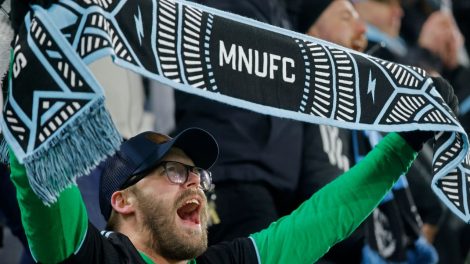
JB: Oh, big time. I think the Impact have already built to that. There is still obviously room to grow. The main difference between the Impact and TFC is the Impact has been around since the 90s, even if they’ve only been around for five or six years in MLS. That club and that jersey have been around, so that’s at least a generation of people in that city who have grown up with that team. Our head coach right now played for the team in the 90s. TFC was just created. Will there ever be TFC ultras? Maybe 20 or 30 years from now. I think the Impact already has ultras that are lighting off flares at the Azteca in Mexico City. Canada is a weird country in that it is so big and even though it is very similar it’s also so different. I think there are some places where soccer can get to a point where it is toe-to-toe with South America. I really do because more kids are playing soccer now than hockey. Canada is much more kind to its first-generation citizens than other countries are and so everyone with kids comes from a soccer country usually. And yes, the Impact tug at my heartstrings and I’ll be watching the Eastern finals very excitedly.
EO: I’m a big MLS fan. MLS is 20 years old. North America has no history with soccer. You’re starting from zero. It’s immensely difficult to build a history. I think MLS are being judged unfairly against other leagues around the world. That’s the point; MLS needs to be treated as a unique thing. It has a unique set of rules. It has a unique transfer system. It’s got a unique way of doing things with single entity. The league owns the player contracts. I think you have immense hardcore support. When you have an average attendance in 2015-16 that was 22,500, that’s fantastic. It gets a bad rep. I think it’s a competitive league. It’s only going to grow and develop. You look at the expansion of the league. Every year they are adding teams from different markets. I think that’s a fantastic way of doing things. There are little quirks that I’d like to see altered.
JB: And some teams hemorrhage money same as the NHL. But some teams are killing it. Seattle sells 30,000-40,000 every god damn game. Portland has a die-hard fan base and that Portland–Seattle rivalry is absolutely incredible. Galaxy is huge. Montreal and Toronto are both teams that sell out like crazy so there is an appetite for it. It is growing and connecting but he’s right, it shouldn’t be compared to leagues in Europe that are four times as old as it is.
EO: In North America you take your cues from what people in Europe are talking about in the game. In Europe, people talk about it in a disparaging way. They want to talk about Steven Gerrard going to LA Galaxy and how much money he is being paid. MLS goes far beyond Steven Gerrard. Steven Gerrard is not going to be remembered by MLS. So that will tell you about the league and who is registered as a success and who is registered as a failure. The real success of MLS is guys like Mike Magee in L.A. and Matt Besler in Kansas, guys who develop through the league and become U.S. internationals.
JB: (Chris) Wondolowski is another one. But that’s not the story that gets told.
EO: No, it’s not but I think the North American league has to take ownership of the story. Not everybody is interested in Andrea Pirlo playing in New York. We know he’s not doing much. So that’s not really a story is it? You have to give both sides of the picture. And mostly the conversation in the U.K. and Europe is how much of a joke the league is. People need to give more credit to MLS as a product because it’s young but it’s heading in the right direction and any product that can be in that space after two decades is in good shape.
JB: Now highlight-to-highlight, we’re keeping pace with a lot of leagues. You watch a MLS highlight, you watch any TFC or Montreal game from the last year or two there is some beautiful football and not just by MLS standards. There is gorgeous football with huge stadiums filled with people that could be anywhere.
DB: Describe what Celtic Football Club means to you in one word.
JB: That’s a good one, that’s a very good question. I’m going to say “home.”
EO: I’m going to say “identity.”
JB: Same shit!