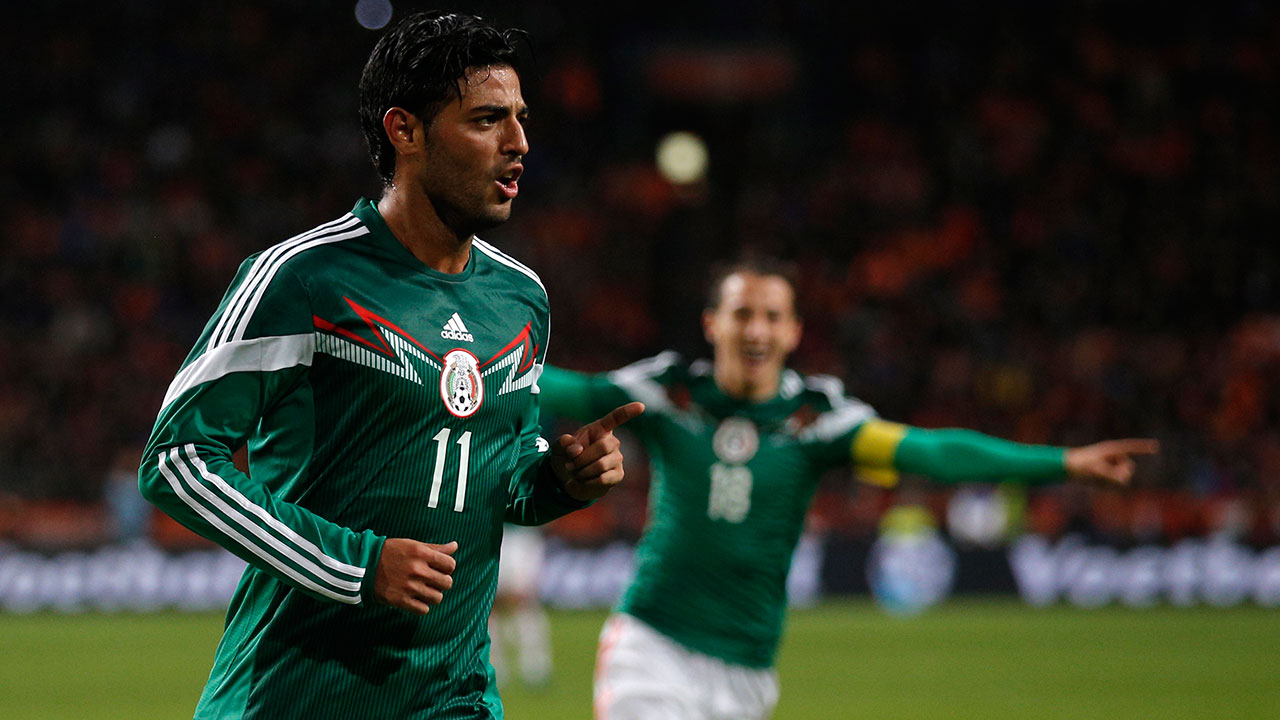

For Mexico manager Miguel Herrera the CONCACAF Gold Cup was always going to take priority over the Copa America, which ended just three days before the start of the North, Central American and Caribbean championship in Canada and the United States.
“We have to win (the Gold Cup) at all costs in order to face the United States in the playoffs for a spot in the 2017 Confederations Cup,” he said last month, in the run-up to the Copa America in Chile.
It may have been the laying-down of a gauntlet—a sort of rallying cry for his players and the country, generally—but in hindsight Herrera’s pronouncement can also be interpreted as a sort of foretelling of imminent doom.
More on CONCACAF Gold Cup: In-depth tournament preview || Match schedule || Group standings || Analytics: Canada looks to youngsters
The squad he took to the Copa America was an assortment of domestic veterans and fringe players, and given the strength of the field it was hardly surprising when El Tri exited at the group stage, having failed to win a single match.
Herrera will have much of his preferred team in Chicago to face Cuba on Thursday in its opening Gold Cup match, and knowing this back in June what he might otherwise have said was, “We know the Copa America will be a catastrophe. But stay the course—our Gold Cup success will put the disaster behind us.”
(No doubt there’s another column to be written regarding the absurdity of CONMEBOL inviting weakened opponents to its signature event in the first place.)
Well, Mexico’s moment of redemption is now at hand, although the nine-time CONCACAF champions (Gold Cup and CONCACAF Championship combined) seem to be bringing as many question marks into the tournament as reasons for optimism.
Since a March victory over Paraguay they have won just once in nine outings, and none of their last seven. In a pair of warm-up matches they struggled with formations, eventually ditching Herrera’s favoured 5-3-2 in favour of a 4-4-2, and played to uninspiring draws with both Costa Rica and Honduras.
They’ve scored more than a pair of goals in a match on just three occasions in 2015 (they’ve played 11 times) and will be without top-scorer Javier Hernandez after the striker suffered a fractured collarbone against Honduras, who also inflicted a knock to Carlos Vela’s ankle.
Vela—recalled to the side last November after an absence of more than three years—will be Mexico’s primary threat of goal over the next few weeks. Javier Orozco, who replaces Hernandez, has yet to score in 11 international appearances.
Then there is the loss of Hector Moreno to injury. The Espanyol defender, who also broke his leg against the Netherlands at the 2014 World Cup (his latest setback came a year to the day after that incident), is a Herrera favourite, and the 27-year-old’s absence is likely the primary reason behind the manager’s experimentation with a four-man defence.
Should he persist with it, Cuba will likely see Francisco Rodriguez and Diego Reyes operating in front of goalkeeper Guillermo Ochoa, with Paul Aguilar and Miguel Layun in the fullback positions. Andres Guardado and one of Jonathan dos Santos and Carlos Esquivel could work to either side of Jose Vazquez and Hector Herrera in midfield, with Vela and Giovani dos Santos up top.
Conversely, either Oswaldo Alanis or Yasser Corona could be used in a like-for-like swap with Moreno, which would allow Herrera to use his 5-3-2, likely with Vazquez, Herrera and Guadardo supporting the attack.
In any event, this is the sort of philosophical deliberation that should have been settled well in advance of the Gold Cup. And as it’s not, and given the multitude of problems that persist in complicating it, Mexico enter the competition rather less prepared than they’d surely prefer to be.
Anything other than the title will be yet another disaster for Herrera and El Tri. At this point, however, it’s a scenario with enough feasibility to make the Mexican national setup very uncomfortable.
Jerrad Peters is a Winnipeg-based writer. Follow him on Twitter