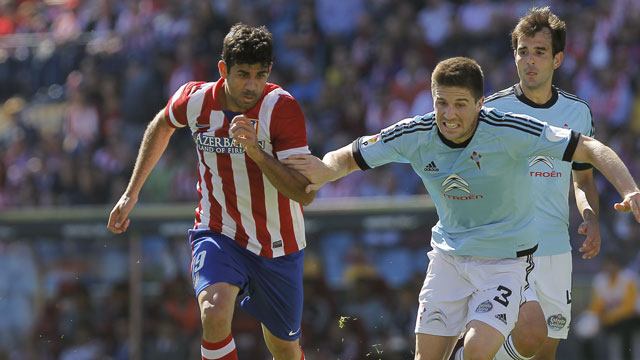

It was Diego Costa in a nutshell.
On Saturday, in a match that would eventually see Atletico Madrid pull level with Barcelona atop the La Liga standings, Colchoneros striker Diego Costa bowled over Elche defender Alberto Botia in the penalty area, allowing teammate Koke a simple tap-in to open the scoring.
Atetico’s Raul Garcia had launched an ambitious attempt at goal from distance, and while goalkeeper Manu Herrera had spilled the ball it looked as though Botia was going to be first to it—until Costa brought him to ground. Then, only 11 minutes later, Costa chased down a majestic, arching pass from Adrian and stroked it into the back of the net with a single touch.
As the home fans hissed and whistled their disapproval with him, Costa brought his index finger to his lips as if to shush them, aggravating an already hostile atmosphere at Estadio Martinez Valero that he had personally escalated.
Brutality and brilliance—the hallmarks of Diego Costa’s life in football and away from it. His, after all, is the story of the streets.
The lizard
Born in Lagarto (it translates as “Lizard”) in the small Brazilian state of Sergipe (World Cup winner Clodoaldo also hails from Sergipe), Diego Costa grew up playing street football because, as he has claimed, his hometown didn’t have any grass pitches.
The sound-bites of his childhood will have been mostly aggressive ones, for as he has previously said, “The street was my school…on the pitch I fought with everyone…I thought I had to kill them.”
It was only at 16-years of age that he began playing organized football, and not long after agreeing terms with a small Sao Paulo club he was issued a four-month ban for punching an opponent and intimidating a referee.
The reputation Costa has established in Europe is hardly surprising given the start he made in the sport. Despite spending more than seven years at various clubs in Portugal and Spain it really took until last season, and an especially revolting incident, for him to register on the general football radar.
Having been re-acquired by Atletico Madrid in the summer of 2012, Costa fought a pitched battle with Real Madrid defender Sergio Ramos during last December’s derby, during which he head-butted the Spain international.
Ramos responded by spitting in Costa’s face, but the reaction only seemed to spur the striker on. He would later be suspended four matches for a head-butting incident in the Europa League.
Even so, the 20 goals he tallied in all competitions helped to soften the blow of Radamel Falcao’s departure to Monaco, and so far this season he is actually scoring at a better rate than the Colombian managed last term.
Built to score, born to fight
Costa’s body was designed to score goals.
Standing 6-foot-2, his is the sort of heavy build that almost makes him seem shorter from a distance. His neck is thick; his centre of gravity is low, and he has to watch his weight. During his first spell with Atletico he was told by a club trainer that he looked like a beach ball.
But after being anointed the club’s number-one striker during the summer he returned to Estadio Vicente Calderon in excellent shape and promptly embarked on a breakout season that has him trailing only Cristiano Ronaldo—and only by two goals—in the race for the Pichichi as La Liga’s top scorer.
With 18 goals from 17 matches in La Liga and the Champions League, he is enjoying a purple patch that makes other purple patches look pink. And as he has mostly behaved himself this season, he has had to look elsewhere for trouble, notably the Brazilian national team.
Capped twice in friendlies by his home country in 2013 he nevertheless sought out a place in the Spain squad after attaining Spanish citizenship, and heading into a World Cup year he is the top candidate to lead the line for the holders in 2014.
Reviled for the betrayal in Brazil, he will experience hissing and whistling and all manner of abuse in June and July.
And he’ll thrive in it.
Diego Costa was build to score, and born to fight.
Jerrad Peters is a Winnipeg-based writer. Follow him on Twitter.