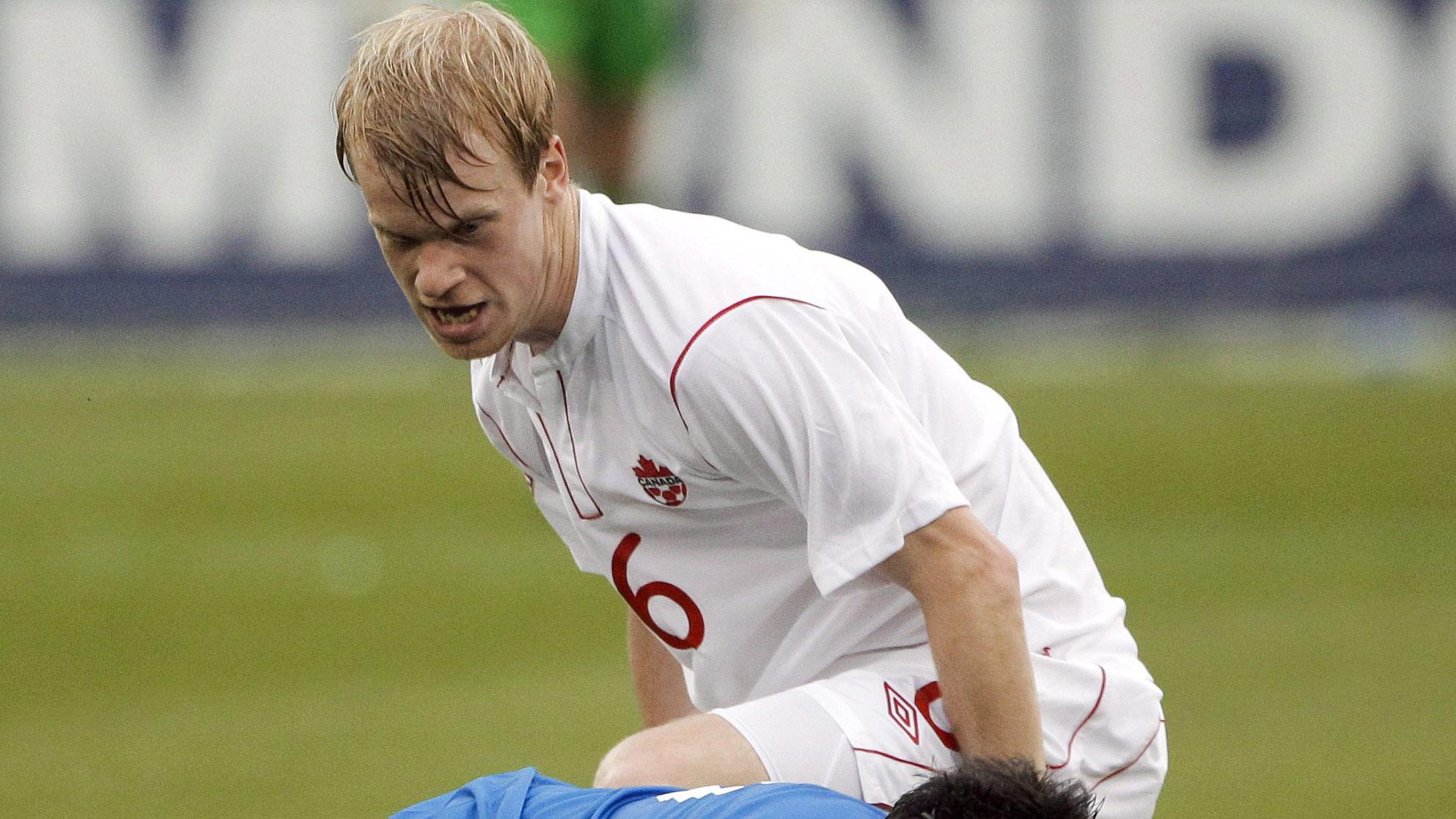

It’s hard to know what to expect from the Canadian men’s team when they kick off against Martinique on Sunday to open their Gold Cup campaign.
It’s an unfamiliar-looking squad in a tournament few countries involved with seem willing to throw their hearts into. The team is in the awkward early throes of a much-needed rebuild. The calamitous 8-1 defeat to Honduras last October prompted the Canadian Soccer Association to call time on a generation of veteran players, led manager Stephen Hart to resign, and made everyone involved silently agree to move on and never speak of it again.
 Programming alert: Watch every game of the CONCACAF Gold Cup live on Sportsnet World and Sportsnet World Online | Match & TV schedule | Tournament preview
At the first major competition since that loss in San Pedro Sula, there’s much to be accomplished. But as much as Canadian fans want to emerge from this Gold Cup knowing Les Rouges have made strides towards a brighter day, the realities of this tournament, this team, and what it hopes to achieve, mean it’s hard to see where substantial gains are going to be made.
Here’s what Canada hopes to accomplish at the Gold Cup. And why it won’t really accomplish any of it.
Win the whole thing
The CSA will tell you — in fact, they have — that this is what Canada is out for, that it’s playing to win. But, really, it isn’t. Not with this roster. It’s not that they’re not going to try to win, that they’ll give less than 100 per cent. Not at all. It’s that this isn’t a team built to win this tournament. That much is obvious.
The sad thing is Canada might have had a chance — a better-than-usual one, at least — were it not for the rebuild. This Gold Cup will feature one of the weakest fields in the tournament’s recent history, with perennial contenders Mexico and the U.S. too wrapped up in difficult World Cup qualifying to care much and fielding a B and B-plus team, respectively.
But the team that might have won it for Canada would look a lot more like the team that flamed out of 2014 World Cup qualifying against Honduras. That team would be familiar and have at least some semblance of chemistry built up after two rounds of meaningful matches in pursuit of a berth in Brazil.
That team would have Patrice Bernier, Dwayne De Rosario and Iain Hume on it. That team might have pushed harder to get Atiba Hutchinson on the roster, and he might have come aboard rather than take a pass to sort out his club future.
But that’s not the team that Canada is fielding. Canadian hopes rest on a squad with an average age of 24.5 — the youngest in the tournament — only seven players with more than 20 caps and a slew of youngsters who aren’t regulars even with their clubs. As nice as it would be to win — as cathartic and reaffirming for fans — it’s not going to happen.
Blood the Pups
The big goal of this tournament, like the past few friendlies, has nothing to do with this tournament — it’s about laying a foundation for the 2018 World Cup, as depressing as that far-away year sounds. It’s about capping a new, young generation of Canadian talent, getting them senior international experience, breeding familiarity and laying the groundwork for years to come.
Fair enough. The kids will be capped and they’ll emerge with games under their belts.
But how much will that mean? The big boxes to tick as far as seasoning young recruits are playing against senior international sides, and playing in hostile environments. Canada needs the kind of experience that prepares them to beat an on-form Honduran team at a hostile and intimidating cauldron in San Pedro Sula.
What Canada is going to get is a rusty Martinique squad in a mostly empty stadium in California. Without being too harsh on the Gold Cup, it carries little of the prestige and intensity of World Cup qualifying. Especially in a year when a slumping Mexican side doesn’t bother to send its best, the tournament loses something as a platform for the players to take a step.
It’s competitive match experience, of course, and that is far from meaningless, but in CONCACAF nothing prepares for World Cup Qualifying like World Cup Qualifying.
Build towards the future
This is Canada’s true objective, in the kind of vague terms the CSA tends to throw around these days: To simply move on from the past and take whatever steps it can towards the future. As much as that’s needed, it’s not really going to happen over the next couple of weeks.
Put it down to nothing more than bad timing. Benito Floro, the national team’s newly minted manager, has a philosophy for his team, a vision, and he has the pedigree to just maybe bring about some real change to a long-stagnant side. But it’s all too late for the Gold Cup. Floro will keep his vision to himself, and be nothing more than an “observer” at Canada’s matches.
The Gold Cup is stand-in manager Colin Miller’s show to run. Therein lies the problem, though it’s hardly Miller’s fault. Whatever his successes or failures, whatever his tactics or lineup choices, whatever growth the team makes in the system Miller implements will be wiped away for Floro’s clean slate once the tournament is over.
In that sense it feels like while this is supposed to be about building for the future, it’s only going end up putting the future on hold.