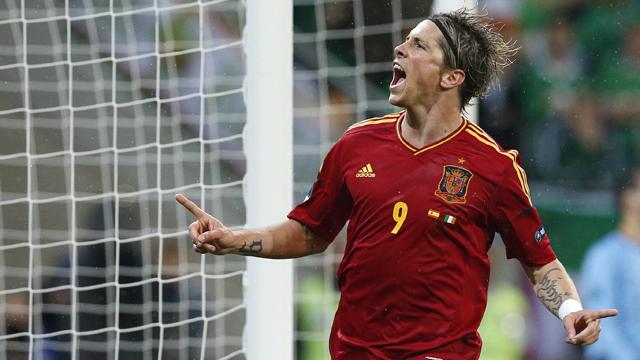

GDANSK, POLAND — Fernando Torres and Spain need each other at this European Championship.
Torres’ pair of goals in Spain’s 4-0 rout of Ireland on Thursday demonstrated as much, with the Chelsea striker perhaps the key to Spain retaining the title and securing a record third straight major championship for the World Cup winners.
Torres’ form on a wet and rainy night at the Arena Gdansk was reminiscent of his Liverpool years, a time when the 28-year-old excelled with the national team. He seems to have nearly shaken off this dip that has followed him since knee surgery in 2010, which sent him into the World Cup stretched for form to emerge as one of the biggest disappointments of those finals.
While Ireland’s defence is not comparable to Italy’s, Torres has shown against both of Spain’s Group C rivals how much more dangerous he makes the team when he is a serious playing threat.
Against Italy, Torres’ touch inside the area let him down and he missed a number of goal-scoring opportunities. Against Ireland, that confidence returned and made his team much better.
Torres’ opener seemed to unleash all the anxiety that had been bottled up over these years with the Spanish team, with whom his last competitive goal before Thursday was in September 2010 against Liechtenstein. He’s already scored two goals here, with his fourth-minute strike showing all those vintage Torres traits — anticipation, movement and finish.
The second goal was also typical Torres, as slow-footed defenders squeezed in too tight, allowing him to use his speed to go free on goal, where his finishing was clear.
Torres is confident. So Spain will be too.
Spain completed 779 of 929 passes, took 26 shots — 20 of those were on goal, making goalkeeper Shay Given Ireland’s lone standout apart from the boisterous, gracious and humorous fans — and controlled 63 per cent of possession. Even for Spain, those numbers are extraordinary.
Without Torres, it’s unlikely we would have seen such a crushing performance.
While the Chelsea striker still isn’t jinking his way around defenders to set up clear goal-scoring chances like in his Liverpool days, that seems to be coming. His pace is back and his strength is unquestionably there. His creativity is also high as he attempted nimble little back-heels.
Torres showed his confidence was high as he brushed off coach Vicente del Bosque’s decision to go with a six-man midfield against Italy, picking midfielder Cesc Fabregas to start in place of Torres, who is now the country’s third all-time leading scorer behind David Villa and Raul Gonzalez. Del Bosque was right to pick Torres over Fabregas against Ireland, although Fabregas would later replace Torres and score his second goal of the tournament.
Former coach Luis Aragones said Spain should have played with a traditional No. 9 and Jose Mourinho called Spain’s game sterile without one. Del Bosque’s decision was bold but they were right as Spain was limited up front until Torres came on in the second half.
Ireland’s aging backline had to back off knowing they would likely get burned by an Andres Iniesta, Xavi Hernandez, David Silva or Xabi Alonso through ball to Torres to chase. So easing back separated Ireland’s defence from its midfield and created more space in the middle, in front of its area. That, in turn, proved the perfect recipe for Iniesta, Xavi, Silva, Alonso and Spain’s midfielders love of quick-touch passing and combinations through the middle.
I was flabbergasted at the pockets of space Ireland gave up in front of its area for Iniesta or Xavi to walk straight in to. That space allowed Spain to distribute the ball much more freely as players found space to dish to and move into and helped Spain’s game plan, which was to attack with much more intent than it did against Italy, when it seemed more hesitant to go forward.
Fullbacks Alvaro Arbeloa and Jordi Alba certainly heeded to Del Bosque’s call for them to better support the attack from the flanks, with Alba combining well along the left and Arbeloa drifting in behind the defence a number of times on the right to set up good scoring chances.
Spain centre-backs Sergio Ramos and Gerard Pique are also gelling. Midfielders Alonso and Sergio Busquets seemed to be aided by Torres’ ability to drag the defence forward from them. Alonso, in particular, showed how important he can be for Spain on his 97th appearance.
Against Italy, the pair stood nearly side-by-side. Against Ireland, Alonso drifted up to leave Busquets alone to mop up in front of the backline. That was probably what Del Bosque had in mind against Italy, only that his midfielders didn’t quite perform it as they should have. Here they did it wonderfully.
Alonso, who played between Xavi and Busquets, sliced a number of long balls forward to set up scoring chances and took three shots, with Given tipping one screamer over the bar. Del Bosque substituted Alonso, who was booked, to protect him from missing Monday’s Group C finale against Croatia, where Spain can qualify for the quarter-finals with a draw. Italy is out if the pair draw 2-2 or anything higher, even with a victory, as at Euro 2004 where Sweden and Denmark’s 2-2 draw knocked the Azzurri out.
Spain should beat Croatia to extend its unbeaten run to 16 games since the World Cup loss to Switzerland, with 15 of those wins. Torres will likely play again, and probably start.
The only complaint against Torres was that perhaps he was not selfish enough and tried to play Spain’s way — tiki-taka passing as they coin it — too often instead of following his instinct and going for goal. The way many of Spain’s playmakers try to walk the ball into goal, somebody has to score, so it might as well be Torres.
Paul Logothetis is a Madrid-based reporter who is in Poland and Ukraine covering Euro 2012 for sportsnet.ca. Follow Paul on Twitter.